Skip to content
Briefings are running a touch slower this week while we rebuild the foundations.See roadmap
Russia-Ukraine War 2026
11APR

Brent's worst month since the Covid crash

3 min read
16:48UTC

Brent Crude settled at $92.05 on Friday 29 May, down more than 19% across the month, its steepest monthly fall since the March 2020 Covid crash, on deal optimism alone.

ConflictDeveloping
Key takeaway

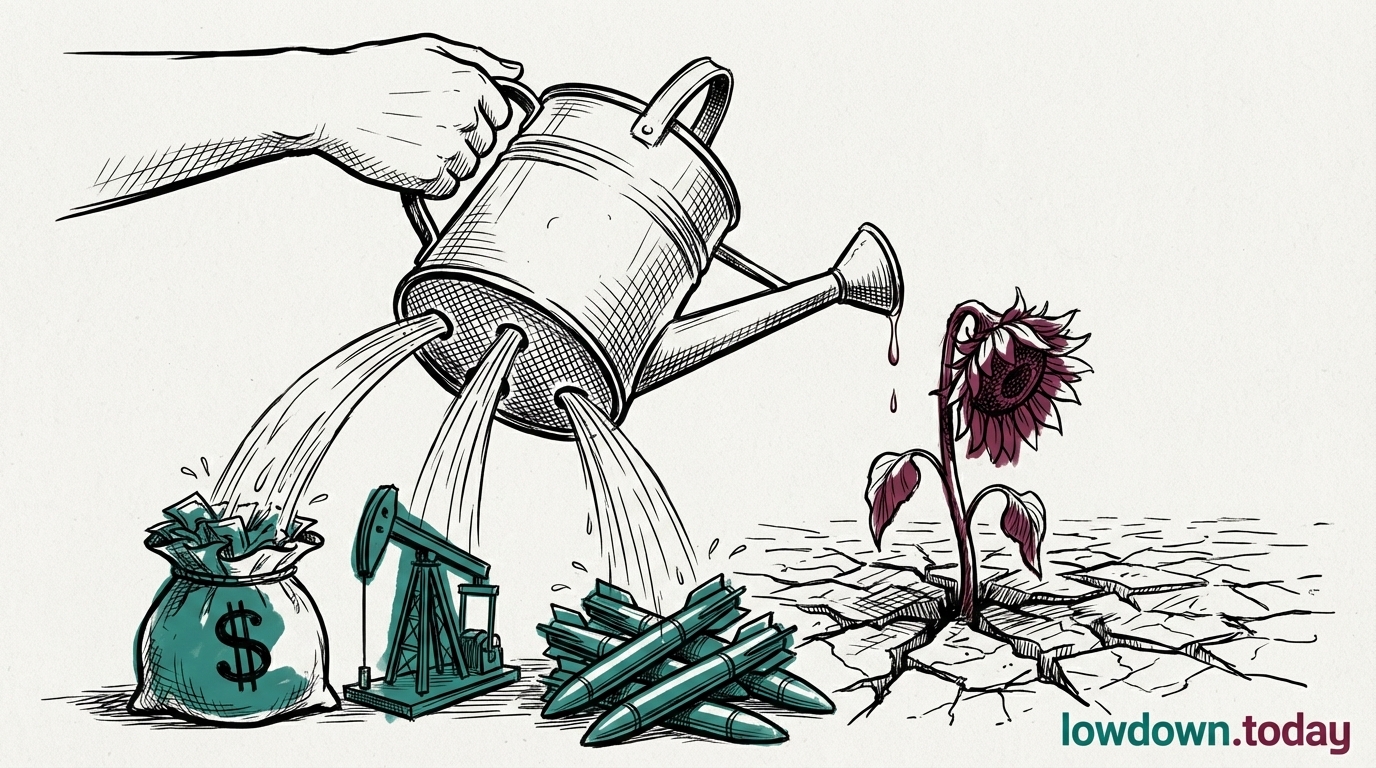
Futures and war-risk insurers read the same war apart: oil down nearly a fifth, yet Lloyd's unchanged.

Brent Crude settled at $92.05 per barrel on Friday 29 May, down more than 19% across May, its steepest monthly fall since the March 2020 Covid crash 1. That is roughly $20 below the $112.10 peak of Monday 18 May, a drop booked in 11 trading sessions, the fastest repricing of the conflict. WTI (West Texas Intermediate), the US oil benchmark, closed near $87.86.

The fall came on diplomatic optimism alone, with no instrument signed. Brent is the global price benchmark for two-thirds of traded crude, so the relief at the pump rests on a deal that could still collapse.

Two markets are reading the same war and pricing it apart. Futures price the probability of a signed page, and traders have bet heavily on one arriving. War-risk underwriters require the page itself. Lloyd's of London has still not de-listed Hormuz from its war-risk register, holding the divergence it opened when Brent first broke $100 .

When Iranian state television aired draft terms on Wednesday 27 May, Brent briefly touched a sub-$95 low before a White House denial reversed it . Friday's settle went lower and stayed there. The deal-optimism premium is unhedged against an unsigned outcome, so a collapse would reverse the move faster than the original war spike built it.

Deep Analysis

In plain English

Brent crude is the main global oil price benchmark, used to set the cost of petrol, diesel, and heating oil worldwide. In May 2026 it fell more than 19%, its steepest monthly drop since March 2020 when Covid stopped most economic activity. Traders became optimistic about a deal to reopen the Strait of Hormuz, pushing prices down. Trump walked out of his Situation Room meeting without signing it. Lloyd's of London, which insures ships sailing through the strait, kept its 'war-risk' designation in place: that designation requires shipping companies to pay tens of millions of dollars in extra insurance per voyage. Lloyd's changes that designation only when a government certifies the area is safe, not when traders feel optimistic. The result is a $20 gap between what futures markets think and what shipping insurers think.

Deep Analysis
Root Causes

Brent's 19% monthly fall reflects a single pricing event: the market's belief, from 27 May, that a Hormuz reopening was days away. Oil futures markets reprice on probability estimates, not on signed documents. The $20 fall in 11 sessions is the market assigning roughly 70-80% probability to a near-term deal, based on the volume of diplomatic signals and the public statements from both sides.

Lloyd's and the futures market diverge because they face different update mechanisms. A futures desk resets its position in milliseconds on a headline. A Lloyd's Joint Hull Committee changes its war-risk designation on a quarterly review cycle, requiring physical evidence of changed security conditions, not optimistic commentary. The two institutions are pricing the same strait but on entirely different information-update schedules.

What could happen next?
  • Risk

    A deal collapse reprices Brent from $92 toward $110-$115 with no hedging floor in place, as the entire $20 fall was deal-optimism premium rather than supply recovery.

  • Consequence

    European hauliers and airline fuel desks that locked forward contracts during the $92-$95 window face margin exposure if the kinetic track resumes.

First Reported In

Update #113 · Trump signs nothing as a Hellfire hits a hull

CNBC· 31 May 2026
Read original
Different Perspectives
Rafael Grossi, IAEA Director General
Grossi's Update 349 of 7 May recorded a drone strike on ZNPP's radiation monitoring laboratory on 3 May. Rosatom's 17 May public attack on the Secretariat's neutrality degrades the diplomatic ground Grossi needs for the sixth repair ceasefire at day 60 on the single backup line.
Indian Government / Embassy Moscow
The Indian Embassy in Moscow confirmed on 18 May that an Indian national was killed and three hospitalised at a refinery construction site in the 17 May barrage. India is among the largest buyers of discounted Russian crude; the fatality forces a diplomatic protest without changing the purchasing posture.
Recep Tayyip Erdogan, Turkish President
Erdogan met Zelenskyy in Ankara for nearly three hours on 15 May before the Istanbul session, recovering Turkey's 2022 mediator role and reducing Trump's leverage by hosting bilateral talks without Washington in the room. Turkey hosts the NATO Ankara summit on 7-8 July; the Istanbul format gives Erdogan standing at both tables simultaneously.
Viktor Orban / Hungarian Government
Budapest's new cabinet, formed 12 May, holds the institutional veto point on the EU tranche disbursement ahead of the first-half June window. Hungary has previously leveraged EU loan tranches to extract bilateral concessions; the combination of a fresh cabinet and a tight disbursement timeline makes Budapest the single highest-leverage actor in the EU track this fortnight.
European Council / Commission
The Commission is preparing a three-document disbursement package for the 9.1-billion euro first tranche of the EU loan to Ukraine, targeting first-half June, but delivery depends on the Magyar cabinet, which formed on 12 May, not blocking the mechanism. The 20th sanctions package remains in force against Russia.
Donald Trump / US Treasury
Treasury issued GL 134C with a 48-hour gap after GL 134B expired, confirming the waiver series functions as permanent monthly management rather than a wind-down instrument. Washington was absent from the Istanbul room; Treasury Secretary Bessent framed the Cuba carve-out as protecting 'most vulnerable nations', maintaining the fiction that the 30-day bridge has a humanitarian rationale.
