Skip to content
Briefings are running a touch slower this week while we rebuild the foundations.See roadmap
Russia-Ukraine War 2026
5APR

Tanker struck at Hormuz mouth, no claim

4 min read
19:51UTC

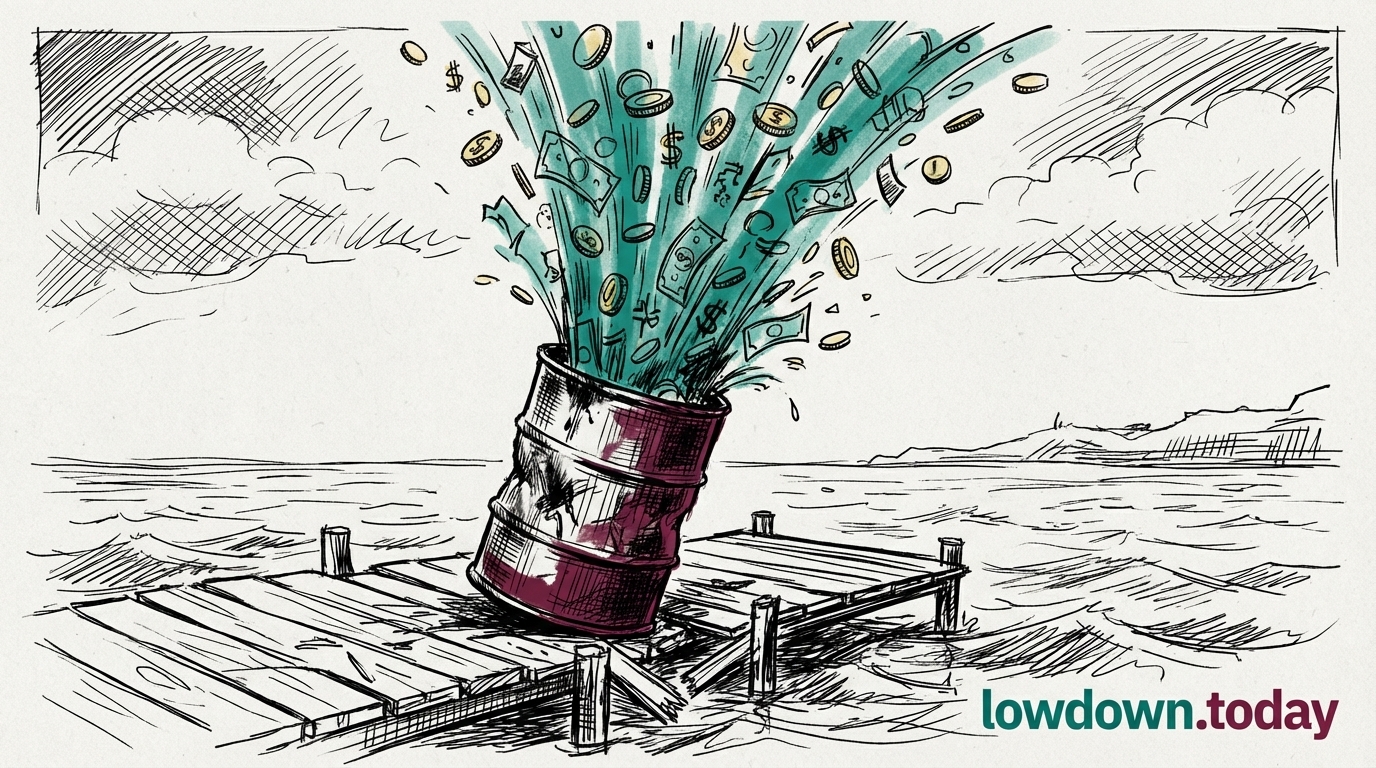
The oil tanker Olympic Life was struck by an unidentified projectile on 26 May, about 60 nautical miles east of the Strait of Hormuz near Muscat; no party has claimed the attack.

ConflictDeveloping
Key takeaway

An unclaimed strike east of Hormuz gives shippers no actor to deter and no risk to bound.

The oil tanker Olympic Life was struck by an unidentified projectile on 26 May, roughly 60 nautical miles east of the strait of Hormuz near Muscat, the Omani capital 1. The hull breach discharged bunker fuel into the Gulf of Oman; no crew were injured. No party has claimed the attack, and the location sits outside Iran's declared transit zone.

This is the first reported hull strike near the strait's eastern mouth. War-risk cover already runs at $10-14 million per voyage through Hormuz, the premium underwriters charge to insure a ship against attack. A hit well beyond the strait forces them to price danger onto routes that were treated as safe, widening the war-risk geography rather than tightening it.

The strike landed the same day CENTCOM, US Central Command, destroyed IRGC mine-laying boats and a surface-to-air missile site at Bandar Abbas, Iran's main naval base on the strait . The timing invites a link to retaliation by the Islamic Revolutionary Guard Corps, but no party has produced evidence, and assigning blame here would be guesswork.

East of the strait, where neither CENTCOM's blockade order nor Iran's transit-zone authority formally runs, an unclaimed strike means no actor owns the risk and no deterrent has an address. That ambiguity tends to push insurance premiums higher than a claimed attack would, because there is no one to warn off and no incident to bound. The vacuum itself does the work the projectile could not.

Deep Analysis

In plain English

The Strait of Hormuz is where most of the attention is: it is the narrow gap through which a fifth of the world's oil normally passes. But the Gulf of Oman, which sits just to the east of the strait, is the sea that vessels must cross to get to and from that gap. On 26 May, a ship called the Olympic Life was hit by something, probably a missile or drone, while crossing the Gulf of Oman about 60 nautical miles east of the strait. A hole appeared in the hull and oil leaked out. Nobody was hurt. Nobody admitted doing it. That matters because it suggests the zone of danger is no longer just the strait itself. Ships that had been taking a slightly longer route to avoid the most dangerous area are now also at risk. And with no one claiming responsibility, neither shipping companies nor governments know who to negotiate with or deter.

Deep Analysis
Root Causes

Two structural conditions sustain the attribution vacuum in Gulf of Oman maritime attacks.

First, the war-risk designation from Lloyd's Joint Hull Committee and the lapse of marine P&I cover since 13 April mean that shipping companies operating through the Gulf of Oman are doing so outside normal insurance arrangements. Vessels in that position have a strong commercial incentive not to file insurance claims that would require a verified incident report, since there is no paying underwriter. Reduced incident reporting leaves the attribution pool thin.

Second, the IRGC's operational doctrine since 2019 has separated kinetic maritime activity from public acknowledgement. Brigadier General Shekarchi's 26 May statement claiming the MQ-9 Reaper downing was framed explicitly as retaliation for Bandar Abbas.

No such framing accompanied the Olympic Life strike, suggesting it was either not an IRGC action or was deliberately kept unclaimed as part of the coercion-without-attribution doctrine the IRGC has used consistently since the Fujairah attacks in May 2019.

Escalation

The Olympic Life strike widens the operational envelope of the maritime threat without changing its formal intensity. CENTCOM's rules of engagement are calibrated to the Hormuz corridor; a consistent pattern of Gulf of Oman strikes would force a geographic expansion of those rules, increasing the risk of encounter with vessels or assets not originally included in the blockade enforcement geometry.

What could happen next?
  • Consequence

    The confirmed hull hit 60 nautical miles east of Hormuz removes the Gulf of Oman as a reliable lower-risk routing alternative. Shipping companies and insurers must now price risk across a larger geographic area.

    Immediate · Assessed
  • Risk

    No actor has claimed the strike. If it is attributed to Iran by Western intelligence services without Iranian acknowledgement, it creates a retaliation obligation for CENTCOM without a defined target or legal basis under existing rules of engagement.

    Short term · Reported
  • Precedent

    Three successive unclaimed attacks in the Gulf of Oman corridor across a 90-day conflict establish a precedent for coercion-without-attribution that other non-state or state actors in the region can exploit under the same fog.

    Medium term · Suggested
  • Risk

    Lloyd's Joint Hull Committee may extend its war-risk designation beyond the Hormuz 33-kilometre corridor to the broader Gulf of Oman if two or more further confirmed hull strikes occur in the area. That extension would apply the $10-14 million per voyage premium to all Gulf of Oman transits.

    Short term · Suggested
First Reported In

Update #110 · Trump vetoes Iran's only uranium exit

The War Zone· 28 May 2026
Read original
Different Perspectives
North Korea / DPRK
North Korea / DPRK
ISW confirmed the first mounting of DPRK Type-75 MLRS on Russian autonomous UGVs near Kharkiv on 7 June, the latest step in a supply axis that escalated from shells in 2023 to troops in 2024. Pyongyang gains live battlefield data on its ordnance and on Russia's uncrewed-systems programme.
IAEA / Rafael Grossi
Grossi confirmed Chornobyl structural damage with nuclear material metres away and could not attribute the ZNPP 15-hour blackout during the agreed repair window. Six ceasefires brokered and broken at ZNPP, compounded by Rosatom's May attack on IAEA neutrality, have eroded his ability to enforce the windows he negotiates.
Emmanuel Macron / France
Macron co-signed the E3 framework whose line-of-contact baseline marks Europe's first formal acceptance that 1991 borders are not the opening position. France's role carries weight because Macron had previously proposed a European force for Ukraine, and the framework's multinational force point is the vehicle for that.
Keir Starmer / E3
Keir Starmer / E3
Starmer, Macron and Merz met Zelenskyy on 7 June and backed a five-point framework taking the line of contact as the talks baseline, conceding roughly one fifth of Ukraine in exchange for a multinational force and frozen assets. With US mediation ended, the NATO Ankara summit on 7-8 July is the next test.
Vladimir Putin / Kremlin
Putin used SPIEF to reject Zelenskyy's summit letter, citing 'elements of rudeness', and repeated the pre-agreed treaty precondition that has frozen every diplomatic round since May. The SPIEF platform's message of investor confidence was punctured by naval fires visible from St Petersburg, which Moscow declined to dispute in scale.
Ukraine / Unmanned Systems Forces
Commander Brovdi confirmed USF units tracked and set fire to Boikyi at Kronstadt, while Code 9.2 struck the Chonhar Bridge the following day. Ukraine is sequencing strikes for rear-area interdiction and political timing rather than ground gains, trading the Baltic Fleet's home base for the logistics squeeze Russia cannot absorb without rationing its own occupied territory.
