Skip to content
You can now search across every topic, entity and event.What's new
Pandemics and Biosecurity
31JUL

Isolation rate sits below the line

3 min read
10:28UTC

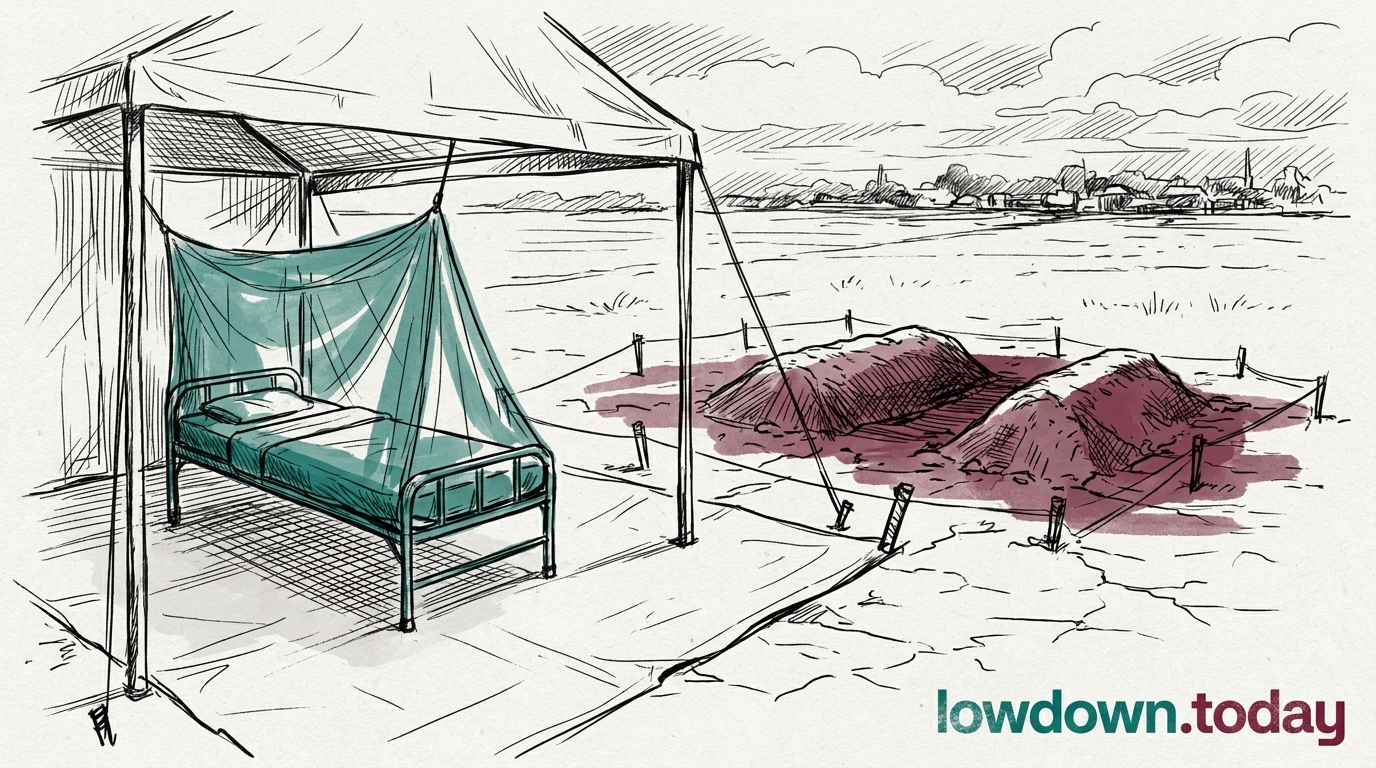
DRC's health ministry counted 782 confirmed cases on 14 June with 359 patients isolated, a 45.9 percent rate. The CDC model says 70 percent isolation collapses the worst case; 46 percent leaves it open.

ScienceDeveloping
Key takeaway

At 46 percent patient isolation, the DRC outbreak sits between the CDC model's safe and worst-case thresholds.

DRC's Ministry of Health, reporting a day after the WHO log on 14 June, counted 782 confirmed cases and 181 deaths, with 359 patients in isolation, meaning 45.9 percent of confirmed cases were isolated in a treatment unit 1. The ministry is the national surveillance authority for the outbreak, and its count runs a day later and slightly higher than WHO's confirmed reference total .

The CDC, the United States federal public health agency, published a reproduction-number model on 5 June that named patient isolation, not contact follow-up, as the variable that decides this outbreak . At the model's R0 of 2.51, every infected person passes the virus to roughly two and a half others if nothing intervenes. The model measured one thing: how many confirmed cases reach a treatment bed where they cannot infect anyone else. At 20 percent isolation, its worst case of 20,000 cases by August occurs in 65 percent of simulation runs. At 70 percent isolation, that worst case collapses to a one-in-a-hundred tail.

DRC's 45.9 percent sits between those two poles, above the baseline that drives the model toward catastrophe but well below the threshold that breaks the chain. The Africa CDC's science advisors point to continuing attacks on health facilities as the reason a traced contact often cannot be moved into a bed. A contact found by phone but unable to reach a treatment unit still transmits. That is the gap the isolation number measures and the tracing number hides.


Deep Analysis

In plain English

The CDC (US Centers for Disease Control and Prevention) published a mathematical model that calculates how many people each Ebola patient infects on average. For this outbreak the number is 2.51. To stop the outbreak growing, you need to get most of those patients into an isolation unit before they infect others. The model says you need roughly 70 percent of confirmed patients isolated to prevent a worst-case explosion. Right now, 46 percent are isolated. That gap, between 46 and 70 percent, is what the outbreak's short-term trajectory depends on. Contact tracing is working better, but tracing someone and then getting them safely to a treatment unit are two different problems in a conflict zone.

Deep Analysis
Root Causes

Patient isolation in Ituri depends on treatment unit capacity, community trust, and physical access to those units, none of which are fully within the response's control. Treatment units require security escorts in at least eight of the 29 affected health zones, meaning the bottleneck is not patient willingness but route safety. Where patients cannot safely travel, isolation cannot happen regardless of tracing coverage.

A structural asymmetry compounds this: the CDC model was derived from early-outbreak data from relatively accessible health zones. The model's 70 percent threshold likely understates what is needed in zones with partial access, because the accessible zones are better-connected to isolation capacity and the inaccessible zones systematically depress the aggregate rate while contributing disproportionately to community spread.

Escalation

The 45.9 percent isolation rate sitting between the model's floor (20 percent) and its collapse threshold (70 percent) means the outbreak is in an indeterminate zone. Three to four percentage points of isolation improvement shifts probability distributions materially; three to four percentage points of decline risks pushing simulation medians toward the 20,000-case scenario. Current trajectory is upward in case count and indeterminate on isolation.

What could happen next?
  • Meaning

    The CDC model makes a specific, testable claim: reaching 70 percent isolation reduces the August worst-case from a 65 percent probability to 1 percent. Every isolation unit opened is a measurable intervention on this probability.

  • Risk

    Ituri's security-constrained zones prevent isolation regardless of contact-tracing investment, setting a practical ceiling on the isolation rate achievable under current conditions.

First Reported In

Update #7 · Bundibugyo's fork stays open

DRC Ministry of Health / UN News· 16 Jun 2026
Read original
Different Perspectives
Chinese health authorities
China reported three human H9N2 cases to WHO between 10 and 16 July: two four-year-olds recovered, a 44-year-old man remains in intensive care, the first severity signal in a cluster that has produced 173 cases and 2 deaths globally since 2015. The subtype is distinct from the H5N1 series this topic otherwise tracks.
US public health authorities
CIDRAP and Dr Andrew Racine, president of the American Academy of Pediatrics, call 2026's 2,318 confirmed measles cases by 24 July the worst year since 1991's 2,126. Zero deaths against three in 2025 and a 7% hospitalisation rate, down from 11%, show record case counts have not brought record severity.
CEPI
CEPI
CEPI put an rVSV-platform vaccine candidate specific to Bundibugyo ebolavirus into trial-production on 31 July, developed by Hilleman Laboratories with MSD manufacturing and IAVI's reference virus, funded up to $8.5m. Eleven weeks into the third-largest Ebola outbreak on record, this is the first species-matched candidate; the licensed vaccine covers only Zaire ebolavirus.
Médecins Sans Frontières
MSF reports sexual-violence care in Ituri is almost non-existent, with 7 of 14 health centres closed or relocated by fighting, as Panzi Hospital logs 646 new survivors in six months, an 85% rise. Withdrawn US funding for post-exposure prophylaxis has left clinics across three provinces without PEP kits for months, a crisis running alongside Ebola, not caused by it.
DRC health workers at Elikya Ebola Treatment Centre
Staff at DRC's Elikya Ebola Treatment Centre walked out on 25 July over unpaid wages, the second such action after Rwampara, while unconfirmed suspects occupy up to 64% of the country's isolation beds awaiting lab results. Workers are absorbing a response that has grown faster than its payroll and its labs.
Uganda's Ministry of Health
Uganda's ministry says it discharged its last confirmed patient on 16 June, completed every contact's 21-day follow-up, and declared the country Ebola-free on 28 July, exactly 42 days later. It names Hon. Dr Chris Baryomunsi, Minister of Health, as overseeing a 20-case, 2-death outbreak it now considers closed.