Skip to content
You can now search across every topic, entity and event.What's new
Media's AI Pivot
17JUN

Gemini makes Canva and Adobe callable

4 min read
09:26UTC

At Google I/O 2026, three creative tools became callable inside Gemini within four days: Canva on 19 May, Adobe's 50-tool connector on 20 May, CapCut confirmed on 21 May.

IndustryDeveloping
Key takeaway

Owning the doorway every creative app runs through is worth more than owning any one app.

At Google I/O 2026, the company's annual developer conference, three creative tools became callable inside Gemini within four days, Tech Times reported 1. Gemini is Google's AI assistant. Canva, the Australian design platform, went live on 19 May as a Connected App: typing @Canva in a Gemini chat generates, searches or edits designs. Adobe followed on 20 May with a "creativity connector" orchestrating more than 50 professional tools, among them Photoshop, Illustrator and Premiere Pro. CapCut, the video editor owned by China's ByteDance, was confirmed on 21 May as coming soon for trimming, transitions and auto-captioning.

A Connected App is a third-party tool that runs as a function inside Gemini rather than as a separate destination the user opens. The reader unfamiliar with the term should picture the editing app no longer as a place you go, but as a capability the assistant reaches for on command. That reframing is the whole point.

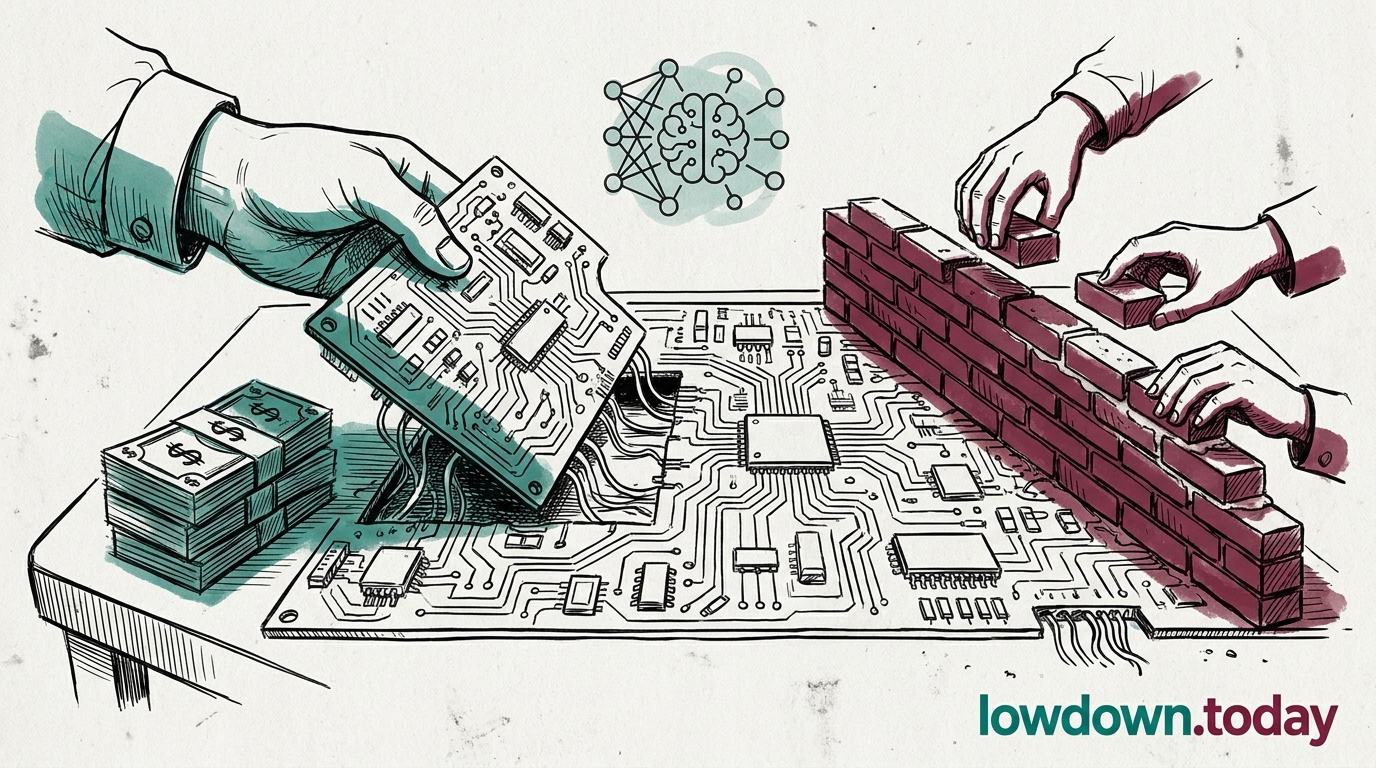
The signal sits above any single integration. Google is selling the orchestration layer, the prompt that dispatches work to other tools, as the product. Even Adobe, a creative-software incumbent, becomes a function called from a Gemini prompt. The move generalises the pattern set when Avid embedded Gemini in its Media Composer editing system through Google Cloud . It also subsumes Adobe's own first step, putting Firefly inside Premiere Pro : where that integration lived natively in one editor, the Gemini connector now reaches Adobe's entire suite from a single prompt.

The layer that owns the workflow entry point captures the margin; the layers beneath it commoditise. The same dynamic ran through earlier software cycles, browsers over plugins, app stores over developers. A creative tool that lives inside Gemini trades Reach for the risk of becoming an interchangeable backend that something else calls.

Deep Analysis

In plain English

Gemini is Google's AI assistant, similar to ChatGPT but built into Google's products. Canva is a design tool used by millions of people to make social-media graphics and presentations. Adobe makes professional creative software including Photoshop (image editing) and Premiere Pro (video editing). CapCut is a video editing app made by ByteDance, the Chinese company that also owns TikTok. Before May 2026, if you wanted to make a video, you would open Premiere Pro, make edits, then maybe switch to Photoshop for graphics, then export. After the Google I/O integrations, you can type a single instruction to Gemini and it calls whichever tools it needs to complete the task without you switching apps. Google becomes the single place where creative work starts, which puts it in a very powerful position above all the individual tool makers.

Deep Analysis
Root Causes

Google's Gemini orchestration play exploits a structural dependency that creative tool vendors created themselves: each tool built its own AI assistant (Adobe Firefly, Canva's Magic AI, CapCut's auto-edit), which trained users to expect AI-native creative interfaces but left the switching cost at the tool level rather than the session level.

Google's position as the dominant search and email provider gives it a pre-existing authenticated session for most enterprise users. Gemini Connected Apps extend that session into creative workflows without requiring a separate login or interface switch.

The consent and API integration cost falls on the tool vendor, not on Google: Adobe, Canva, and ByteDance each invested engineering resource to become callable, because the alternative is exclusion from the session layer where users increasingly spend their intent.

What could happen next?
  • Risk

    Tool vendors integrated as Gemini Connected Apps cede the user's first intent signal to Google, reducing direct-app-open behaviour over time.

    Medium term · Assessed
  • Opportunity

    Vendors not yet in the Gemini Connected Apps ecosystem face exclusion from the session layer; early integration captures positioning before Google's selection criteria tighten.

    Short term · Assessed
  • Precedent

    Canva and Adobe's acceptance of Gemini orchestration terms sets a de-facto standard API shape for creative-tool integration that late entrants must match.

    Short term · Assessed
  • Consequence

    Professional broadcasters using Avid Media Composer with Gemini embedded (ID:3188) now face a consumer-tier Gemini orchestration layer running the same model above their NLE (non-linear editing) workflow.

    Medium term · Assessed
First Reported In

Update #3 · ITV nears sale into Sky's AI stack

AI Lawsuit Tracker· 27 May 2026
Read original
Different Perspectives
Italian market: Fastweb signed, Mediaset and RAI did not
Fastweb, the Italian broadband operator, signed Section 2 as a deployer, while Mediaset and the state broadcaster RAI are both absent. Italy therefore shows the split in miniature: a telecommunications company with one obvious deployment surface accepted the standard, and the two companies that actually broadcast to Italian audiences did not.
Paramount Skydance and its French exposure
Paramount filed a stipulation not to close on 24 July and had trial specialists admitted three days later, after nine months arguing that antitrust risk was regulatory rather than judicial. Its 22 July European clearance obliges it to divest a stake in the Universal International Pictures distribution venture and to strike no Universal distribution deal in Europe for a decade.
Time and the agent-advertising camp
Time and Mobian treat AI agent traffic as sellable inventory rather than leakage, on a site where bots now outnumber humans most days. Chief operating officer Mark Howard frames agent impressions as an extension of sponsorship, against an industry consensus still pursuing compensation for scraping.
German broadcasters
German broadcasters
ARD, ZDF, RTL and ProSiebenSat.1 are all absent from the list, making Germany the largest single national bloc of non-signatories. Their position rests on three defensible grounds: signature is voluntary, most deployed systems are grandfathered to 2 December 2026, and a broadcaster's compliance surface spans production, archive, advertising and distribution rather than one product. None has publicly explained the decision.
Synthesia and the signed vendor layer
Synthesia signed Section 1 alongside Getty Images, Google, Meta, Microsoft, Anthropic, OpenAI, Mistral and Aleph Alpha, accepting a documented marking standard for the product they sell. London-headquartered Synthesia is the only pure AI-video vendor on the providers list, and gains a compliance artefact to put in front of European media buyers at the moment those buyers acquire a live obligation.
European Commission
European Commission
The Commission published its initial signatory list on 31 July with roughly 190 organisations and let Article 50 take effect on 2 August as scheduled. Its own page stresses that adherence to the Code is voluntary while the transparency requirements are legal obligations, which frames non-signature as an evidentiary choice rather than a breach.


