Skip to content
Briefings are running a touch slower this week while we rebuild the foundations.See roadmap
Iran Conflict 2026
11MAY

Goldman raises US recession odds to 25%

3 min read
14:01UTC

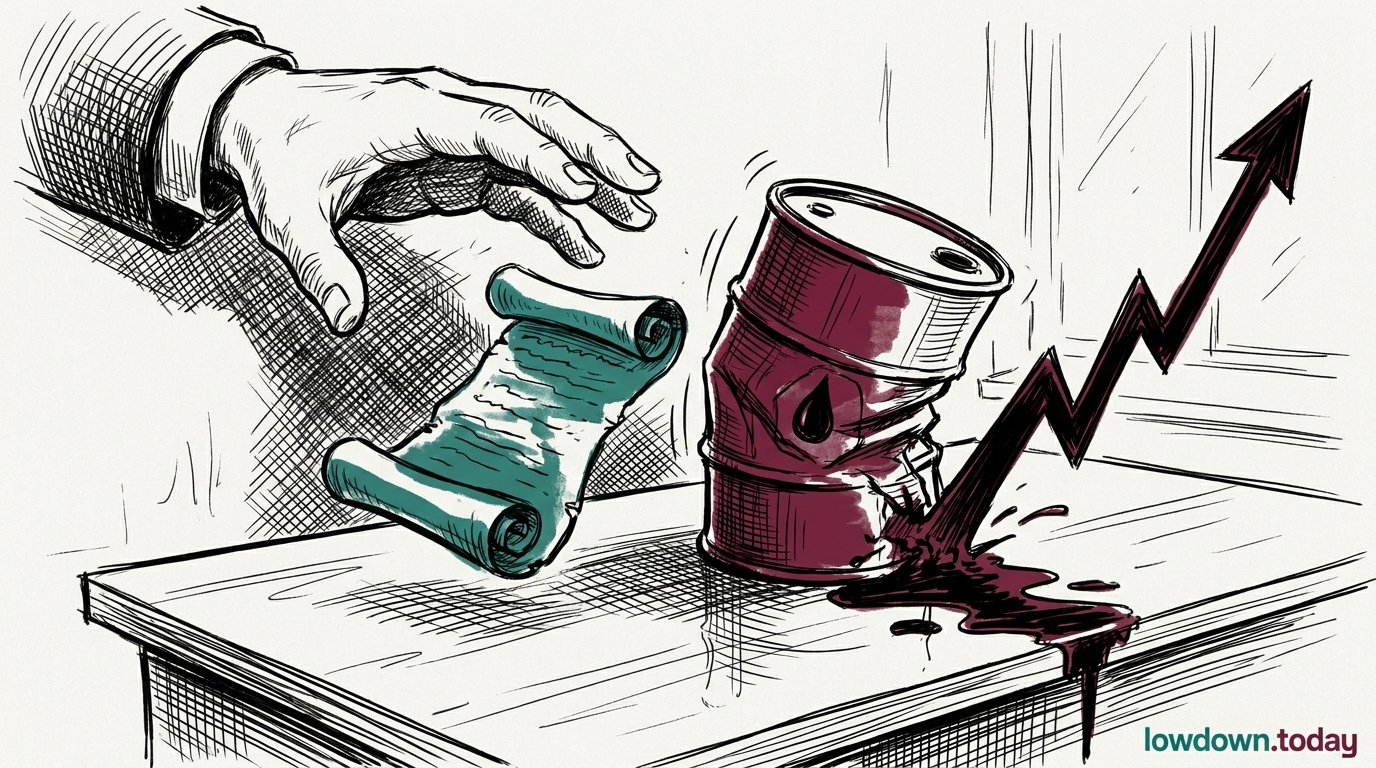
Goldman Sachs's top oil analyst places US recession probability at 25% as the Hormuz supply disruption holds crude 70% above pre-war levels and American households absorb $300 million a day in additional fuel costs.

ConflictAssessed
Key takeaway

Goldman's 25% recession probability masks a stagflation trap the Fed cannot resolve with standard tools.

Daan Struyven, Goldman Sachs's head of oil research, raised the bank's US recession probability to 25%, driven by sustained crude price elevation from the strait of Hormuz supply disruption. Brent peaked at $126 per barrel this week — roughly 70% above the pre-war benchmark of $67.41 — before settling around $114. American households are collectively paying an additional $300 million per day at the pump, with national average petrol prices at $3.88 per gallon and California above $5.

The assessment follows Struyven's warning days earlier that Brent could exceed its 2008 all-time intraday record of $147.50 if Hormuz flows remain depressed for 60 days . The war is NOW 24 days old. The IEA has documented an 8 million barrel-per-day supply shortfall — the largest on record — and the 400 million barrels released from strategic petroleum reserves amount to roughly four days of global consumption. Neither the Treasury's sanctions waiver on 140 million barrels of Iranian crude nor Trump's 60-day Jones Act suspension addresses the underlying chokepoint: roughly a fifth of global petroleum trade passes through Hormuz in normal conditions, and the IRGC's selective toll system is replacing military blockade with commercial extraction rather than restoration of open passage.

A 25% recession probability from Goldman Sachs sits above the roughly 15% unconditional baseline that economists assign to any given year — the level at which institutional investors begin repositioning for contraction rather than slowdown. The figure measures the cumulative weight of a war fought over the world's most concentrated oil chokepoint: four weeks of disrupted flows, strategic reserves draining at emergency rates, charter costs quadrupled to $800,000 per day, and war-risk premiums of $3.6–6 million per voyage layered onto every tanker transit. Congressional opposition to the $200 billion war funding request adds fiscal uncertainty on top of energy-price pressure. Every week without resolution compresses the distance between Struyven's current estimate and a full recession call.

Deep Analysis

In plain English

A recession probability of 25% means Goldman's models assess roughly a one-in-four chance of two consecutive quarters of economic contraction within the next 12 months. Before this war, the baseline was closer to 15%, reflecting existing tariff and trade tensions — so the oil shock has added approximately 10 percentage points. The deeper problem is the policy bind this creates. When oil drives inflation up, the standard central bank response is to raise interest rates to cool spending. But raising rates simultaneously slows growth — and if growth is already at risk from the oil shock, the cure can tip the economy into recession. This is the stagflation trap the US last fell into in the 1970s, when the Fed's attempts to fight inflation worsened the economic contraction for years.

Deep Analysis
Synthesis

The 25% figure is a point estimate at current prices. Goldman's own threshold architecture likely puts probability above 50% if crude sustains above $130 for more than four weeks. The recession risk is nonlinear: each additional $10 per barrel accelerates transmission simultaneously through consumption, business investment, and financial conditions channels.

Root Causes

The US economy consumes approximately 20 million bpd; domestic shale covers roughly 13 million bpd, leaving approximately 7 million bpd exposed to global price transmission. That residual import exposure — combined with the global price linkage of domestically produced oil — is sufficient to transmit the full economic magnitude of a Hormuz shock to domestic conditions even with substantial home production.

What could happen next?
  • Risk

    If crude sustains above $130 for more than four weeks, recession probability in Goldman-style models will likely exceed 50%.

    Short term · Suggested
  • Risk

    The Fed's inability to cut rates to counter recession risk without worsening oil-driven inflation creates a stagflation dynamic not seen since the 1970s.

    Medium term · Assessed
  • Consequence

    A published 25% recession probability materially affects business investment and hiring decisions well before any actual economic contraction occurs.

    Immediate · Assessed
  • Meaning

    Goldman's figure is calculated at current prices and does not incorporate the IRGC counter-threat to Gulf energy infrastructure — it is a floor, not a ceiling.

    Immediate · Assessed
First Reported In

Update #45 · Ultimatum expires; Iran tolls Hormuz at $2m

Axios· 23 Mar 2026
Read original
Causes and effects
This Event
Goldman raises US recession odds to 25%
Goldman Sachs's recession probability upgrade quantifies the domestic economic risk of the Hormuz disruption in institutional terms that drive investment decisions, fiscal policy, and consumer confidence across the US economy.
Different Perspectives
Israel
Israel
Israeli strikes on Hezbollah positions in Lebanon continued through the weekend, maintaining the secondary front. The IDF has publicly named Mojtaba Khamenei as an assassination target; his courier-governance mode complicates targeting but does not remove him from the order.
Russia
Russia
Putin told a Moscow press conference that Washington, not Tehran or Moscow, killed the Russia-custody uranium arrangement by demanding US-territory-only storage. Neither Tehran nor Washington has corroborated the account, which appeared in second-tier outlets only, consistent with a trial balloon rather than a formal position.
United Kingdom
United Kingdom
HMS Dragon was redeployed from the Eastern Mediterranean to the Middle East on 9 May, the first physical European platform commitment to the Gulf. The Ministry of Defence called it "prudent planning" while publishing no rules of engagement, no tasking order, and no vessel name, committing a named asset to a conflict zone before the political instrument authorising it exists.
United Arab Emirates
UAE air defences intercepted two Iranian drones over its territory on 10 May, a kinetic escalation six days after the Fujairah oil terminal strike that drew no formal protest. The three-state simultaneous operation, not the severity of individual strikes, appears to have crossed the threshold at which the GCC states collectively began responding.
Saudi Arabia
Saudi Arabia
Riyadh issued the first formal Gulf-state protest of the conflict on 10 May, demanding an "immediate halt to blatant attacks on territories and territorial waters of Gulf states", ending 10 weeks of channelling displeasure through OPEC+ quota discussions. The protest forecloses Saudi Arabia's preferred quiet-channel role and reduces the functioning back-channel architecture to Pakistan alone.
Qatar
Qatar
Doha is simultaneously a strike target, the site of the Safesea Neha attack 23 nautical miles offshore, and an active MOU mediator: Qatar's prime minister met Rubio and Vance in Washington the same weekend. Whether Qatar issues its own formal protest or maintains its dual role is the critical escalation indicator for the week of 11 May.