Skip to content
Welcome, thoughtbot's Giant Robots listeners!Start here
Iran Conflict 2026
10MAY

Trump: regime change a very big hurdle

3 min read
14:22UTC

The president acknowledged on Fox News Radio that unarmed Iranians cannot overthrow their government — the war aim he stated on Day 1 — and no alternative objective has been articulated.

ConflictDeveloping
Key takeaway

Trump's public concession of a failing war aim leaves the US without a viable endstate.

President Trump acknowledged on Fox News Radio the problem at the centre of his war aim: "I think it's a very big hurdle to climb for people that don't have weapons." He was referring to the popular revolution he called for on Day 1, when he urged Iranians to "seize institutions" once bombing stopped. He added: "It'll happen, but… maybe not immediately."

The concession arrives after two weeks of compounding evidence that the objective was not achievable by the means available. Netanyahu told reporters he did not know whether the Iranian government would fall. Administration officials have privately assessed that Iran's leadership remains largely intact and not at risk of collapse. The Council on Foreign Relations assessed that with Russian and Chinese diplomatic cover, IRGC institutional loyalty, and no civilian political figure capable of overriding him, Mojtaba Khamenei holds the minimum viable legitimacy base to sustain the war effort regardless of military outcome. The IRGC pledged "complete obedience" within hours of his appointment. The 1953 precedent — when CIA-organised crowds toppled Mossadegh — required an existing military willing to switch sides. No equivalent faction exists in today's IRGC command structure.

No alternative war objective has been stated. The operational sequence — destroy military capability, hope for popular uprising, declare victory — has lost its middle term. What remains is military destruction at $1.9 billion per day without a defined achievable outcome. At that rate, the war will have cost over $30 billion by the time the 5,000-strong Marine deployment from Japan arrives around 27 March. Trump's earlier "already won in many ways" sat beside "we haven't won enough" at the same Florida retreat; the pattern is a president publicly adjusting expectations while privately acknowledging the gap between rhetoric and operational reality.

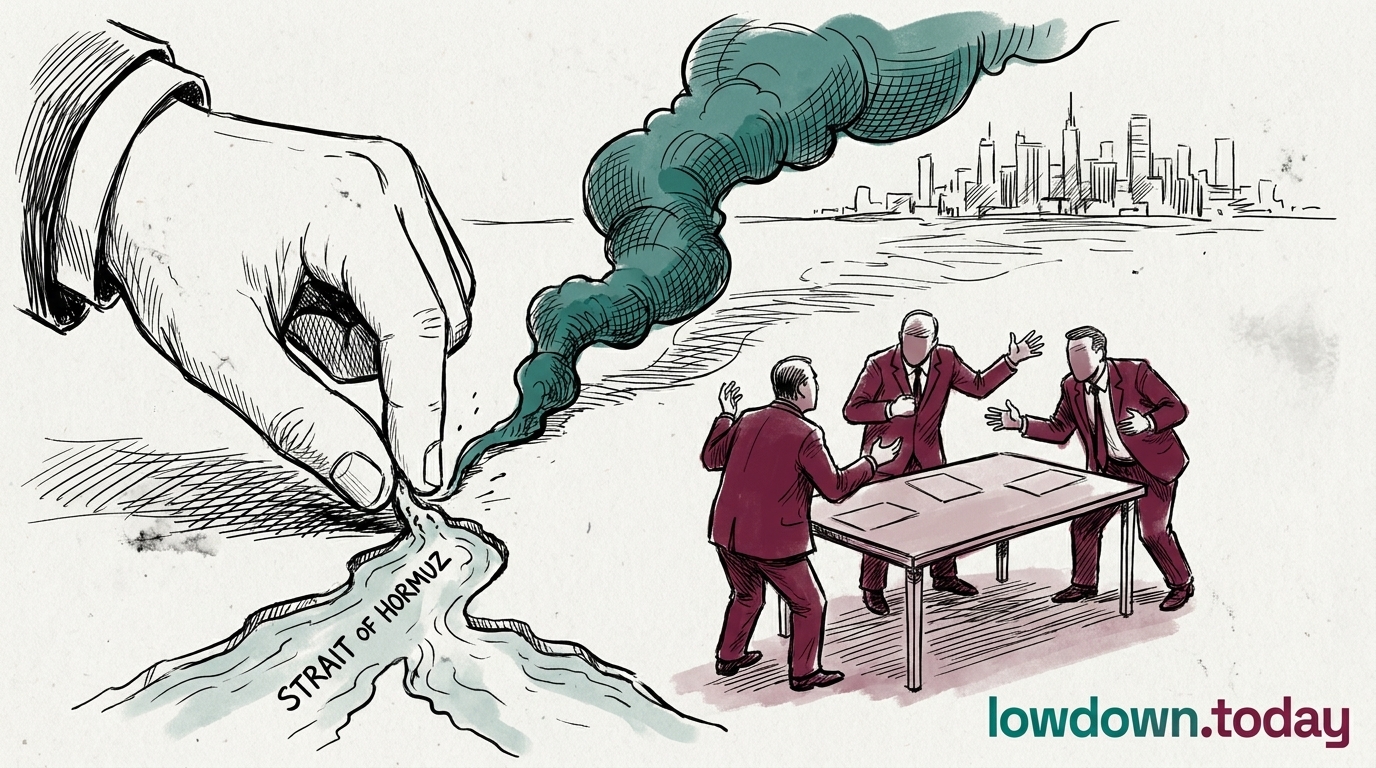
The absence of an endstate compounds the absence of a diplomatic process. Trump's demand amounts to capitulation. Pezeshkian's three conditions — recognition of Iran's nuclear programme and regional role, reparations, and binding security guarantees against future attack — are incompatible with it. No third party has proposed bridging terms. Three administration officials offered three incompatible descriptions of the same inability to reopen the strait of Hormuz: Wright's "simply not ready", Bessent's "as soon as militarily possible," and Hegseth's "don't need to worry about it". A war without an achievable stated objective, no mechanism to end it, and no internal consensus on basic operational status operates on institutional momentum rather than strategic direction.

Deep Analysis

In plain English

From day one, Trump said he wanted ordinary Iranians to rise up and take over their government once the bombing started. He is now publicly admitting that is extremely unlikely. The problem is that no one in The Administration has said what they are trying to achieve instead. Going to war without knowing what winning looks like is one of the most dangerous strategic positions a country can be in — it removes the conditions under which either side could agree to stop fighting.

Deep Analysis
Synthesis

Trump's public concession simultaneously creates a domestic political liability and eliminates Iran's incentive to offer diplomatic concessions. If the stated US war aim is already acknowledged as unachievable, Iran gains nothing by moderating — and The Administration cannot credibly claim victory under any outcome short of the goal it has just disowned.

Root Causes

The failure of regime change as a war aim reflects a structural mismatch in US Iran strategy: two decades of sanctions were designed to inflict economic pain, not to build insurrectionary capacity. Iran's Revolutionary Guard was specifically architected after 1979 to pre-empt exactly the kind of internal coup or popular revolt The Administration is counting on.

Escalation

The absence of an articulable endstate structurally prevents de-escalation. Iran has no reason to moderate its position if the stated US objective — regime change — is already off the table, and the US has no framework within which to accept Iranian concessions even if offered.

What could happen next?
  • Risk

    A war without an articulable endstate removes the conditions for a negotiated settlement, as neither side has defined terms on which to stop.

    Short term · Assessed
  • Consequence

    Iran's incentive to offer diplomatic concessions is structurally reduced if its government's survival is no longer the stated American war aim.

    Immediate · Assessed
  • Risk

    Congressional pressure for a war powers authorisation debate may intensify as the original stated objective publicly collapses.

    Short term · Suggested
  • Meaning

    The gap between stated war aim and private intelligence assessment is now public, degrading the administration's coercive credibility for this and future conflicts.

    Medium term · Assessed
First Reported In

Update #35 · Kharg Island struck; oil terminal spared

Times of Israel· 14 Mar 2026
Read original →
Causes and effects
This Event
Trump: regime change a very big hurdle
The stated endstate of popular revolution has been abandoned in substance if not in name, leaving a war costing $1.9 billion per day without an articulated achievable objective and no diplomatic process to produce one.
Different Perspectives
International Energy Agency
G7 members agreed on 2 October to release up to 100 million barrels through the IEA over four months, front-loading diesel.
China
China
China signed the 15 October text reaffirming the Resolution 2216 arms embargo on the Houthis. The Wall Street Journal reported that Conflict Armament Research found Chinese parts in a Houthi copy of Iran's Kheibarshekan missile.
Russia
Russia
Russia joined the 15 October consensus condemning the Houthis, a month after vetoing a mandate for a UN panel of experts on Iran sanctions on 17 September. One Western official told Bloomberg that Moscow is providing Iran with missiles, and the White House rejected the assessment.
India
India
National Security Adviser Ajit Doval raised seafarer safety with Mohsen Rezaei on 12 October, after a drone hit the Petro Dolphin with 11 Indians aboard at Sohar. External Affairs Minister S. Jaishankar urged that attacks on commercial shipping and seafarers be avoided.
Lebanon
Lebanon
President Joseph Aoun met UN peacekeeping chief Jean-Pierre Lacroix in Beirut on 14 October as UNIFIL winds down before its mandate ends on 31 December. Two days later Qatar's prime minister pledged in Beirut to fund a solar plant for Lebanon.
Kataib Hezbollah
Kataib Hezbollah
The militia announced a halt to operations except against "hostile aircraft" and denied any disarmament deal with Prime Minister Ali al-Zaidi. A day later Quds Force chief Esmail Qaani urged eliminating "remaining traces of the US presence in other arenas".

Written with AI from Lowdown's published reporting. Not individually reviewed by an editor. Editorial standards.