Skip to content
Briefings are running a touch slower this week while we rebuild the foundations.See roadmap
Iran Conflict 2026
1MAY

Yeltsin Library, not Kremlin, hosted Araghchi

3 min read
10:38UTC

Putin received Araghchi at the Boris Yeltsin Presidential Library on St Petersburg's Senate Square on Monday, not at the Kremlin as previously reported. Lavrov, Yury Ushakov and GRU chief Igor Kostyukov attended.

ConflictDeveloping
Key takeaway

Russia hosted Araghchi at a St Petersburg archive, not the Kremlin, signalling partner not co-belligerent.

Vladimir Putin received Abbas Araghchi at the Boris Yeltsin Presidential Library on St Petersburg's Senate Square on Monday 27 April, not at the Kremlin as the prior reporting had it , which had logged the meeting in line with the earlier Araghchi-Putin Kremlin framing 1. The Moscow Times logged Sergei Lavrov, presidential aide Yury Ushakov and Igor Kostyukov, head of the GRU (Russia's military intelligence directorate, the Main Directorate of the General Staff) in attendance. Russian state media had carried a Kremlin-facing readout on Sunday before the Moscow Times confirmed the St Petersburg venue on Monday.

The Boris Yeltsin Presidential Library is the federal archive opened in 2009 and named for Russia's first post-Soviet president, occupying the former Senate building on Senate Square in St Petersburg. Russia's working diplomatic protocol distinguishes Moscow visits, which signal alignment, from St Petersburg visits, which signal access without endorsement. Receiving a wartime foreign minister at an archive named for the president who dissolved the Soviet Union is a calibrated downward register from receiving him in the Kremlin's Catherine Hall. Russia is presenting itself as a strategic partner, not a co-belligerent.

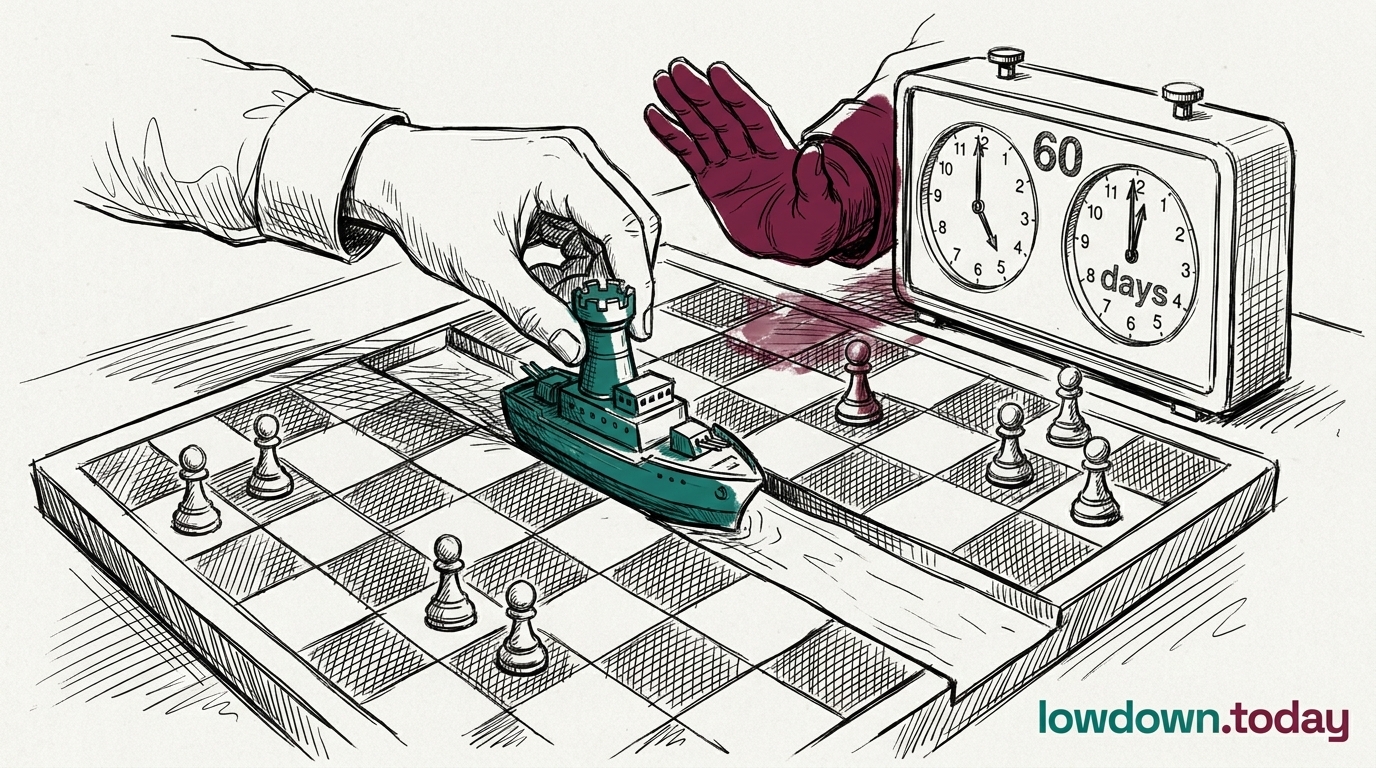
Putin pledged Russia would do 'everything that serves your interests' to secure peace; Ushakov said Moscow would 'analyse the signals received from both Americans and Israelis'. CGTN's coverage of the meeting omits the Hengli Petrochemical designation entirely 2, which keeps the Russia-Iran solidarity story clean of the sanctions dispute. The venue, the supporting cast and the public statements line up: Moscow will host Araghchi, will brief on his behalf, and will not be photographed inside the Kremlin alongside an Iranian envoy on a war Russia has not entered. The downward shift from Kremlin to Yeltsin Library is the substantive Russian move on Day 60.

Deep Analysis

In plain English

Iran's top diplomat met Russia's president, foreign minister and intelligence chief in St Petersburg. Russia promised to do everything it could to help secure peace. The meeting happened outside Moscow at a symbolic library, which is how Russia signals 'we support you but we are not at war alongside you'. Iran is using Russia as a diplomatic backstop while its own talks with the US stall.

Deep Analysis
Root Causes

GRU chief Kostyukov's presence signals that the meeting covered military intelligence sharing, not purely diplomatic messaging. Kostyukov's portfolio includes signals intelligence and satellite monitoring; his attendance alongside Ushakov (presidential coordination) and Lavrov (diplomatic messaging) suggests Russia provided an updated battlefield assessment rather than just political solidarity.

The Il-76 radar transfer pattern logged at high tempo in prior days provides the operational context: Russia and Iran are running a military-technical channel alongside the diplomatic channel, and the St Petersburg meeting formalised both.

What could happen next?
  • Consequence

    Russia's 'analyse signals from Americans and Israelis' framing positions Moscow as a potential back-channel between Tehran and Washington, inserting itself into any eventual settlement architecture.

  • Risk

    Kostyukov's attendance raises the probability that Russia provided updated CENTCOM operational data to Iran, narrowing IRGC tactical uncertainty about US carrier positioning.

First Reported In

Update #82 · Iran writes Phase 1; Washington still has no pen

The Moscow Times· 28 Apr 2026
Read original
Different Perspectives
Oil markets
Oil markets
Brent fell $1.05 to $106.0 on summit Day 1 but remains $5-7 above the post-ceasefire equilibrium analysts modelled in March; the market is pricing a holding pattern, not a breakthrough. OilPrice.com and Aramco CEO Nasser converge on buffer-exhaustion before Hormuz reopens if the blockade extends past mid-June.
Iranian dissidents and human rights monitors
Hengaw documented a five-prison simultaneous execution cluster on 13 May, with Gorgan appearing for the first time in the wartime register. Espionage charges framed as Israel-linked moharebeh now extend across Mashhad, Karaj, and Gorgan, using the war as judicial cover for protest-era detainees.
BRICS / Global South
Araghchi's Delhi appearance positioned Iran as a victim of US aggression before non-Western foreign ministers, with Deputy FM Bagheri Kani calling on BRICS to act against US aggression. India, as the largest non-Chinese user of Iranian-routed crude, faces pressure to balance bloc solidarity against its own shipping and sanctions exposure.
China
China
Beijing accepted the Nvidia chip clearance on summit Day 1 and gave Rubio verbal acknowledgement of Iran as an Asian stability concern, having already put Pakistan on paper as the mediatory channel on 13 May (ID:3253), deflecting the US ask for direct Chinese action without refusing it.
Iran (government and civilian diplomatic track)
Araghchi denied any Hormuz obstruction at BRICS Delhi on 14 May while Iran's SNSC had finalised a Hormuz security plan the day before. Israel Hayom's single-sourced 15-year freeze offer gives Tehran a deployable figure in non-Western forums regardless of corroboration; the state attributed 3,468 wartime deaths with no independent verification.
United States (Trump administration and Senate moderates)
Trump signed a chip clearance for 10 Chinese firms on summit Day 1 and zero Iran instruments across 76 days; Rubio and Vance made verbal Iran asks without paper. Murkowski voted yes on the 49-50 war-powers resolution after Hegseth told the Senate that Article 2 makes an AUMF unnecessary.