Skip to content
Briefings are running a touch slower this week while we rebuild the foundations.See roadmap
Iran Conflict 2026
1MAY

General License U Sets a Hidden Deadline

2 min read
10:38UTC

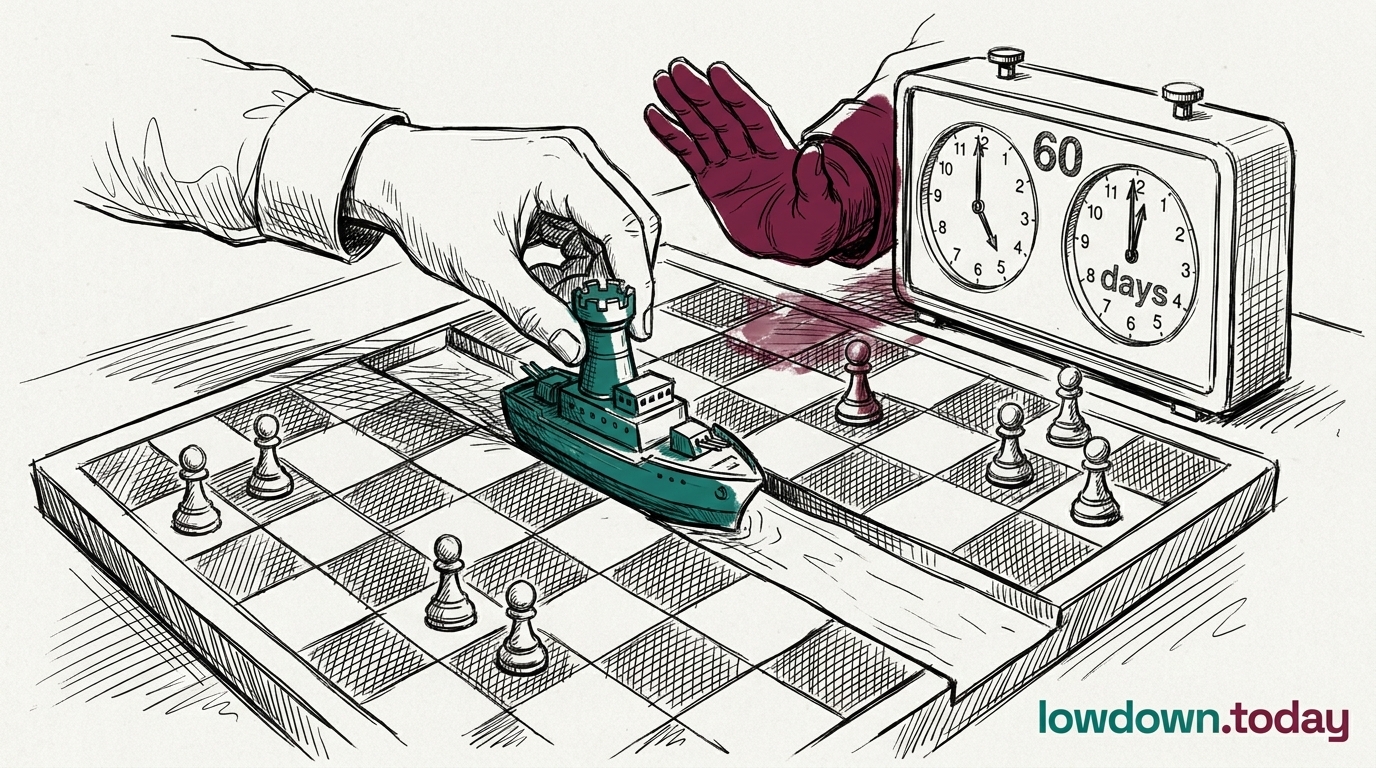
A US Treasury licence allowing the sale of stranded Iranian crude expires on 19 April. No renewal signal has come. It may matter more than the power grid.

ConflictAssessed
Key takeaway

The 19 April GL-U expiry may reshape oil markets more than the 6 April deadline.

The US Treasury issued General License U on 20 March, authorising sale of Iranian crude oil loaded on vessels on or before that date 1. It expires on 19 April, seventeen days from now. No renewal signal has come from Treasury.

The licence covers approximately 128 million barrels of Iranian crude stranded in transit or floating storage. It does not restore banking access or create a formal payment channel, limiting uptake to buyers with existing settlement mechanisms. India is the only swing buyer. The sanctioned Aframax PING SHUN made the first delivery of Iranian crude to India since May 2019: 600,000 barrels from Kharg to Vadinar, purchased by Reliance Industries 2.

If GL-U lapses and 128 million barrels lose their legal market, April becomes the month oil markets re-price for protracted conflict. US petrol already broke $4 per gallon . Renewal would tacitly acknowledge that Iranian oil is needed to cap price spikes. Either outcome carries political cost.

Deep Analysis

In plain English

GL-U is a US government permit that let some Iranian oil already loaded onto ships be sold legally, even though Iran is under sanctions. It covers about 128 million barrels sitting on tankers or in floating storage. The permit expires 19 April. If it is not renewed, those 128 million barrels have no legal buyer, which pushes oil prices higher. If it is renewed, that sends a signal the US does not expect the war to end soon enough to solve the oil shortage through military means.

Deep Analysis
Root Causes

GL-U was issued because the sanctions architecture succeeded too completely: blocking all Iranian crude removed 3.2 million barrels per day of supply from a market with no immediate substitute, producing the domestic price pressure the administration is simultaneously trying to suppress.

The structural cause is the tension between the war's military objective (coerce Iran by cutting its revenue) and its economic collateral (cut global supply and raise prices everywhere else). GL-U attempts to resolve this by allowing Iranian crude to move without restoring Iranian revenue; in practice it primarily benefits Reliance Industries' shareholders rather than solving the supply deficit.

The deeper root is that the US has no energy policy instrument capable of replacing Hormuz supply at scale. The IEA's 400 million barrel emergency release bought weeks, not months. GL-U is the second improvisation in three weeks.

What could happen next?
  • Risk

    GL-U non-renewal on 19 April removes the legal market for 128 million barrels, driving Brent toward $120 and adding roughly 20p per litre at UK pumps.

  • Consequence

    GL-U renewal signals Treasury has no near-term resolution expectation and effectively acknowledges Iranian oil is needed to prevent domestic political damage.

First Reported In

Update #55 · The Last Door Closes

Windward AI· 2 Apr 2026
Read original
Different Perspectives
Oil markets
Oil markets
Brent fell $1.05 to $106.0 on summit Day 1 but remains $5-7 above the post-ceasefire equilibrium analysts modelled in March; the market is pricing a holding pattern, not a breakthrough. OilPrice.com and Aramco CEO Nasser converge on buffer-exhaustion before Hormuz reopens if the blockade extends past mid-June.
Iranian dissidents and human rights monitors
Hengaw documented a five-prison simultaneous execution cluster on 13 May, with Gorgan appearing for the first time in the wartime register. Espionage charges framed as Israel-linked moharebeh now extend across Mashhad, Karaj, and Gorgan, using the war as judicial cover for protest-era detainees.
BRICS / Global South
Araghchi's Delhi appearance positioned Iran as a victim of US aggression before non-Western foreign ministers, with Deputy FM Bagheri Kani calling on BRICS to act against US aggression. India, as the largest non-Chinese user of Iranian-routed crude, faces pressure to balance bloc solidarity against its own shipping and sanctions exposure.
China
China
Beijing accepted the Nvidia chip clearance on summit Day 1 and gave Rubio verbal acknowledgement of Iran as an Asian stability concern, having already put Pakistan on paper as the mediatory channel on 13 May (ID:3253), deflecting the US ask for direct Chinese action without refusing it.
Iran (government and civilian diplomatic track)
Araghchi denied any Hormuz obstruction at BRICS Delhi on 14 May while Iran's SNSC had finalised a Hormuz security plan the day before. Israel Hayom's single-sourced 15-year freeze offer gives Tehran a deployable figure in non-Western forums regardless of corroboration; the state attributed 3,468 wartime deaths with no independent verification.
United States (Trump administration and Senate moderates)
Trump signed a chip clearance for 10 Chinese firms on summit Day 1 and zero Iran instruments across 76 days; Rubio and Vance made verbal Iran asks without paper. Murkowski voted yes on the 49-50 war-powers resolution after Hegseth told the Senate that Article 2 makes an AUMF unnecessary.