Skip to content
Briefings are running a touch slower this week while we rebuild the foundations.See roadmap
Iran Conflict 2026
19APR

EU sovereignty law slips a third time

4 min read
11:05UTC

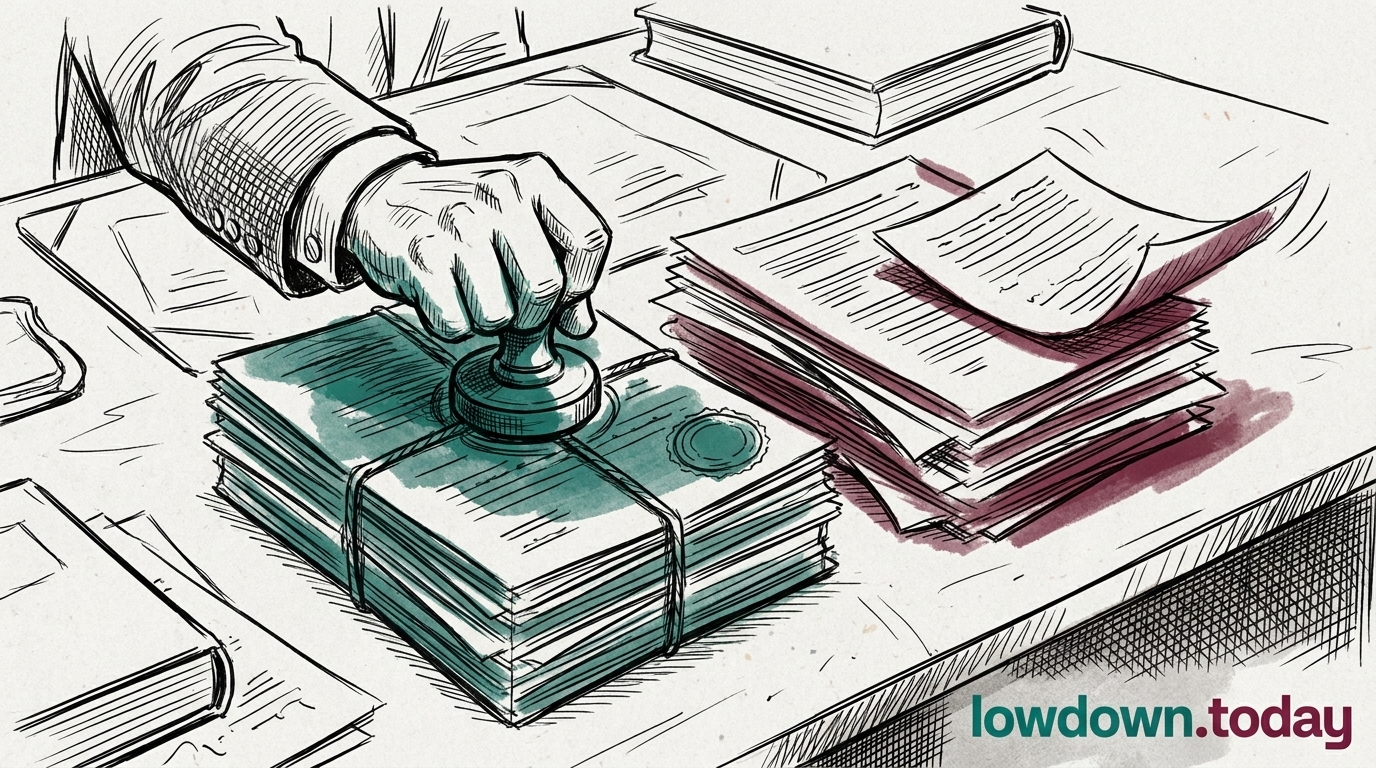
The Cloud and AI Development Act did not reach the College of Commissioners on Wednesday 27 May, the date Brussels itself had locked, and the US ambassador supplied the reason: a trade-framework red line.

ConflictDeveloping
Key takeaway

A package Brussels calendar-locked for today was pre-defeated diplomatically before it was ever formally proposed.

The Cloud and AI Development Act (CAIDA, the EU law that would bar US cloud giants from hosting sensitive public-sector data) did not reach the College of Commissioners on Wednesday 27 May 2026, the date the Commission itself had locked for adoption . The package slipped a third time, to a tentative 3 June, extending a sequence that now reads 25 March, 15 April, 27 May . Andrew Puzder, the US Ambassador to the EU, gave the proximate reason this time, and it was not industrial: he warned the package "crosses a red line" and is inconsistent with the EU-US trade framework 1. Politico, separately, reported the 400-page text was simply not ready 2.

For readers arriving cold: CAIDA is the centrepiece of the Tech Sovereignty Package, bundled with a revamped Chips Act II that would hand Brussels direct equity authority in semiconductor fabs. Alexandra Geese, a German Green MEP, put the trade link on the public record: the EU kept digital rules out of last August's framework, but Washington has kept pressing on the Digital Services Act (DSA, the EU's platform-accountability law) ever since 3.

For five updates the binding constraint on European sovereignty was an implementation gap: the right diagnosis, the right prescriptions, and an 11.2% delivery rate against the recommendations in Mario Draghi's 2024 competitiveness report . That constraint has changed character. Europe's problem is no longer only that it cannot build; it is that it cannot legislate sovereignty without tripping the trade framework, and the veto runs through Berlin. France favours the protectionist line. Germany, exposed to a threatened US tariff package on its automotive and luxury exports worth up to $200bn, does not 4.

The charitable reading deserves a hearing: reconciling procurement law, competition rules and international agreements across hundreds of pages is genuinely slow, and reading a US veto into a routine delay over-reaches. It does not survive the calendar. A third slip on a date the Commission locked, coinciding with a named ambassadorial red line and a documented Paris-Berlin split, means the package lacks the consensus to ship whatever the proximate cause. The instrument built to escape US dependence was pre-defeated diplomatically before a word of it reached the College.

Deep Analysis

In plain English

The European Commission wants to pass a law called CAIDA (the Cloud and AI Development Act) that would stop American tech giants like Microsoft, Amazon, and Google from handling sensitive government data in Europe. Think of it as a 'European data only' rule for public services. This was supposed to be approved on 27 May 2026, but it has now been delayed three times in a row. The latest holdup comes from two directions. First, the US ambassador to the EU publicly warned that the law would break trade rules agreed between Europe and America. Second, Germany is quietly reluctant because the United States has threatened up to $200 billion in tariffs on European cars, and Berlin does not want to provoke Washington further over a digital rule that does not directly affect the car industry.

Deep Analysis
Root Causes

Germany's automotive sector exported €84bn in vehicles and parts to the United States in 2024, representing approximately 27% of total German goods exports to the US. A $200bn threatened tariff package on EU automotive and luxury goods would fall disproportionately on German industry, not French or other member-state industry.

Berlin's CAIDA calculus is therefore not primarily about digital policy; it is about managing a trade-off between cloud procurement rules affecting German public-sector institutions and tariff exposure affecting the German private sector at roughly two orders of magnitude greater economic scale.

The Commission's public rationale for each successive slip has been procedural: finalising legal text, coordinating College positions. The structural cause is that CAIDA requires a qualified majority of member states, and Germany's silence functions as a blocking mechanism inside the College consensus model. Puzder's public intervention on 25 May crystallised what was already known internally: the US had communicated its position bilaterally before the ambassador went public.

What could happen next?
  • Risk

    A fourth slip beyond 3 June would push CAIDA past the summer recess, making October 2026 the earliest plausible adoption and extending US hyperscaler public-sector contract eligibility by another quarter.

    Short term · Assessed
  • Consequence

    Germany's automotive tariff calculus sets a precedent: any EU digital sovereignty instrument that conflicts with a US trade threat can be slowed by member-state export exposure, regardless of the instrument's merits.

    Medium term · Assessed
  • Precedent

    Puzder's public red-line warning, if unrebutted by the Commission, establishes that bilateral US pressure can visibly influence Commission adoption calendars on non-trade legislation.

    Long term · Assessed
First Reported In

Update #6 · Brussels slips sovereignty law a third time

BankInfoSecurity· 27 May 2026
Read original
Different Perspectives
Israel
Israel
IDF Chief Eyal Zamir declared on 3 June there was no ceasefire for his forces, and strikes killed at least 10 civilians and one Israeli soldier on 4 June. The IDF killed Hezbollah's chief engineer and warned three south Lebanon villages to evacuate on 5 June, advancing into ground the unsigned Washington framework has not caught.
Hezbollah / Lebanon
Hezbollah / Lebanon
Naim Qassem rejected the Washington Lebanon framework on 4 June as "absurd, humiliating and insulting", blocking a ceasefire instrument that required Hezbollah to withdraw north of the Litani before any Israeli withdrawal. Over one million Lebanese remain displaced; the framework's collapse prolongs that toll.
Iran
Iran
Foreign Minister Araghchi publicly coupled the Lebanon ceasefire to the Iran-US nuclear track on 4 June, carrying IRGC authority rather than his own civilian mandate. The IRGC delegation has sent no HEU counter-proposal since Araghchi confirmed no progress that same day; Mojtaba Khamenei's 21 May order to keep the 440.9 kg stockpile inside Iran remains operative.
United States
United States
Rubio placed the Iran-US deal at 95 per cent complete on 4 June while the administration signed no Iran instrument and OFAC designated only Cuban targets. Trump separately disclosed and rejected an airlift plan to collect Iran's HEU stockpile, claiming the material is "entombed", a claim the IAEA cannot verify.
China
China
Beijing's MOFCOM Blocking Rules constrain OFAC enforcement on the mainland; China has not corroborated Trump's verbal account of any bilateral summit, and the rial's failure to hold its Rubio bounce, combined with the IRGC's stablecoin rail closure, increases Chinese yuan-denominated oil-payment exposure through Hormuz.
Bahrain
Bahrain
The IRGC struck Bahrain on 3 June as its sirens sounded and its PAC-3 magazine neared exhaustion; excluded from Rubio's 2 May emergency resupply, Bahrain received a 50-round Federal Register notice on 1 June on an 18-month delivery timeline, meaning it is defending the US Fifth Fleet headquarters on the last rounds it has.