Skip to content
Briefings are running a touch slower this week while we rebuild the foundations.See roadmap
Iran Conflict 2026
18APR

Ukraine delegation heads to Washington

3 min read
14:57UTC

Seventeen days after the Istanbul trilateral collapsed, Kyiv is sending negotiators back to the table — but Russia has not confirmed anyone will be on the other side.

ConflictDeveloping
Key takeaway

Russia's silence on attendance makes Washington a referendum on whether the peace track survives.

President Zelenskyy announced on 19 March that First Deputy Head of the Presidential Office Sergiy Kyslytsya will lead a Ukrainian delegation to Washington for a meeting on Saturday 21 March 1. The trip is the first diplomatic movement on the Russia-Ukraine peace track since US envoys Steve Witkoff and Jared Kushner cancelled the Istanbul trilateral on 4 March . Kremlin spokesman Dmitry Peskov called the pause "situational, for obvious reasons," attributing it to the Iran war consuming American attention 2. Russia has not confirmed whether it will send a delegation.

The last face-to-face round was Geneva on 17–18 February, which advanced Ceasefire monitoring mechanics but deadlocked on territory, security guarantees, and monitoring deployment . The Abu Dhabi follow-up collapsed; Istanbul was cancelled; no replacement was scheduled. Three weeks of silence followed — the longest gap since the trilateral format began. Whether Moscow sends a team on Saturday will determine if the track has restarted or shifted to a bilateral US-Ukraine conversation from which Russia absents itself. Kyiv's willingness to travel without confirmed Russian participation positions Ukraine as the party sustaining diplomacy while the Iran conflict commands American attention.

The diplomatic context has shifted since Geneva. Trump told Zelenskyy on 25 February that he wanted the war ended "in a month" ; that deadline has passed. The Putin-Trump phone call on 9 March produced no commitments on Ukraine, with Putin insisting his forces were "advancing quite successfully" . Bloomberg reported in late February that Russia was weighing a suspension of negotiations unless Ukraine pre-committed to ceding Donetsk, Luhansk, Zaporizhzhia, and Kherson — a condition Kyiv has consistently rejected. If Russia attends on Saturday, talks will test whether any movement is possible on the three deadlocked issues. If it does not, Washington faces a choice: press ahead bilaterally with Kyiv in a format Moscow opposes, or acknowledge that the peace track is functionally suspended for as long as the Iran war persists.


Deep Analysis

In plain English

Ukraine is flying its top negotiator to Washington for a Saturday meeting. The critical question is whether Russia will send anyone at all. Past peace talks were held on neutral ground — Istanbul, Geneva, Abu Dhabi — with the US observing rather than hosting. Switching to Washington gives America more direct leverage to push both sides toward a deal. But if Russia does not show up, it signals that the diplomatic pause is not temporary: it is a deliberate choice to keep fighting while the US is distracted by the Iran conflict. The venue itself has become the message.

Deep Analysis
Synthesis

The simultaneous occurrence of record battlefield intensity (286 engagements on 18 March) and diplomatic re-engagement is not coincidental. Ukraine has historically applied military pressure immediately before or during negotiating rounds — as at Istanbul in March 2022 — to improve its leverage at the table. Kyslytsya's seniority in the Presidential Office rather than the Foreign Ministry signals this is an exploratory political channel, not a formal negotiating round — consistent with a probing strategy rather than a commitment to terms.

Root Causes

Three structural factors sustain the diplomatic impasse beyond Iran's temporary distraction. First, Russia and Ukraine hold irreconcilable public positions on territorial sovereignty, making any agreement either side could sell domestically extremely narrow. Second, the absence of a mutually hurting stalemate — Russia still believes time is on its side despite decelerated advances — reduces Moscow's incentive to accept terms now. Third, US envoys Witkoff and Kushner lack the institutional knowledge and leverage of career diplomats, reducing Washington's capacity to craft bridging proposals with the technical precision required.

Escalation

The venue shift from neutral third countries to Washington elevates diplomatic stakes in two directions simultaneously. Ukrainian attendance without Russian confirmation frames Russia as the party blocking progress, generating political pressure Moscow may find difficult to sustain publicly. However, if Washington talks become bilateral US–Ukraine sessions, they risk hardening into a format Russia then refuses to join even when it is genuinely ready to negotiate — structurally closing off the trilateral track.

What could happen next?
  • Meaning

    The shift from neutral venues to Washington signals the US has moved from observer to active mediator — a qualitative change in American engagement that raises both potential and the stakes of failure.

    Immediate · Assessed
  • Consequence

    If Russia does not attend, the trilateral format may be permanently abandoned in favour of a bilateral US–Ukraine channel that excludes Moscow, reducing any eventual deal's durability.

    Short term · Suggested
  • Risk

    A Washington meeting producing only a US–Ukraine communiqué without Russian participation could harden positions and make later trilateral re-engagement structurally harder to reconvene.

    Medium term · Suggested
  • Opportunity

    Ukraine can leverage direct Washington access to secure enhanced military commitments as diplomatic insurance regardless of whether talks produce a ceasefire framework.

    Short term · Assessed
First Reported In

Update #6 · Ukraine sends negotiators as front reverses

Kyiv Independent· 20 Mar 2026
Read original
Causes and effects
This Event
Ukraine delegation heads to Washington
Tests whether the Russia-Ukraine peace track has survived the Iran war's pull on American attention. Russia's decision to attend or absent itself will reveal whether diplomacy continues in trilateral format, shifts to bilateral, or stalls entirely.
Different Perspectives
Lloyd's of London underwriters
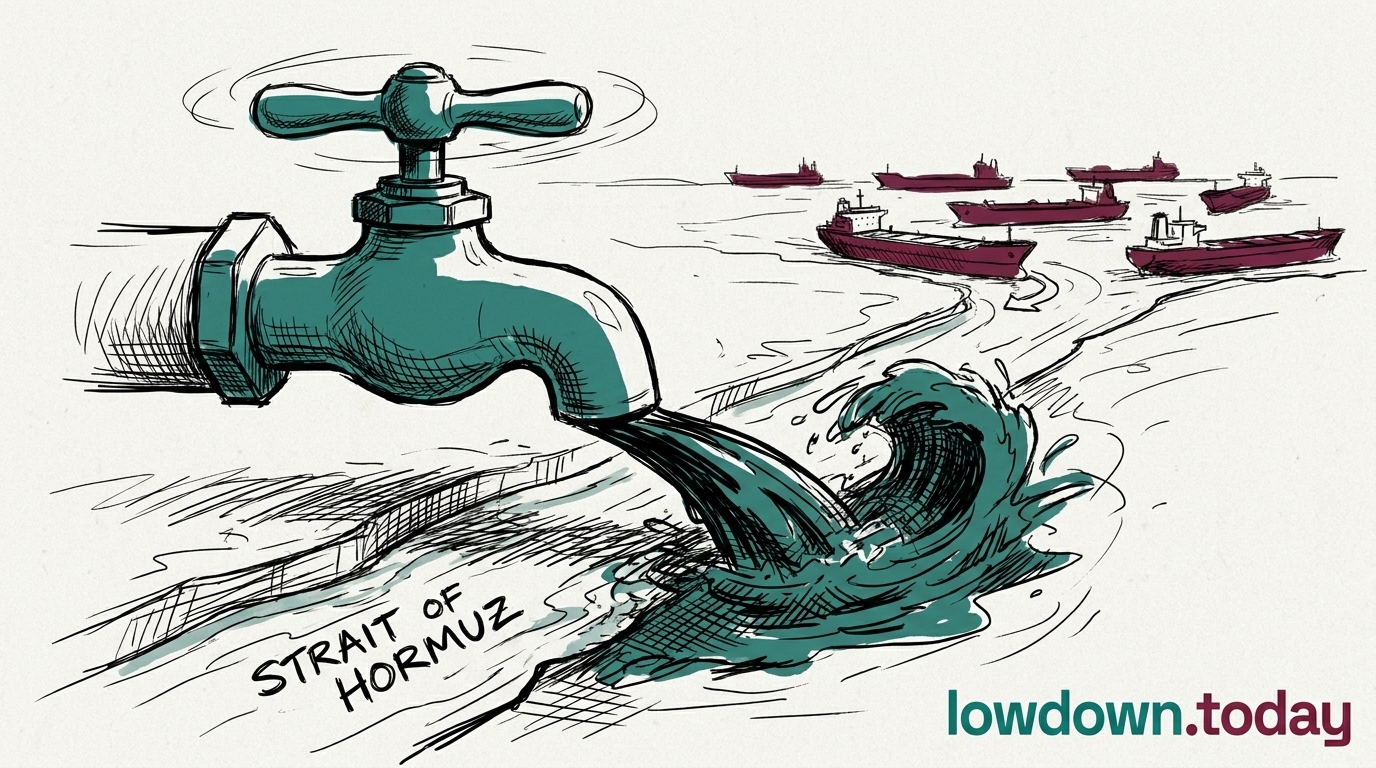
Lloyd's held its Hormuz war-risk rate at $10-14 million per voyage; underwriters need a UN Security Council resolution or formal PGSA de-listing before repricing, not a Senate testimony. The PGSA remains on the SDN list under EO 13224, so any vessel transiting a nominally reopened strait still deals with a sanctioned counterparty.
Saudi Arabia and Gulf states
Brent crude at $95-97 on 2-3 June reflects Gulf producers benefiting from the conflict premium; a genuine Hormuz deal would likely cut that premium by $10-15 per barrel. Riyadh's $87 per barrel budget breakeven means the current price is comfortable, reducing the Gulf's urgency to push for a rapid settlement.
China
China
OFAC's Nobitex designation leaves China's informal bilateral currency-swap lines with Iran as the CBI's remaining rial-defence mechanism; Chinese financial institutions face secondary-sanctions risk if they interact with successor wallets. Beijing's MOFCOM Blocking Rules protect mainland refineries from direct designation but do not shield informal swap-line counterparties.
Lebanon / Hezbollah
Lebanon / Hezbollah
Lebanon's Washington delegation demanded full Israeli withdrawal and the return of 1.2 million displaced; Hezbollah deployed an FPV drone that killed an Israeli soldier at Yohmor while talks ran, demonstrating it can impose costs even at Israel's deepest penetration point. Lebanon's government cannot deliver the Hezbollah disarmament guarantee Israel demands.
Israel / Benjamin Netanyahu
Israeli forces seized Beaufort Castle above the Litani on 1-2 June and advanced to within 10 km of the Zaharani river while ceasefire delegations sat in Washington; the advance ran entirely outside the Beirut-only truce Netanyahu accepted on 1 June. Each kilometre taken raises Israel's withdrawal price before any permanent text is signed.
Iran: Foreign Ministry and domestic population
Araghchi rang six capitals in 48 hours to reopen talks the SNSC had suspended, calling the IRGC line 'speculation'; at home, 37 political prisoners were executed since 19 March while students marched in Tehran, Mashhad and Hamadan. The diplomatic thaw has not eased the state's wartime repression tempo.



