Skip to content
Briefings are running a touch slower this week while we rebuild the foundations.See roadmap
Iran Conflict 2026
18APR

Hengaw documents five-prison execution cluster; Gorgan appears for first time

3 min read
14:57UTC

Hengaw documented seven executions on 13 May across five prisons in Birjand, Tabriz, Kerman, and Gorgan, with Gorgan appearing in the wartime register for the first time and Ehsan Afrashteh's secret execution on espionage charges confirmed.

ConflictDeveloping
Key takeaway

Five simultaneous executions across four cities imply central standing orders; Gorgan's first appearance shows the programme widening.

Hengaw, the Norway-based Kurdish human rights monitor that has become the principal independent casualty tracker for the 2026 Iran conflict, documented seven executions across five prisons on 13 May 1. Five unnamed prisoners were executed simultaneously in prisons in Birjand (South Khorasan province), Tabriz, Kerman, and Gorgan (two in Gorgan); Mohammad Abbasi was executed in a separate action the same day. Ehsan Afrashteh's secret execution on espionage charges was confirmed as part of the cluster Hengaw first reported on 12-13 May .

Gorgan, capital of Golestan province in Iran's north-east, appeared in Hengaw's wartime execution register for the first time. Previous documentation by Hengaw had mapped a geographic concentration in the Tehran region, anchored by the Shakourzadeh execution at Qezel Hesar prison in Karaj and the earlier Karaj cluster. Gorgan's first appearance, 600 km north-east of Tehran, indicates the programme is broadening geographically rather than remaining concentrated by proximity to the capital's judicial infrastructure.

The coordination visible in the five-prison cluster is not a feature of Iran's peacetime judicial system. Simultaneous executions across prisons in four cities in a single day imply centrally issued standing orders rather than independent provincial court calendars, each operating on its own sentencing timeline. The IRGC's security apparatus has been using the war as judicial cover for a category of detainee held before the conflict began: the espionage charging pattern, "Israel-linked moharebeh" (enmity against God), has now appeared in cases from Mashhad to Karaj. The 13 May cluster adds Gorgan to that register.

The Shahbakhsh-Afrashteh cluster plus the five unnamed prisoners on 13 May add at least eight to Hengaw's wartime count across the 12-13 May window. The total wartime execution register has risen sharply since the Shakourzadeh documentation established the Tehran-area baseline.

Deep Analysis

In plain English

Hengaw, a human rights group based in Norway that tracks executions in Iran, documented seven people killed in prisons on 13 May. Five were executed at the same time across four different cities, which is unusual: normally each prison runs on its own schedule. A city called Gorgan, far north-east of Tehran, appeared in Hengaw's records for the first time. The pattern suggests someone issued a central order for multiple prisons to act on the same day, using the cover of the war and a nationwide internet shutdown to limit outside scrutiny.

Deep Analysis
Root Causes

The IRGC security apparatus operates a category of detainee held before the conflict began, arrested under the 2022-2023 Mahsa Amini protest wave and charged with espionage-for-Israel through the "moharebeh and Israel" charging pattern that Hengaw first documented in Mashhad.

The wartime internet blackout, 1,704+ cumulative hours, provides operational cover: executions that would generate immediate diaspora and international media pressure during peacetime occur inside a communications blackout that delays confirmation by days.

Gorgan's first appearance is a geographic extension indicator: the programme is not confined to provinces near Tehran's judicial infrastructure but is operating across Iran's full provincial prison system. That geographic breadth implies a national-level coordination instruction, not a series of independently timed provincial decisions.

What could happen next?
  • Consequence

    Gorgan's first appearance in the wartime execution register confirms the programme extends beyond the Tehran-area judicial infrastructure where Hengaw established its baseline; every provincial prison in Iran is now within the documented geographic scope of the cluster pattern.

  • Risk

    The 1,704+ hour internet blackout suppresses the speed at which execution clusters reach international monitors; the actual number of executions in the 12-13 May window may exceed the seven Hengaw has confirmed, with further cases surfacing as blackout lifts.

First Reported In

Update #97 · Chips for Beijing, no paper for Iran

Jewish Insider· 14 May 2026
Read original
Different Perspectives
Lloyd's of London underwriters
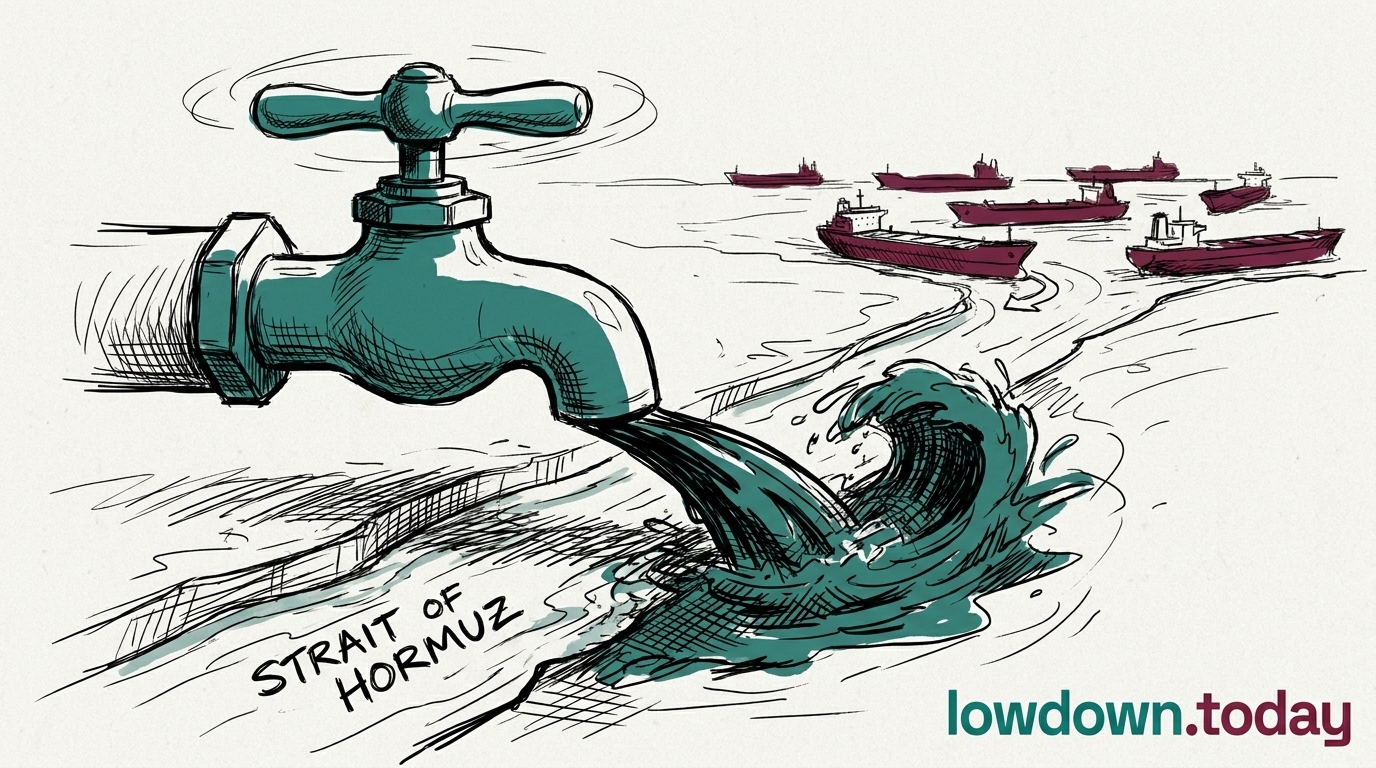
Lloyd's held its Hormuz war-risk rate at $10-14 million per voyage; underwriters need a UN Security Council resolution or formal PGSA de-listing before repricing, not a Senate testimony. The PGSA remains on the SDN list under EO 13224, so any vessel transiting a nominally reopened strait still deals with a sanctioned counterparty.
Saudi Arabia and Gulf states
Brent crude at $95-97 on 2-3 June reflects Gulf producers benefiting from the conflict premium; a genuine Hormuz deal would likely cut that premium by $10-15 per barrel. Riyadh's $87 per barrel budget breakeven means the current price is comfortable, reducing the Gulf's urgency to push for a rapid settlement.
China
China
OFAC's Nobitex designation leaves China's informal bilateral currency-swap lines with Iran as the CBI's remaining rial-defence mechanism; Chinese financial institutions face secondary-sanctions risk if they interact with successor wallets. Beijing's MOFCOM Blocking Rules protect mainland refineries from direct designation but do not shield informal swap-line counterparties.
Lebanon / Hezbollah
Lebanon / Hezbollah
Lebanon's Washington delegation demanded full Israeli withdrawal and the return of 1.2 million displaced; Hezbollah deployed an FPV drone that killed an Israeli soldier at Yohmor while talks ran, demonstrating it can impose costs even at Israel's deepest penetration point. Lebanon's government cannot deliver the Hezbollah disarmament guarantee Israel demands.
Israel / Benjamin Netanyahu
Israeli forces seized Beaufort Castle above the Litani on 1-2 June and advanced to within 10 km of the Zaharani river while ceasefire delegations sat in Washington; the advance ran entirely outside the Beirut-only truce Netanyahu accepted on 1 June. Each kilometre taken raises Israel's withdrawal price before any permanent text is signed.
Iran: Foreign Ministry and domestic population
Araghchi rang six capitals in 48 hours to reopen talks the SNSC had suspended, calling the IRGC line 'speculation'; at home, 37 political prisoners were executed since 19 March while students marched in Tehran, Mashhad and Hamadan. The diplomatic thaw has not eased the state's wartime repression tempo.