Skip to content
Briefings are running a touch slower this week while we rebuild the foundations.See roadmap
Iran Conflict 2026
16APR

Trump rejects Iran's text on Truth Social

3 min read
09:27UTC

Donald Trump rejected Tehran's 14-point proposal on Truth Social on 2 May and warned reporters in Florida that strikes could resume; no written counter-text was issued.

ConflictDeveloping
Key takeaway

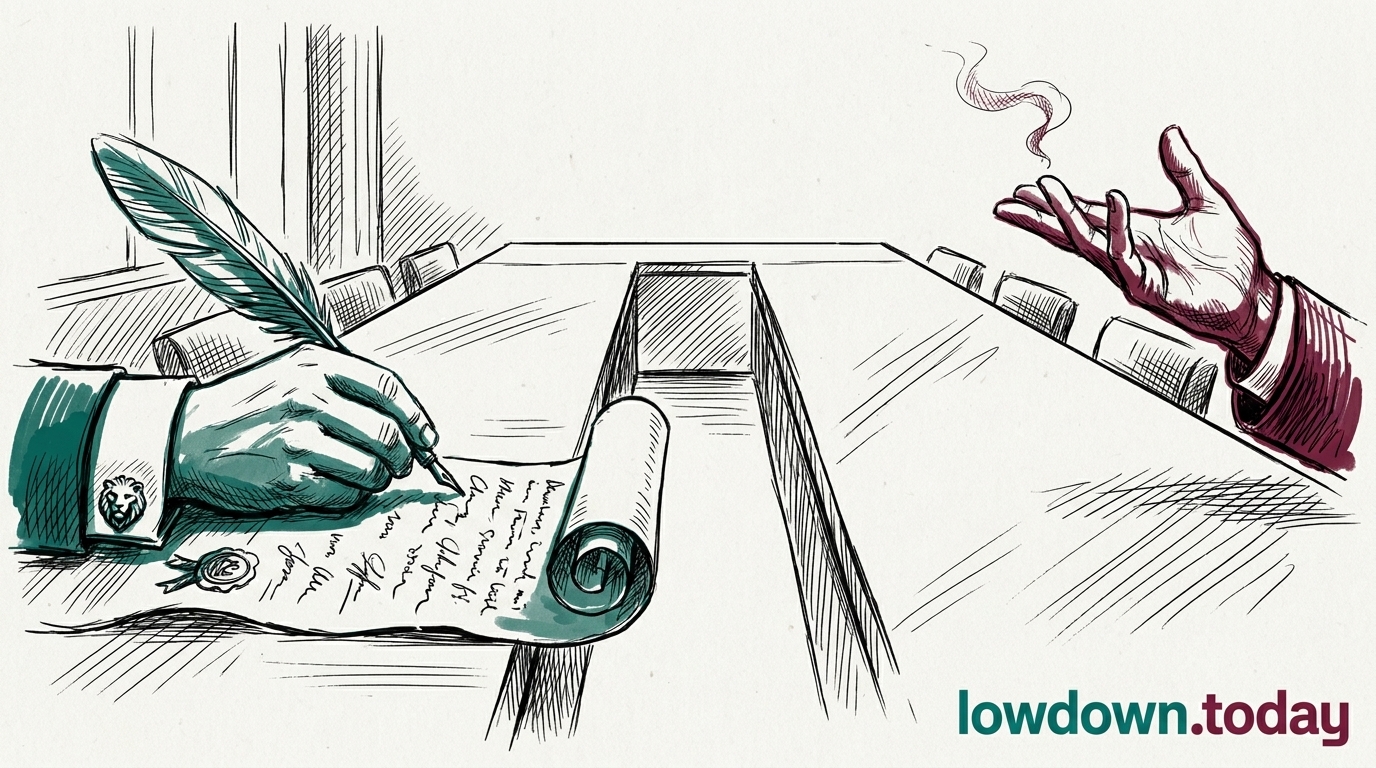
Tehran writes 14 points; the President posts. The asymmetry now defines the negotiating record.

Donald Trump rejected Iran's 14-point ceasefire proposal in a Truth Social post on 2 May, writing that Tehran has 'not yet paid a big enough price' and that the document is 'difficult to imagine would be acceptable' 1. Speaking to reporters in Palm Beach before boarding Air Force One the same day, he added: 'If they do something bad, there is a possibility it could happen,' a verbal threshold for resuming US strikes. The White House issued no written counter-text and signed no executive instrument on Iran in response.

Truth Social posts and pool-spray remarks are the entire surface area of the US presidential reply to a structured proposal delivered through the Pakistani channel . The asymmetry is not new; it has been the documented pattern of the war since the opening weeks. Iran has now placed three sequential written texts in front of Washington (two-phase, three-phase, 14-point) without a single written American answer.

Verbal-only positioning preserves presidential discretion. A signed instrument commits political capital and ties allied governments into the enforcement architecture; a Truth Social post commits neither. Foreign ministries, insurers and adversary general staffs cannot plan against social-media posts the way they can plan against signed orders. The IRGC's same-day declaration of full standby is calibrated against this ambiguity, as is Brent Crude's $14.83 single-session fall to $108.17 the previous day on the rejection signal . The longer the verbal posture runs, the more pressure builds on every other actor to write rules of engagement that work without an American authorial signature.

Deep Analysis

In plain English

Donald Trump responded to Iran's peace proposal by posting a rejection on Truth Social on 2 May, saying Iran had 'not yet paid a big enough price' and warning that military strikes could restart. He did not produce any written counter-proposal. This is the fourth time in a row he has rejected an Iranian written offer verbally without committing anything to paper himself. The gap matters because a verbal rejection leaves no record of what terms the US would actually accept, while Iran has now submitted four detailed written proposals.

Deep Analysis
Root Causes

Trump's verbal-only rejection reflects two structural constraints operating simultaneously. First, any signed presidential counter-text would constitute a formal executive instrument that Congress and the courts could examine under the War Powers Resolution, compressing presidential discretion.

Second, the domestic political coalition backing the Iran campaign (Republican hawks, the Israeli lobby, evangelical Christian supporters) does not want a documented concession list. A Truth Social post can be walked back; a signed counter-proposal cannot.

The 'not yet paid a big enough price' formulation repeats a pattern established when Trump dismissed the earlier Pakistan-brokered texts . It is calibrated to signal continued pressure without specifying a threshold that would tell Tehran precisely what additional pain would unlock US flexibility.

What could happen next?
  • Consequence

    With no written US counter-text at Day 65, the ceasefire negotiation has no agreed reference document on either side. Iran holds four written submissions; the US holds zero, leaving no documentary basis for any eventual agreement to be tested against.

  • Risk

    Senator Murkowski's 11 May AUMF deadline (ID:2980) creates an institutional pressure point: if Trump still has no written Iran instrument by that date, Murkowski's bill may pass committee with bipartisan support, forcing the first signed congressional Iran paper of the war onto Trump's desk.

First Reported In

Update #87 · China blocks OFAC; Iran writes; Trump tweets

Al Jazeera· 3 May 2026
Read original
Different Perspectives
Iran human rights monitors (Amnesty International, Iran HRM, Hengaw)
Monitors documented 30 women held on capital moharebeh charges in a basement prison ward, Benyamin Naqdi's death sentence with a forced-confession broadcast, and 39 political executions since February. Iran's security courts have processed protest cases at uninterrupted wartime tempo regardless of the diplomatic track.
Lloyd's of London (war-risk underwriters)
Lloyd's held its Hormuz war-risk designation at $10-14 million per voyage while Brent fell 19%, maintaining a structural divergence from futures pricing. Underwriters require a UN Security Council resolution or government certification letter, not diplomatic optimism, before de-listing the strait.
Oman (Sultan Haitham's government)
Muscat issued a mine alert in its own territorial waters while denying any Hormuz toll plan after US Treasury threatened sanctions. A suspected mine in Omani waters on the same weekend as US financial pressure forces Muscat to demonstrate sovereignty without appearing to choose sides.
China (PRC)
China (PRC)
Beijing sent scholars rather than its defence minister to Shangri-La for the second year running and addressed Taiwan and multilateralism without mentioning Iran. China maintains its bilateral energy corridor protection with Tehran while refusing the diplomatic exposure of a public position at multilateral forums.
Iran Supreme National Security Council
The SNSC framed the unsigned MOU as a 10-point Iranian victory with enrichment already recognised, and the foreign ministry rejected Trump's nuclear conditions within hours. Tehran treats each unsigned day as validation that Iran has retained its stockpile without surrendering it.
Trump administration (CENTCOM/White House)
Trump posted three non-negotiable public conditions while CENTCOM disabled a commercial ship and Hegseth threatened resumed strikes from Singapore. The administration treats the unsigned MOU as leverage to extract maximum Iranian concessions before any ceasefire instrument is committed to paper.