Skip to content
Briefings are running a touch slower this week while we rebuild the foundations.See roadmap
Iran Conflict 2026
9APR

Brent at $111, IEA at $106: the $5 gap

3 min read
11:02UTC

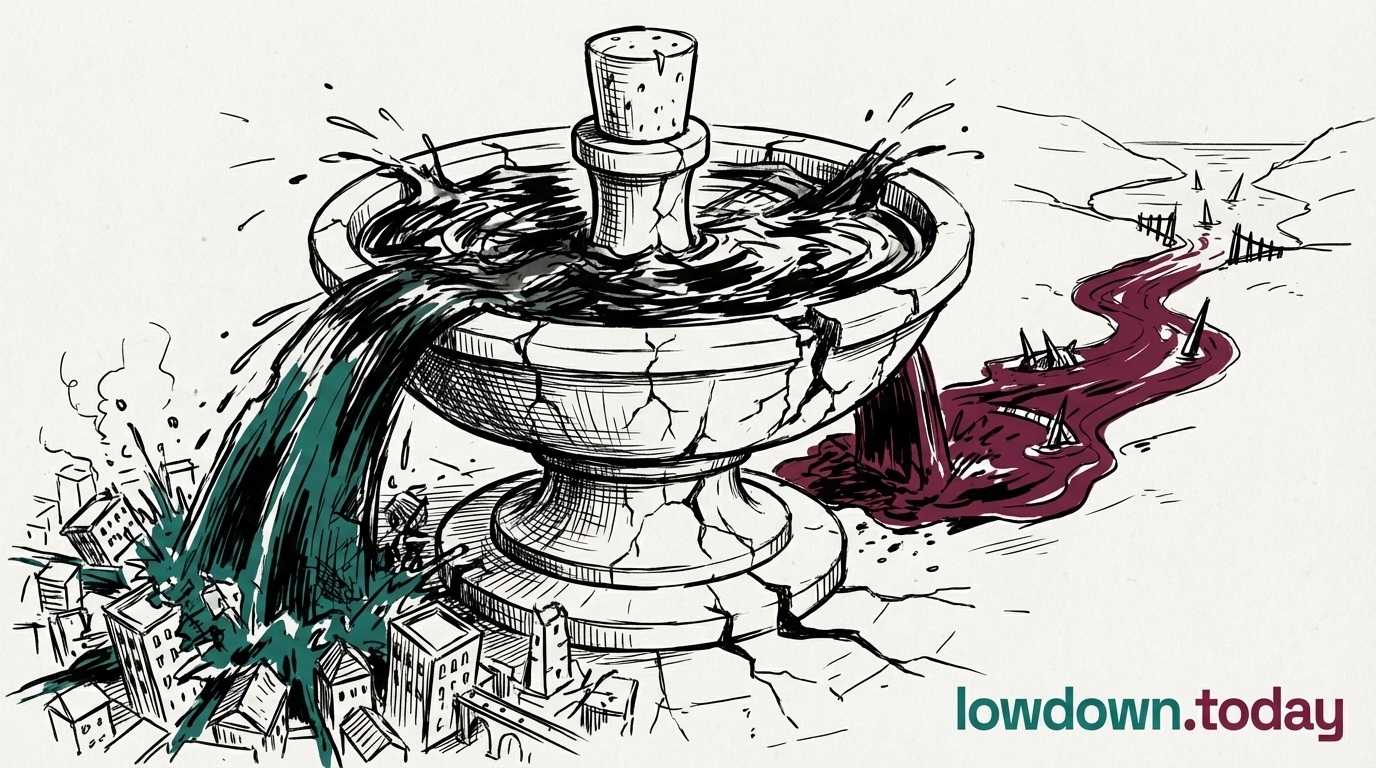
Brent crude settled at $111.22 on 19 May while the IEA's May Oil Market Report projects $106; Goldman Sachs and Morgan Stanley identified two stacked premium layers.

ConflictDeveloping
Key takeaway

Brent's $5 spread above the IEA model is the price of unwritten governance from every Hormuz party.

Brent settled at $111.22 per barrel on 19 May 2026, down 0.79 per cent from the $112.10 conflict high on 18 May , yet the IEA (International Energy Agency) May Oil Market Report projects Brent at roughly $106 per barrel for May-June, with global supply shut-ins peaking at 10.8 million barrels per day this month and observed inventories drawing 129 million barrels in March and 117 million in April 1. The spread runs at roughly $5 per barrel above the IEA model and is widening, not contracting.

Saudi Aramco and ADNOC output data feeds the IEA base case, yet current production cannot explain a premium of this size. What the market is pricing is institutional uncertainty: the PGSA permit regime with no public price, the Hormuz coalition with no published rules of engagement, the WPR clock with no presidential text, and the UNSC Barakah session producing a record but no resolution. Goldman Sachs and Morgan Stanley identified the two-layer premium two weeks earlier, separating a volatile kinetic component from a sticky structural insurance one. The $5 per barrel is the daily settlement of that structural flag.

Brent had reached $109.30 per barrel on 16 May before the Barakah strike and Trump's strike stand-down post drove the trajectory upward then back. The contour traces a market reading every institutional signal in real time, yet no paper has issued from the institution that could anchor a settlement.

Deep Analysis

In plain English

Brent crude settled at $111 per barrel on 19 May. The IEA, the international body that tracks oil markets, calculates the price should be around $106 given current supply levels. The $5 gap is not explained by how much oil is actually being produced or consumed. The extra $5 is not because there is less oil available than expected. It is because no one has published the rules governing who can ship oil through the Strait of Hormuz, at what cost, and under what legal framework. When markets cannot price risk, they add a buffer. That buffer is $5 per barrel and it flows through to petrol prices, food transport costs, and energy bills.

Deep Analysis
Root Causes

The IEA's $106 May-June projection models supply and demand but does not model war-risk insurance costs, which are a frictional charge that sits between supply and the market's effective price. Lloyd's suspension of Hormuz war-risk cover is not a supply disruption in the engineering sense but it raises the effective cost of moving supply to market, which shows up as a price premium disconnected from barrels-per-day arithmetic.

Four sources of unwritten governance compound the premium simultaneously: the PGSA tariff vacuum, the 26-nation coalition without published rules of engagement, the WPR clock without a presidential instrument, and the UNSC Barakah session that produced a record but no resolution. Goldman and Morgan Stanley's two-layer model captures the first two; the latter two are additional structural flags priced simultaneously.

What could happen next?
  • Consequence

    Aramco CEO Amin Nasser's 12 May warning that markets will not normalise until 2027 even if Hormuz reopens in June reflects the 6-12 month lag in war-risk cover reinstatement and fleet repositioning; the premium has a floor even post-ceasefire.

    Medium term · 0.78
  • Risk

    IEA May OMR projects global inventories will remain in deficit through Q4 2026 even if Hormuz flows resume in June. If resumption is delayed past August, the inventory draw since March (246 million barrels cumulative) begins producing physical shortage rather than premium pricing.

    Medium term · 0.72
  • Opportunity

    A PGSA published tariff, even an informal one, would satisfy Lloyd's stated threshold for reconsidering war-risk cover; that single document could compress part of the structural premium within weeks of publication.

    Short term · 0.6
First Reported In

Update #103 · Senate 50-47; UNSC at Barakah; no US paper

Trading Economics / ICE· 20 May 2026
Read original
Causes and effects
This Event
Brent at $111, IEA at $106: the $5 gap
The widening $5 spread is the daily settlement of institutional uncertainty: no PGSA tariff, no coalition rules of engagement, no WPR text, no UNSC resolution.
Different Perspectives
Civilians and prisoners inside Iran
Mojtaba Kian was hanged in under 50 days from arrest, the fastest wartime espionage case in Hengaw's record, as Trump announced a peace deal. Amnesty places Iran's 2026 execution count above 200 at its fastest pace in 44 years; the diplomatic track has not altered the internal enforcement tempo.
China
China
Beijing accepted a Pakistani civilian briefing mission on the same day OFAC's GL V expired, keeping itself inside the deal architecture without being a named signatory. How Chinese banks respond to Monday's Hengli dollar-clearing decision is the first real-world test of whether the verbal MOU carries any institutional weight.
Pakistan
Pakistan
Islamabad split its highest-level delegation: army chief Munir to Tehran on the security track, Prime Minister Sharif and Foreign Minister Dar to Beijing before Monday's GL V-driven bank compliance decision. The architecture routes the deal's hardest problem, IRGC buy-in, through the general-officer channel that has extracted every wartime concession.
Israeli government
Israeli government
An unnamed Israeli official told the Times of Israel that Trump privately told Netanyahu the deal will dismantle Iran's nuclear programme and remove all its uranium, terms incompatible with what Tehran and a Reuters source describe. If Netanyahu believes he was promised full dismantlement and the deal delivers less, Israel holds a sabotage veto before any signature.
Iranian Foreign Ministry
Spokesman Esmail Baghaei told state agency IRNA that nuclear issues are 'not in the current negotiations text' and the sequencing is: end the war first, then negotiate nuclear over two months. Baghaei's formulation preserves Khamenei's 21 May uranium-stay directive while letting the civilian diplomacy track continue.
Donald Trump / White House
Trump declared the Iran deal 'largely negotiated' on 23 May via Truth Social and signed nothing; the White House's only paper was a Memorial Day proclamation. The verbal-track method converts maximum political signalling into minimum legal exposure: no congressional notification, no Senate treaty ratification, no instrument for Iran to formally reject.