Skip to content
Briefings are running a touch slower this week while we rebuild the foundations.See roadmap
Iran Conflict 2026
8APR

Trump says war 'very close to over' while threatening infrastructure

4 min read
09:27UTC

Trump told Fox Business on 16 April the war is 'very close to over' and at a Las Vegas event said 'you could be very impressed', while simultaneously reiterating threats to destroy Iranian bridges and power plants.

ConflictDeveloping
Key takeaway

Optimism and destruction threats in one afternoon, no signed instrument behind either.

Donald Trump told Fox Business on 16 April: "I think it's close to over, yeah, I mean I view it as very close to over." At a Las Vegas event the same day he told supporters: "Let's see what happens over the next week or so, you could be very impressed." In the same Fox Business interview he reiterated threats to destroy Iranian bridges and power plants, and suggested Islamabad talks could resume "as early as this weekend". No new presidential executive instrument was announced.

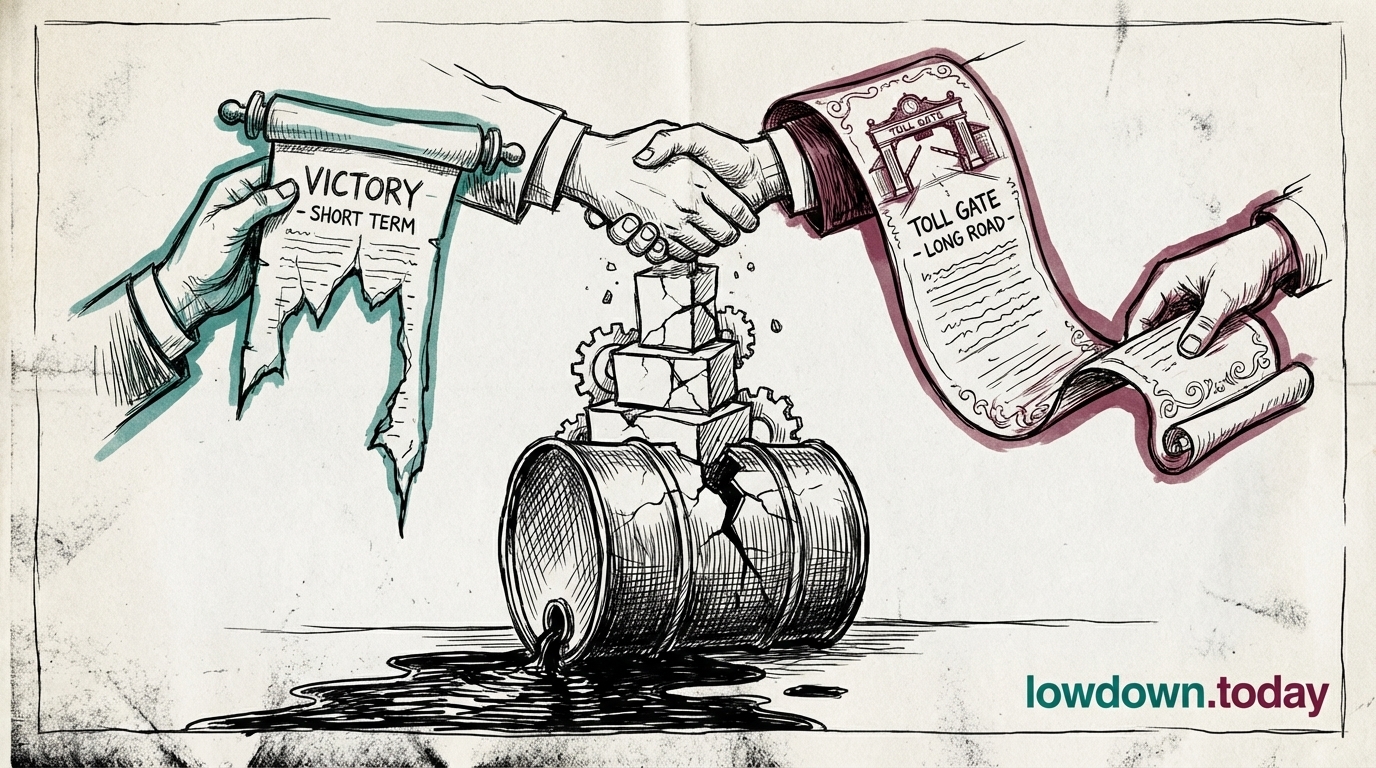
The verbal pattern mirrors the 8 April declaration that the war was "won" , and sits inside the same 48-day window in which the White House presidential-actions index has produced zero Iran instruments . Optimism about a deal and threats to destroy civilian infrastructure coexist in a single afternoon of remarks because neither is tied to a signed text that would force one to harden and the other to be walked back. Both survive as parallel verbal tracks. An AUMF on the desk would collapse that parallelism.

"Let's see what happens over the next week or so, you could be very impressed" puts a verbal horizon on top of a calendar already containing the four-deadline stack. A reader inside the Saudi foreign ministry, a European planning officer at Northwood, an Iranian general-officer track running through Islamabad, and a P&I underwriter pricing the GL-U lapse all now have a presidential statement that something is close, without a specification of what or when. Trump can claim victory if a deal lands this week, or escalation if it does not, and both readings survive the same sentence.

The Iran-side response to these remarks will not land in the same register. Tehran negotiates through Araghchi's written positions, the Mojtaba weapons statement, Majlis votes and general-officer shuttles. None of those channels respond to Fox Business cadence. Which means the verbal track Trump is running produces more pressure on the domestic audience, the allied audience and the insurance industry than it does on the counterparty it nominally addresses. The same applies, in parallel, to the House WPR that failed 213-214 the same day: the House was voting to force signed paper on the war. Trump's response was to keep the paper unsigned and say the war was nearly over. Both can coexist for 48 days; whether both can coexist for another 12 is the open question the deadline stack will answer.

Deep Analysis

In plain English

President Trump told Fox Business that the Iran conflict is 'very close to over'. In the same week he threatened to destroy Iranian bridges and power plants. This simultaneous optimism and threat is a pattern he has repeated throughout the conflict: announcing good news before it is confirmed, then maintaining military threats as leverage. There is no signed agreement and no official peace framework. Whether his optimism reflects genuine back-channel progress or is public positioning before a diplomatic deadline is the central unknown.

Deep Analysis
Root Causes

Trump's Fox Business statement reflects the structural constraints of governing by social-media announcement: having committed the US to an Iran conflict via Truth Social without executive instruments, he must also signal its conclusion via media appearances rather than signed agreements. The absence of a Peace Treaty, a formal ceasefire agreement, or any signed instrument means 'close to over' is the only mechanism available to him , a rhetorical claim, not a legal one.

The simultaneous threat to destroy bridges and power plants is not contradictory in Trump's signalling logic: it is the coercive complement to the optimistic offer. The pattern matches his tariff escalation-then-deal approach: maximum threat rhetoric maintained until the deal is signed, at which point the threat is retroactively characterised as successful leverage.

Escalation

Ambiguous. Publicly expressed optimism tends to create political pressure to avoid escalation , no leader wants to contradict their own 'close to over' statement with fresh strikes. However, the concurrent infrastructure threats signal that the military option is not off the table and that Trump's peace optimism is conditional.

What could happen next?
  • Risk

    The second repetition of the optimism-then-collapse pattern (23 March optimism, 12 April Islamabad failure) will make Iranian negotiators deeply sceptical of any Trump public statement, potentially hardening their position at the next formal round.

  • Opportunity

    If 'close to over' reflects a genuine Witkoff or Kushner back-channel framework, the 22 April ceasefire window may produce the first formally-signed agreement of the conflict rather than another social-media lapse.

First Reported In

Update #71 · Netanyahu learned from the media

Bloomberg / Associated Press· 17 Apr 2026
Read original
Causes and effects
This Event
Trump says war 'very close to over' while threatening infrastructure
The verbal optimism runs on a parallel track to the threat rhetoric, and neither is accompanied by a signed instrument.
Different Perspectives
Gulf shipping and insurance markets
With Hormuz and Bab el-Mandeb both hostile at once, war-risk underwriters face their first dual-chokepoint pricing problem; the rerouting hedge that absorbed one closure is gone for Israeli-linked hulls. Any deal that reopens Hormuz without a Houthi stand-down clause delivers only partial shipping relief.
Russia and China
Russia and China
Russia and China met IAEA chief Grossi jointly in Geneva on 5 June to coordinate an advance blocking position against Washington's censure resolution, the first documented instance of proactive pre-session obstruction rather than reactive post-vote dissent. Beijing's move came four days after OFAC designated Shanghai Qianye Energy under Iran energy sanctions.
Saudi Arabia
Saudi Arabia
Saudi Arabia was left out of the emergency $4.01 billion Patriot waiver Qatar received on 2 May as its own PAC-3 stocks ran near-empty from intercepting Iranian salvoes over Aramco facilities. Riyadh is on a standard 18-month FMS queue behind a production line booked through 2030, with no equivalent priority to Qatar's Al Udeid basing role.
Houthis (Ansar Allah)
The Houthis declared a complete ban on Israeli Red Sea navigation on 8 June and struck Jaffa, their first attack on Israeli territory since April, seven days after the Tasnim authorisation to activate other fronts including Bab el-Mandeb. The declaration put both chokepoints under hostile authority simultaneously.
Iran
Iran
Iran agreed the 9 June mutual halt after the Mahshahr exchange and coordinated with Russia and China to block Washington's IAEA censure resolution, using the Board as a second front while the bilateral pause held on the military one. Tehran's acceptance of the Lebanon carve-out contradicts the linkage position it stated on 1 June.
Benjamin Netanyahu and the IDF
Israel struck the Karun Petrochemical plant at Mahshahr on 8 June over Trump's explicit objection, then agreed a halt with Iran the following day scoped on Israeli terms with Lebanon carved out. Netanyahu's posture is that the IDF will not accept Iranian missile factories as off-limits regardless of US diplomatic timelines.