Skip to content
Briefings are running a touch slower this week while we rebuild the foundations.See roadmap
Iran Conflict 2026
8APR

IDF kills engineer, warns three villages

3 min read
09:27UTC

The Israel Defense Forces said on Friday 5 June they had killed Hezbollah's chief engineer and warned three south Lebanon villages to flee, one day after strikes killed at least 10 civilians and an Israeli soldier.

ConflictDeveloping
Key takeaway

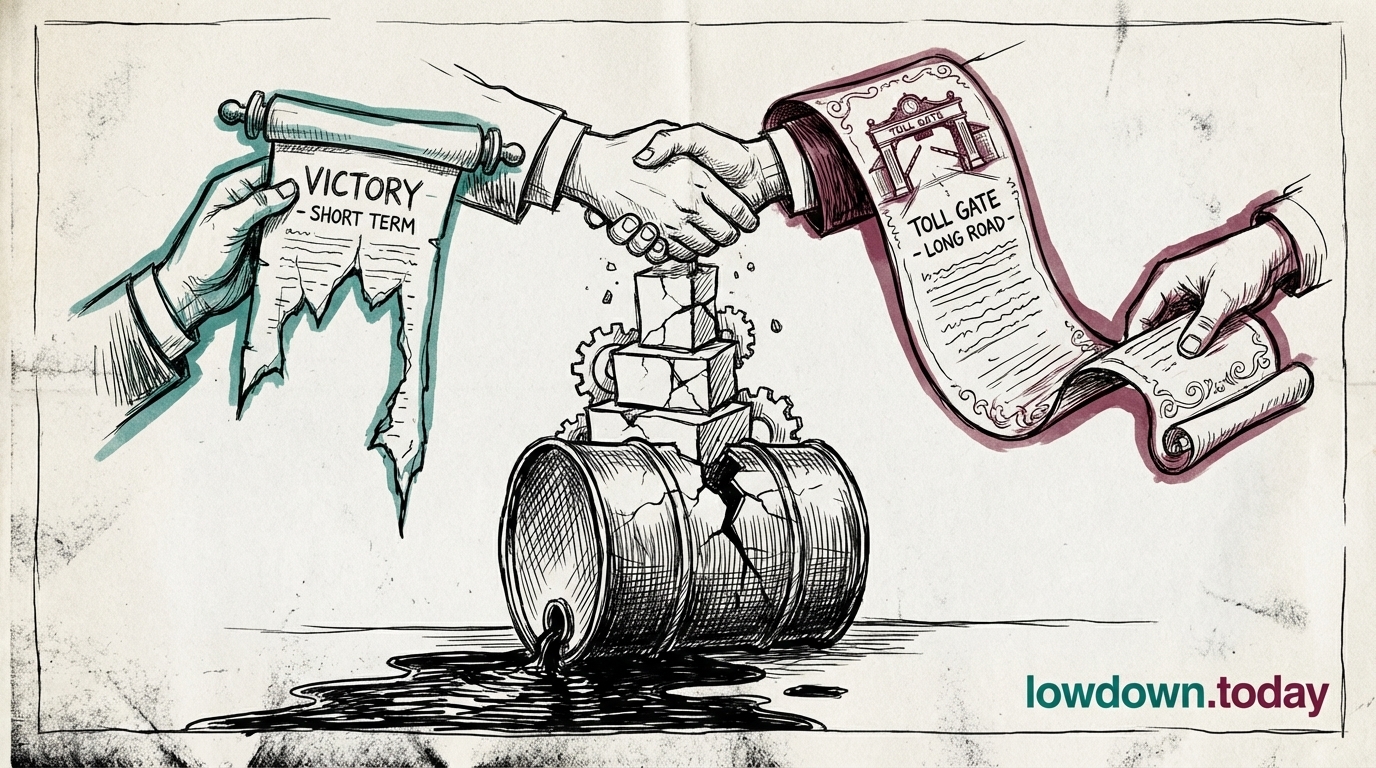
Israel's advance keeps setting facts on the ground the unsigned Lebanon framework cannot catch up to.

The Israel Defense Forces (IDF), Israel's military, announced on Friday 5 June that they had killed Hezbollah's chief engineer in a strike the previous week, and issued evacuation warnings for three villages in south Lebanon ahead of fresh airstrikes 1. Lowdown is not naming the engineer; the IDF gave a role, not an identity. Hezbollah is the Lebanese Shia paramilitary movement Israel has been pushing back through south Lebanon over recent weeks.

The killing and the warnings came one day after strikes killed at least 10 civilians in south Lebanon and one Israeli soldier on 4 June 2. Both sides took casualties on the very day the Washington Lebanon framework was announced, the ceasefire instrument Hezbollah rejected hours later . The advance that took Beaufort Castle above the Litani on 1 June and pushed toward the Zaharani, where Hezbollah's drone killed Staff Sergeant Adam Tzarfati , has not paused for the framework. IDF Chief of Staff Eyal Zamir said on 3 June there is no ceasefire for his forces, the same week a peacekeeper from UNIFIL (the UN Interim Force in Lebanon) was killed near Marjayoun.

The military facts and the diplomatic text are moving in opposite directions on the same ground. Each kilometre the IDF takes raises Israel's withdrawal price before any permanent text exists. Hezbollah's reading is the mirror image: a drone that kills a soldier at Israel's deepest penetration point is its argument that it can refuse the framework and still impose costs. A ceasefire that Israel will not honour for its own forces and Hezbollah will not sign is a framework neither party is treating as binding.

Deep Analysis

In plain English

The Israeli military (IDF) announced on 5 June that they had killed Hezbollah's chief engineer in a strike the previous week. An engineer in this context is not someone who builds bridges; this person designed and maintained Hezbollah's underground tunnel network in southern Lebanon, which Hezbollah spent roughly fifteen years and hundreds of millions of dollars constructing after the last major war in 2006. Losing this person matters because the tunnels are how Hezbollah moves fighters, weapons and communications out of sight of Israeli aircraft. On 4 June, the same day the US announced a ceasefire framework, Israeli strikes killed at least 10 civilians in south Lebanon and one Israeli soldier was killed. The IDF also issued warnings to three villages to evacuate ahead of further strikes. This advance followed the capture of Beaufort Castle (ID:3856) and the earlier push toward the Zaharani River where a soldier was killed (ID:3857). The fighting continued on the day of the ceasefire announcement, because the IDF's orders had not changed to include a stop.

Deep Analysis
Root Causes

The IDF's continued advance through 4-5 June, simultaneous with Washington's Lebanon framework announcement, reflects a structural command-level disconnect. IDF Chief of Staff Eyal Zamir declared on 3 June there was no ceasefire for his forces even as the Washington framework was being drafted.

This divergence is not tactical: the IDF operates under Israeli cabinet authorisation, and the cabinet's war-aims order has not changed to include a ceasefire horizon. The Washington framework is a US-brokered text that Israel signed diplomatically; it does not constitute an Israeli military standstill order.

The civilian casualty pattern in south Lebanon on 4 June, with at least 10 killed, reflects a second structural constraint: the IDF's evacuation-warning doctrine issues alerts for villages before strikes but does not pause operations while civilians comply. In south Lebanon, where road infrastructure is damaged and evacuation routes pass through active fire zones, the gap between warning and compliance can exceed the operational tempo.

What could happen next?
  • Consequence

    The killing of Hezbollah's chief engineer removes the primary person responsible for maintaining south Lebanon tunnel infrastructure at the moment ceasefire talks require Hezbollah to withdraw north of the Litani, where that same infrastructure would be handed over or destroyed.

  • Risk

    The simultaneous operation and diplomatic announcement on 4 June establishes a precedent that IDF ground operations run independently of White House-brokered ceasefire timelines, increasing Hezbollah's stated grounds for rejecting any framework that does not include a prior military standstill.

First Reported In

Update #118 · Hezbollah veto stalls Iran-US deal

Times of Israel· 5 Jun 2026
Read original
Different Perspectives
Markets
Markets
Brent crude rose 2.2 per cent to $96.34 on 10 June, reversing a 7 per cent weekly decline built on deal optimism, as the overnight exchange repriced the Strait of Hormuz risk premium in a single session. The move reflects transit-risk repricing rather than supply shock: Iran's exports had already collapsed to below 300,000 barrels per day.
Pakistan
Pakistan
Pakistan's Naqvi channel, the only mediation track carrying both civilian and military buy-in, was stress-tested by live ordnance within 48 hours of the 6-7 June Tehran visit. Whether Washington informed Islamabad of the imminent strike plan while Naqvi was in Tehran remains undisclosed, putting the channel's neutrality under scrutiny.
Kuwait
Kuwait
Kuwait hosted the third Iranian strike on its soil since the 3 June airport drone attack, with Ali Al Salem airbase targeted in the three-country salvo. Its recent $1.98 billion Anduril Anvil counter-drone purchase signals it is rearming rather than reconsidering its hosting posture.
Bahrain
Bahrain
Bahrain absorbed the IRGC barrage via PAC-3 intercepts with its magazine already at 87 per cent depletion and no resupply before 2027. Sounding air-raid sirens over Manama, it faced the intercept burden with the thinnest defensive stack in the Gulf coalition.
Jordan
Jordan
Jordan reported all five incoming missiles intercepted with no injuries and no damage, a clean defensive performance that strengthens Amman's case for staying in the Western coalition without escalating its own posture. It now sits on Iran's target list for the first time despite not being a party to the Abraham Accords confrontation.
Iran / IRGC
Iran / IRGC
Foreign Minister Araghchi posted on X that US forces should 'leave our region if you want to be safe' and framed the exchange as a US defeat, while the IRGC claimed 21 targets hit and an F-35 hangar destroyed. The claims serve a domestic and Arab-audience framing rather than a verified battle-damage assessment.