Skip to content
Welcome, thoughtbot's Giant Robots listeners!Start here
Iran Conflict 2026
8NOV

The dark fleet fakes an anchored ship

2 min read
19:56UTC

A sanctioned tanker loaded 1.87 million barrels at Kharg Island while faking an anchor-swing track that mimicked a parked ship, a spoof Windward says it had never documented before.

ConflictAssessed
Key takeaway

Iran's shadow tankers now fake the physics of anchoring, so only satellite imagery catches them loading crude.

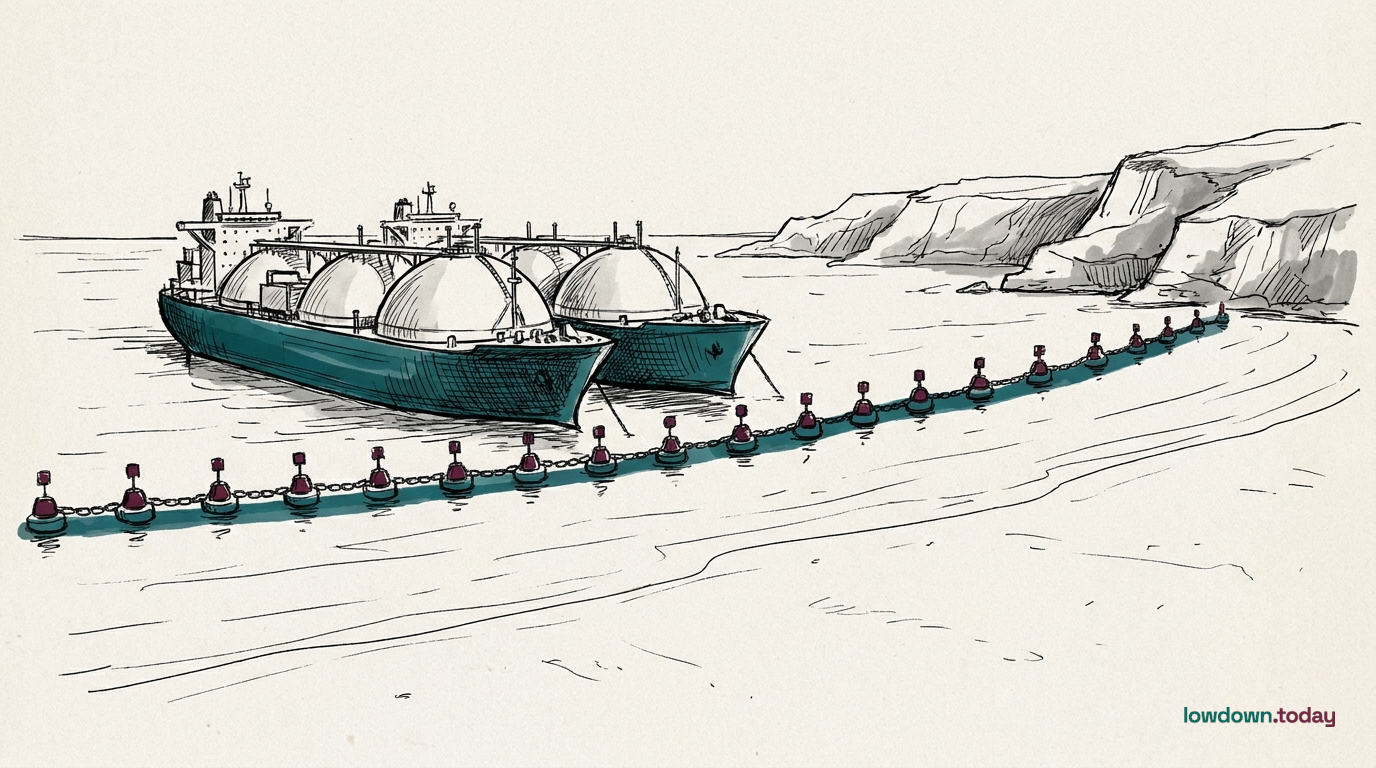
An OFAC-sanctioned Guyana-flagged VLCC, a Very Large Crude Carrier, loaded an assessed 1.87 million barrels of Iranian crude at Kharg Island between 23 June and 4 July while broadcasting a fabricated position, according to Windward maritime intelligence⁠1. Kharg Island is Iran's main crude export terminal, and a VLCC carries about two million barrels, so this is close to a full cargo moved under sanctions. Rather than transmit a static false location, the 333-metre tanker faked an anchorage track that swung asymmetrically around a fixed point some 57 nautical miles to the west, mimicking the natural yaw of a ship riding its anchor chain.

The spoof exploits the rule enforcers use to flag suspect ships. An AIS, the Automatic Identification System transponder every vessel broadcasts, that sits perfectly motionless reads as suspicious; a slowly swinging track reads instead as a hull turning on its anchor in the current, so the automated filter clears it. Windward says it had not seen the pattern before this loading, and the fake was caught only when electro-optical satellite imagery contradicted the broadcast. Detecting evasion at Kharg now needs a photograph, no longer a signal alone.

The economic war runs underneath the kinetic one. Crude keeps loading even as OFAC winds down the waiver that let buyers pay for it, the same authorisation under which Iran had opened crude talks with Japan a week earlier. As the legal route to Iranian oil narrows, the covert one is adding techniques faster than stationary-position detection can follow.

Deep Analysis

In plain English

Ships are supposed to broadcast their location using a tracking system called AIS, which sanctions enforcers use to see which tankers are moving sanctioned oil. This tanker, flagged in Guyana and already under US sanctions, faked its AIS signal to look like it was anchored and not moving, while it was actually loading more than a million barrels of Iranian oil at Kharg Island, Iran's main oil export terminal. Analysts only caught the deception by comparing the fake signal against satellite photos, a method not seen used against this kind of trick before.

Deep Analysis
Root Causes

The approaching 17 July hard deadline on General License X1 creates a closing window that rewards concealment now: a tanker loading visibly before 17 July still risks OFAC designation, so operators have an incentive to mask the loading itself rather than simply accept sanctions exposure after the fact.

Electro-optical satellite imagery, not AIS data, caught the spoof, exposing a structural gap in sanctions monitoring: any system relying on a vessel's own broadcast position can be defeated by a vessel willing to fake it, which is why Windward needed a second, independent data source to catch this pattern at all.

First Reported In

Update #150 · Second US strike wave, first heavy toll

IRNA· 9 Jul 2026
Read original →
Causes and effects
This Event
The dark fleet fakes an anchored ship
A novel spoof that defeats stationary-position tracking pushes sanctions enforcement toward costly satellite imagery for every suspect cargo.
Different Perspectives
Office for Budget Responsibility
The OBR's 28 October forecast assumed $82 oil for 2026 and 2027, from market prices for the ten working days to 19 August, and blamed dearer wholesale energy on the war without naming Iran. It expects CPI inflation close to 4% in early 2027 even at that price.
Hengaw, Kurdish rights group
Hengaw reported the 3 November hangings of Amirhossein Maleki and Amirhossein Ebrahimi in Isfahan, saying Ebrahimi was tortured into confessing and that nine of 12 people sentenced to death in the case have now been hanged. Iran's judiciary holds that the defendants killed members of the security forces.
FINTRAC, Canada's financial intelligence unit
FINTRAC worked with the US Treasury on the 6 November designation of eight money services businesses in British Columbia, Ontario and Quebec. Treasury says the businesses still operate, some under new names, so closing them falls to Ottawa.
Abdul Qadir al-Dakhil, Governor of Nineveh
Al-Dakhil cancelled three Mosul International Airport contracts on 7 November over alleged links to armed groups, after meeting Prime Minister Ali al-Zaidi in Baghdad. He named no group or company, and said the contracts will go to international companies.
Kuwait
Kuwait
Kuwait condemned the Houthi missile fired towards the Madinah region on 5 November and restated its support for Saudi Arabia, the Qatar News Agency reported. Its state tanker company, Kuwait Oil Tankers Company, is among the Gulf state fleets on Iran's expanded Hormuz list.
Scott Bessent, US Treasury Secretary
Treasury designated an alleged Chandigarh false-flag network on 4 November and eight Canadian exchangers on 6 November, while State sanctioned alleged MANPADS intermediaries. None of the actions touches an oil buyer; they target the paper, cash and procurement around Iran's trade.

Written with AI from Lowdown's published reporting. Not individually reviewed by an editor. Editorial standards.
