Skip to content
You can now search across every topic, entity and event.What's new
Iran Conflict 2026
23AUG

Khamenei backs deal, in language of leaving

3 min read
19:02UTC

Mojtaba Khamenei endorsed the US-Iran MOU in his first written message on 18 June, then branded the enemy's demands excessive and handed the deal's outcome to President Pezeshkian.

ConflictDeveloping
Key takeaway

Permission to negotiate arrived in the language of permission to leave.

Mojtaba Khamenei broke a written silence on Thursday 18 June, the day after the signing, with his first message to the nation since taking office 1. Unseen in public since 8 March and reachable only by sealed courier, Iran's Supreme Leader endorsed the US-Iran memorandum and stripped it of ideological weight in the same breath.

Future talks with the doshman, the enemy, "do not mean accepting its views", he wrote, and Iran will not yield to zeyadeh-khahi, excess demands. The original Farsi runs harder than the English summaries carried. Doshman is a formal designation in Iranian state discourse, not a turn of phrase, and its use signals that the negotiation is tolerated, not embraced.

Khamenei delegated accountability for the deal to President Masoud Pezeshkian, keeping his own name off the outcome. This is the leader his negotiators had told Washington approved the framework at the highest level . His authority rests on the Revolutionary Guard Corps rather than the clergy, and a written endorsement that brands the enemy's asks excessive is the cheapest way to satisfy hardliners while keeping the talks nominally alive. The same actor who approved the framework now frames its enforcement as overreach. The endorsement reads as permission to negotiate that doubles as permission to walk.

Deep Analysis

In plain English

Iran's Supreme Leader is the most powerful person in the country, above even the elected president. After the peace deal was signed, Mojtaba Khamenei published a message on 18 June backing it. But his backing came with important conditions. Khamenei used the Farsi word for enemy to describe the US and said that talking to the enemy does not mean agreeing with it. He placed all responsibility for how the deal turns out on President Masoud Pezeshkian. Under the Iranian constitution, this means Pezeshkian carries the political cost if the deal fails, and Khamenei remains insulated. No previous Supreme Leader had used this liability-transfer formula for a major diplomatic agreement.

Deep Analysis
Root Causes

The liability-transfer structure reflects the circumstances of Mojtaba Khamenei's appointment. Named Supreme Leader under IRGC pressure following his father's death on 28 February 2026, he has no independent religious authority base and communicates only through handwritten messages. His legitimacy rests on IRGC support, which means he cannot afford to own a deal the IRGC's Ahmad Vahidi opposes.

In Iranian state discourse, designating the US as doshman (enemy) rather than a softer term signals that negotiations carry no moral weight of reconciliation. Khamenei used the doshman label to signal to the IRGC hardline base that he was permitting the talks without validating them ideologically. This framing pre-empted IRGC criticism: Nahavian and the Paydari Front had already publicly opposed the MOU before Khamenei's statement arrived.

Pezeshkian formally accepted accountability for MOU outcomes on 18 June, mirroring the IRGC's own framing that Iran was negotiating from a position of strength. Pezeshkian must now deliver an outcome satisfying both that framing and US minimum demands, positions that may be structurally incompatible.

Escalation

Khamenei's liability-transfer posture reduces the risk of immediate MOU collapse (he has endorsed it) while increasing the risk of Phase 2 collapse (he has pre-classified US nuclear demands as excessive). The 60-day window for final agreement now runs against a Supreme Leader who has built himself a credible exit from any deal that touches the nuclear programme.

What could happen next?
  • Risk

    Khamenei's pre-classification of full IAEA access and stockpile transfer as excessive demands creates a structural collision with the MOU's stated nuclear obligations, making Phase 2 nuclear talks likely to fail on day one if the US presents those as minimum requirements.

    Short term · Assessed
  • Consequence

    Pezeshkian now carries political accountability for MOU outcomes he cannot deliver without IRGC consent, placing Iran's reform faction in an impossible position during Phase 2.

    Medium term · Assessed
  • Meaning

    The doshman framing in the statement is the first public use of that designation in a formal Supreme Leader communique since the war began, signalling that the MOU has not changed Tehran's ideological posture toward Washington.

    Immediate · Assessed
First Reported In

Update #132 · Trump lifted the blockade, not the strait

Sputnik Farsi / Times of Israel· 19 Jun 2026
Read original
Different Perspectives
Hizballah
Hizballah
Has not commented on the US Treasury's 20 August designation of ten people, including named couriers, over a cash network Treasury says moved money to it from the IRGC-Qods Force. ACLED recorded a sharp rise in attacks around it the same day.
Kuwait
Kuwait
Kuwait's Chief of the General Staff, Lieutenant General Khaled al-Shriaan, co-chaired the 16th US-Kuwait Joint Military Commission at the Pentagon on 21 August. Kuwait has not published what was agreed; only a summary of the meeting's existence and attendees is sourced.
Qatar
Qatar
Has not commented publicly on the $4.5bn KC-46A tanker Foreign Military Sale notification the State Department approved on 20 August. The notification opens a sale process; Doha has not confirmed whether it will proceed to a signed transfer.
Mohammad Bagher Ghalibaf
Told a Baghdad business meeting on 20 August that Iran will not endure a hungry population regardless of its military strength, against 87.9% point-to-point inflation and 128.1% food inflation for Tir. His fellow Majlis Economic Committee member Samsami separately warned a petrol price rise would ignite unrest.
US Navy
US Navy
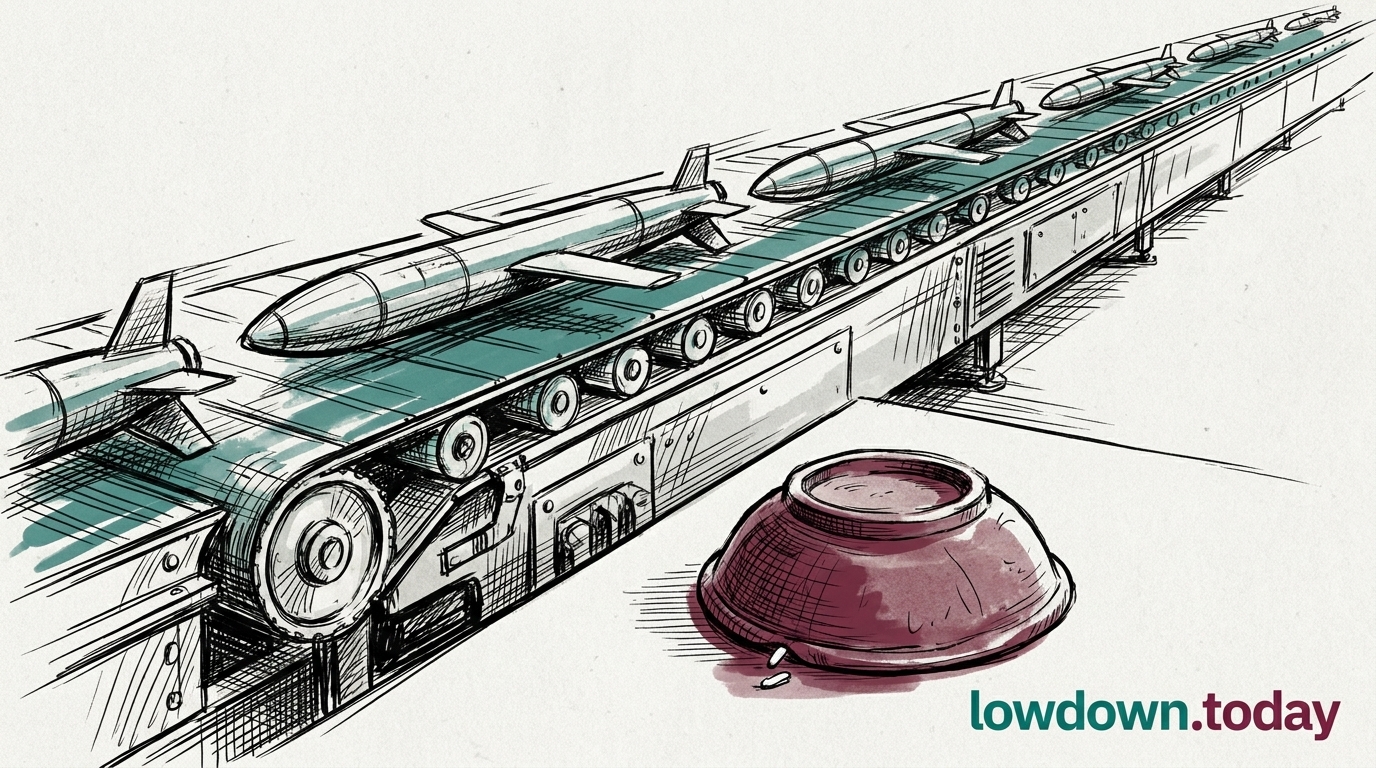
Signed a $22.9bn, seven-year contract with Raytheon on 17 August to raise Tomahawk output from about 60 a year to more than 1,000. The Acting Navy Secretary, quoted via an X post, framed it as the "Arsenal of Freedom" initiative; it replaces the 850 missiles fired by 1 April in about ten months at the new rate.
UK Maritime Trade Operations
UKMTO logged six armed men boarding a tanker 136 nautical miles east of Al Mukalla on 20 August and redirecting it toward Somalia. A vessel steered toward the Somali coast reads as an attempted seizure, a distinct hazard from the stand-off strikes the same lane has seen before.