Skip to content
You can now search across every topic, entity and event.What's new
Iran Conflict 2026
23AUG

Bruegel resolves refill bill at EUR 26bn

4 min read
19:02UTC

Bruegel published a three-scenario refill model on Thursday 23 April: EUR 26 billion at TTF EUR 45/MWh, EUR 35bn at EUR 60/MWh, EUR 44bn at EUR 75/MWh. With TTF settling at EUR 44.86 on 25 April, the operative number is the lower one.

ConflictDeveloping
Key takeaway

At TTF EUR 44.86, the operative refill cost is EUR 26bn; the EUR 35bn anchor is EUR 60/MWh territory.

Bruegel, the Brussels economic policy think tank, published a three-scenario refill model on Thursday 23 April: EUR 26 billion at EUR 45/MWh TTF, EUR 35 billion at EUR 60/MWh, and EUR 44 billion at EUR 75/MWh 1. With TTF settling at EUR 44.86/MWh on 25 April , the operative number is EUR 26 billion, EUR 9 billion below the figure that has anchored EU policy debate since update #288 .

This matters because the EUR 35 billion figure has been quoted in finance-minister letters and in the consumer-relief framing of the Commission's AccelerateEU package, which was published on 22 April with no storage injection mechanism. At today's TTF print, AccelerateEU's gap looks smaller than its critics costed it; desks short summer and long winter against an EUR 60/MWh case have been pricing roughly EUR 9 billion of phantom buyer demand.

Bruegel itself stops short of endorsing the package. The same paper recommends against price caps, windfall instruments, and ETS (the EU Emissions Trading System, the bloc's carbon market) weakening, and flags Spain's drop in gas-price-setting hours from 75% in 2019 to 15% in 2026 as evidence that demand-side adjustment is doing the work caps would distort. Bruegel also notes Qatar supplies only 4% of total EU gas imports and 8% of LNG imports, lower than commonly cited; US LNG carries two-thirds of EU LNG flow.

Spain's drop from 75% to 15% gas-set hours is what Bruegel uses to argue the policy position. When fewer than one in six Iberian power-market clearing intervals are set by gas, the marginal price-formation mechanism for EU electricity has migrated towards renewables and storage. A price cap on gas in 2026 hits a smaller fraction of European power-market hours than it would have in 2022. The EUR 26 billion case sits inside that picture; the EUR 35 billion case requires either a Hammerfest LNG overrun beyond 10 July or a renewed Hormuz escalation to land.

Deep Analysis

In plain English

Bruegel is a Brussels-based economics research institute whose analysis informs EU policymakers. On 23 April it published a three-scenario estimate for how much it will cost the EU to fill its gas storage from current levels to the target level by November 2026. The three scenarios depend on where gas prices go: EUR 26 billion if prices stay around EUR 45 per megawatt-hour (where they are now), EUR 35 billion if prices rise to EUR 60, and EUR 44 billion at EUR 75. Importantly, the EUR 35bn figure that has been widely cited in EU policy discussions was never Bruegel's base case, it was the middle scenario, which assumes prices significantly higher than today's.

Deep Analysis
Root Causes

The EUR 35bn anchor that dominated EU policy debate originated from Bruegel's initial modelling at EUR 60/MWh TTF, which was the forward curve midpoint in late March 2026 when AccelerateEU was being drafted. Commission officials anchored their refill cost framing to the middle scenario rather than the spot-price-at-time-of-calculation scenario, creating a policy cost estimate that was already EUR 9bn above the operative number by 25 April.

The underlying structural cause is that EU energy policy operates on a 2-3 month legislative cycle while commodity markets price continuously. Models frozen at a forward curve midpoint diverge from actual cost as prices move.

What could happen next?
  • Consequence

    Commission officials and finance ministers working from the EUR 35bn anchor are overstating refill costs by EUR 9bn at current TTF, which may lead to unnecessarily restrictive demand measures if the policy frame is not updated.

  • Precedent

    Bruegel's explicit recommendation against price caps, supported by the Spanish gas-price-setting hours data, strengthens the analytical case against the five-finance-minister windfall levy letter and sets a benchmark for Madrid Forum discussions.

First Reported In

Update #5 · Ban day muted; Germany doubles injection rate

Bruegel· 26 Apr 2026
Read original
Different Perspectives
Hizballah
Hizballah
Has not commented on the US Treasury's 20 August designation of ten people, including named couriers, over a cash network Treasury says moved money to it from the IRGC-Qods Force. ACLED recorded a sharp rise in attacks around it the same day.
Kuwait
Kuwait
Kuwait's Chief of the General Staff, Lieutenant General Khaled al-Shriaan, co-chaired the 16th US-Kuwait Joint Military Commission at the Pentagon on 21 August. Kuwait has not published what was agreed; only a summary of the meeting's existence and attendees is sourced.
Qatar
Qatar
Has not commented publicly on the $4.5bn KC-46A tanker Foreign Military Sale notification the State Department approved on 20 August. The notification opens a sale process; Doha has not confirmed whether it will proceed to a signed transfer.
Mohammad Bagher Ghalibaf
Told a Baghdad business meeting on 20 August that Iran will not endure a hungry population regardless of its military strength, against 87.9% point-to-point inflation and 128.1% food inflation for Tir. His fellow Majlis Economic Committee member Samsami separately warned a petrol price rise would ignite unrest.
US Navy
US Navy
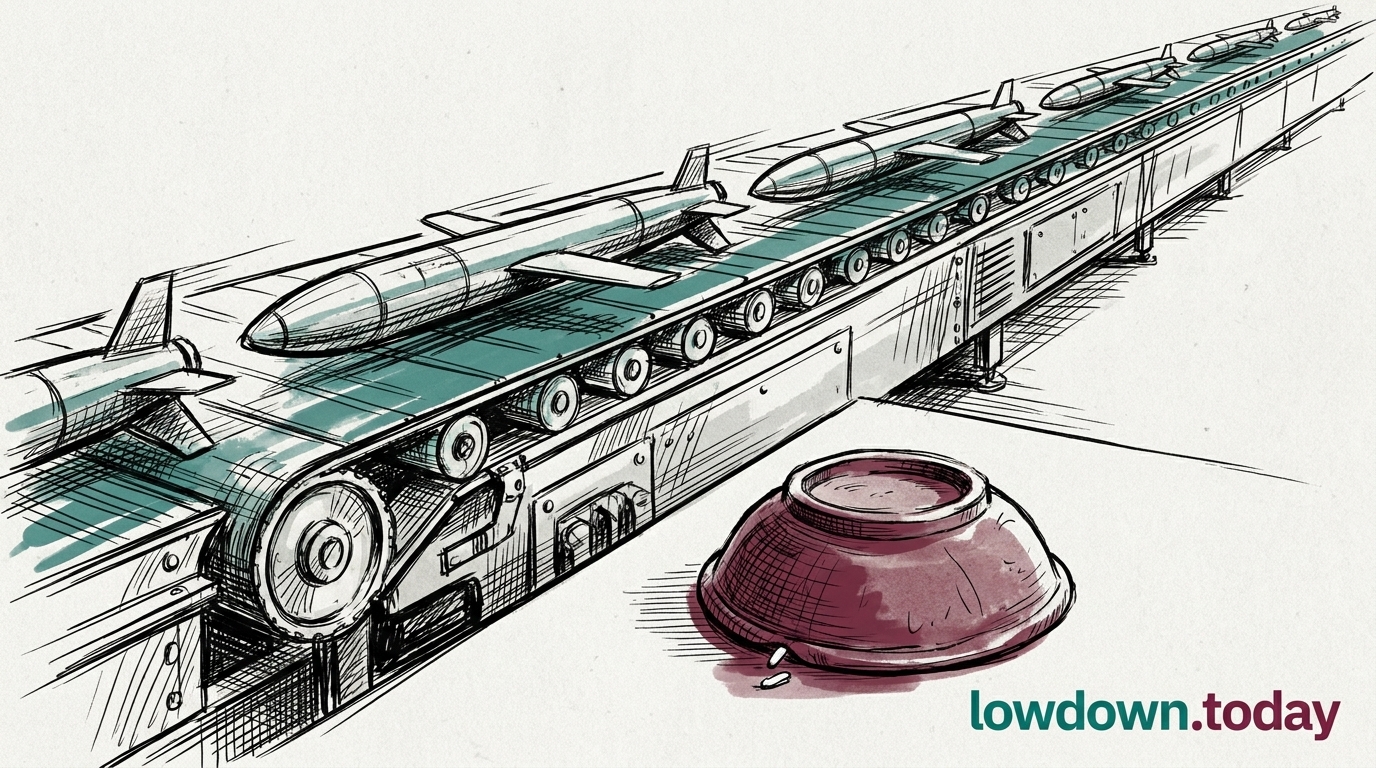
Signed a $22.9bn, seven-year contract with Raytheon on 17 August to raise Tomahawk output from about 60 a year to more than 1,000. The Acting Navy Secretary, quoted via an X post, framed it as the "Arsenal of Freedom" initiative; it replaces the 850 missiles fired by 1 April in about ten months at the new rate.
UK Maritime Trade Operations
UKMTO logged six armed men boarding a tanker 136 nautical miles east of Al Mukalla on 20 August and redirecting it toward Somalia. A vessel steered toward the Somali coast reads as an attempted seizure, a distinct hazard from the stand-off strikes the same lane has seen before.