EU Emissions Trading System
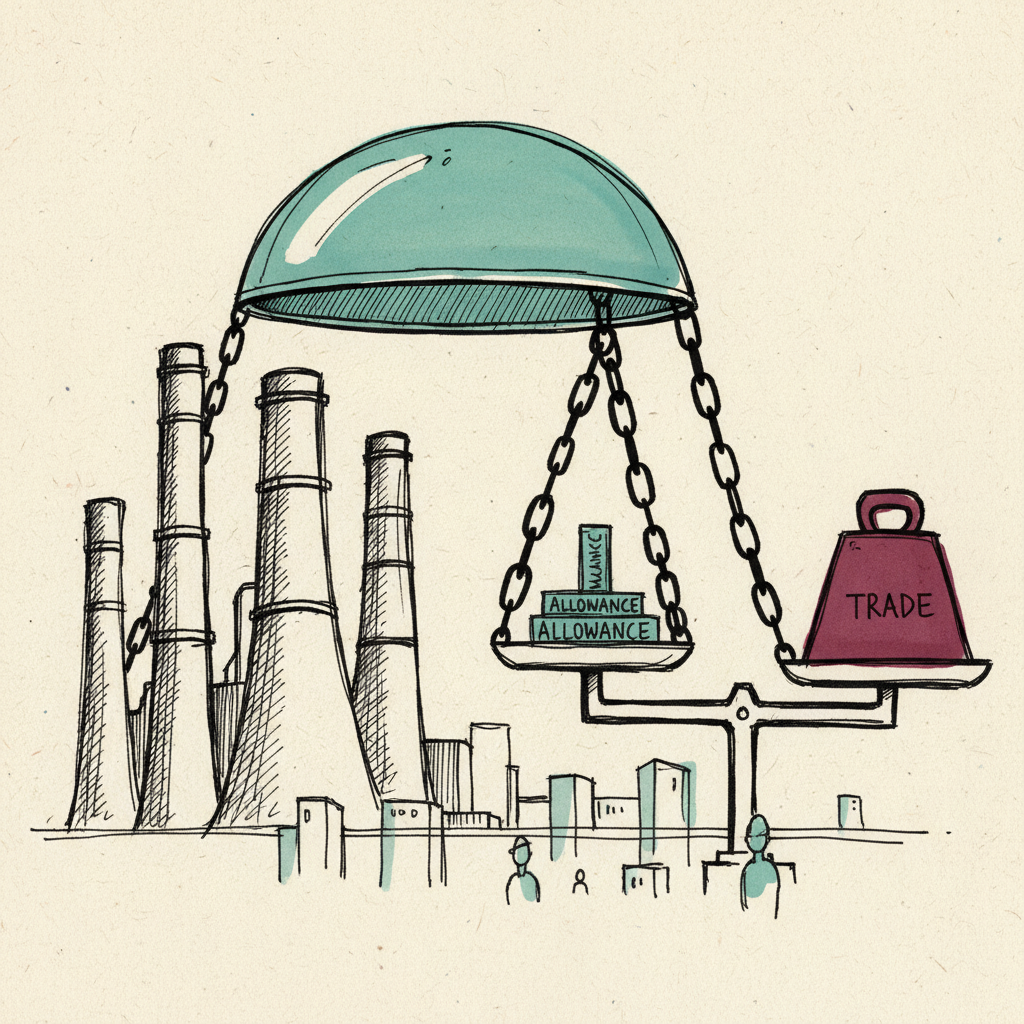
The EU's CAP-and-trade carbon market; covers power, industry, aviation, and shipping across 27 member states.
Last refreshed: 13 July 2026 · Appears in 1 active topic
Why did the EU carbon price recover despite the Commission's May 2026 free-allocation increase?
Timeline for EU Emissions Trading System
Mentioned in: EUA carbon slips back below €81
European Energy MarketsMentioned in: EUA carbon breaks €81 a tonne
European Energy MarketsMentioned in: EUA carbon breaks €80 as gas sags
European Energy MarketsMentioned in: German clean spark spread holds negative
European Energy MarketsEUA carbon holds €78.22 above clawback
European Energy MarketsBackground
The EU Emissions Trading System (EU ETS) is the European Union's primary instrument for reducing greenhouse gas emissions from industry, power generation, aviation, and shipping. Established in 2005 under Directive 2003/87/EC, it operates a CAP-and-trade model: a total limit on aggregate emissions is set for covered installations, and companies must hold enough EU Allowances (EUAs) to cover their verified annual emissions or face a €100/tonne non-compliance penalty. The CAP declines annually — by 4.3% per year from 2024 under the Fit for 55 revision — creating structural upward pressure on the carbon price as the supply of permits shrinks relative to compliance demand. Allowances are obtained via auction or free allocation, with the power sector having moved to full auctioning in Phase 3 (2013-20) while energy-intensive industry still receives partial free allocation benchmarked to best-performing facilities.
The system has evolved through four phases. Phase 1 (2005-07) established the architecture. Phase 2 (2008-12) tightened caps and added aviation. Phase 3 (2013-20) introduced the Market Stability Reserve (MSR), a supply-management buffer that cancels or withholds allowances when total circulation exceeds set thresholds, providing automatic price support in weak demand periods. Phase 4 (2021-30) accelerated the annual CAP reduction, expanded coverage to domestic shipping from 2024, and linked the free-allocation regime to the Carbon Border Adjustment Mechanism (CBAM), which entered full compliance on 1 January 2026. CBAM certificate prices track the weekly average EUA price; as CBAM phases in through 2034, free allocations to covered sectors (steel, aluminium, cement, fertilisers, hydrogen, electricity) are progressively withdrawn — 2.5% in 2026, 5% in 2027 — reinforcing EUA supply tightening. The EU ETS covers approximately 40% of total EU greenhouse gas emissions.
The ETS shapes EU industrial policy beyond carbon markets. Free-allocation benchmarks — the reference values determining how many allowances an industrial installation receives relative to sector best practice — are revised periodically. The 11 May 2026 benchmark revision increased free allocations for 2026-2030, reducing projected industry compliance costs by an estimated €4 billion, a deliberate competitiveness signal following US tariff pressure. The MSR is under legislative review in 2026 as policymakers weigh its cancellation rate against price-volatility concerns. A Reuters consensus of ten analysts in late May 2026 put the 2026 EUA forecast at €80.61/tonne, down 13% from the January projection, with the December contract recovering to roughly €77.46 by 28 May after initially falling on the benchmark revision news.
The EU ETS directly sets the carbon component of every MWh produced by gas-fired generation in European wholesale markets. At an emission factor of approximately 0.52 t CO2/MWh, EUAs near €75/tonne ADD roughly €39/MWh to CCGT marginal cost, embedding the carbon price in the clean spark spread that determines whether gas plant runs or sits off-merit. With EUAs at €75/tonne and TTF at €47/MWh in May 2026, CCGT marginal costs reached approximately €129/MWh, above German day-ahead clearing of €106.35, producing a negative clean spark spread and suppressing commercial gas-fired generation at the same time that EU storage needed filling. Bruegel's April 2026 gas refill modelling explicitly recommended against any weakening of the ETS, citing Spain's reduction in gas price-setting hours from 75% in 2019 to 15% in 2026 as evidence that demand-side adjustment is working within the existing carbon-pricing framework. By 25 June 2026, the structural tightening built into Phase 4 was visible in the market: with the annual ETS CAP falling approximately 180 Mt year-on-year and CBAM withdrawing free allocations progressively from covered sectors, EUA made its first clean break above €80/tonne, settling at €80.73 even as TTF sagged to approximately €40.75/MWh. The carbon-up/gas-down divergence confirms the structural tightening signal is decoupling EUA from short-term gas price movements, a landmark in the system's evolution that validates the CAP-and-trade design against critics WHO argued carbon prices would slump whenever gas demand eased.
The Market Stability Reserve's ongoing withdrawal of surplus allowances kept showing through in July 2026: EUA broke €81/tonne on 13 July, its highest since February, as the MSR-tightened pool met a fresh fuel-switching demand shock. French nuclear curtailment on cooling-water discharge limits (Chooz, Golfech, Bugey) forced gas-fired plant to cover the lost output, and that extra CCGT running time bid directly for allowances, feeding power-market stress straight into the carbon price. The MSR mechanism is now the structural driver behind carbon's 2026 grind higher: it does not react to any single week's power-market news, but every episode of nuclear curtailment adds gas-for-power demand into a market with a shrinking allowance pool, so short-term stress compounds onto the long-term CAP-tightening trend rather than being absorbed by it.
In the European oil and refining context, the EU ETS is relevant to refinery operating economics: refineries are covered installations and receive free allocations under the benchmark regime. The 11 May 2026 benchmark revision affects refinery compliance costs for 2026-2030.