Skip to content
You can now search across every topic, entity and event.What's new
Iran Conflict 2026
20AUG

Freight has not confirmed the spike

3 min read
16:36UTC

Brent traded near $79.16 on 13 July, its highest since 22 June, yet no dated VLCC rate or war-risk premium has printed to confirm the move physically.

ConflictDeveloping
Key takeaway

Brent's highest since 22 June rests on strait fear that freight has yet to confirm.

Brent traded near $79.16 and WTI $74.38 by Monday 13 July, the highest Brent since 22 June, after a fourth US strike on Iran in a week and Iran's Strait Authority declared vessels on unauthorised routes forfeit any safe-passage guarantee 12. The Strait of Hormuz, the 33km chokepoint carrying roughly a fifth of the world's oil, saw crossings thin to 6-9 vessels a day against a pre-war baseline near 130 3. The strike sits with the wider Iran conflict coverage; what it did to the physical balance and the spreads is what decides the P&L here.

The Brent-Dubai EFS, the exchange-for-swaps spread between the two crude grades and a gauge of Atlantic-versus-Gulf demand, stood at $4.24 on 8 July . No dated TD3C VLCC rate or war-risk premium for 10-13 July has printed since. On 22 June the TD3C forward held $181,163/day flat while Brent shed 8% , and war-risk cover sat at 3 to 4% of hull value .

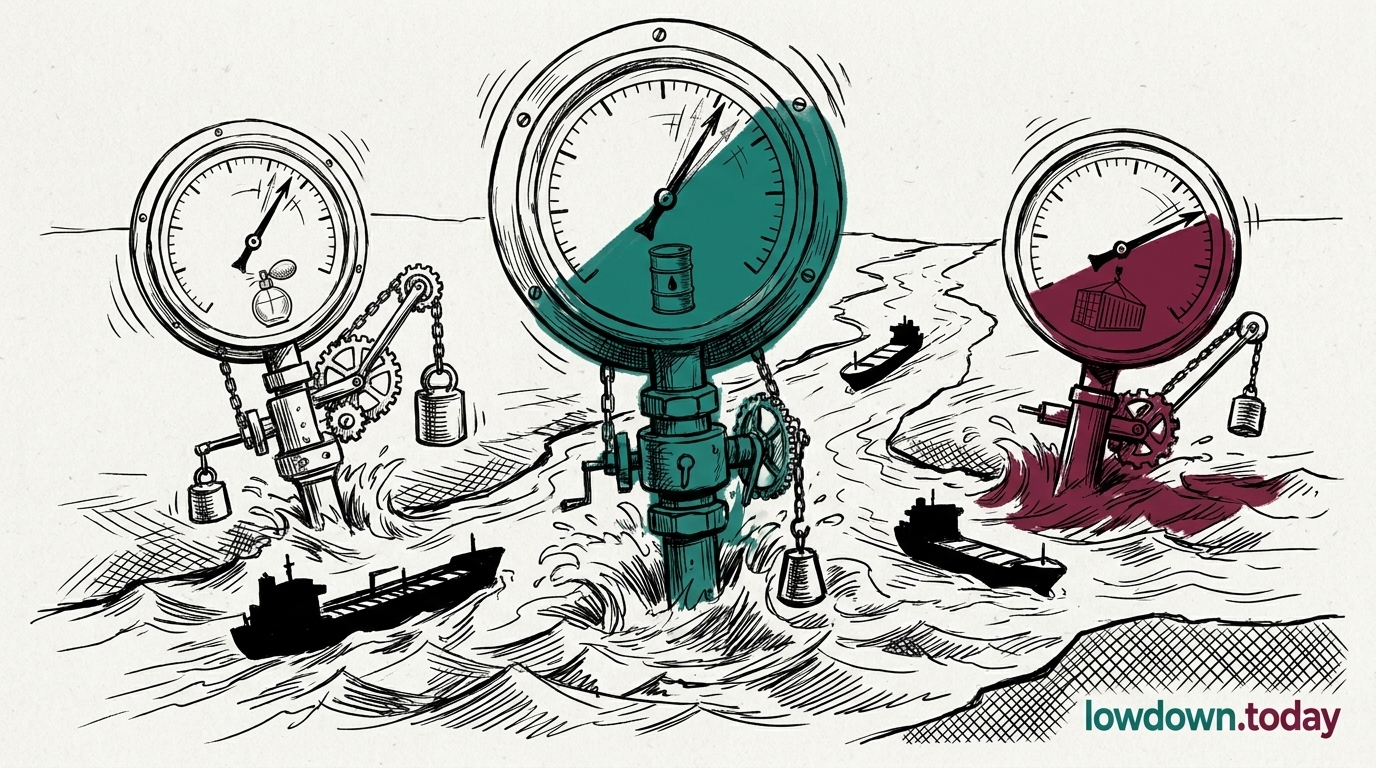
Freight is the desk's cleanest test of whether Hormuz risk is physical or paper. A rate that holds flat while flat price spikes says the tankers are still moving and the premium is on the screen, not on the water. Through 10-13 July it stayed silent, so the highest Brent since 22 June rests on strait-transit fear that the physical market has yet to ratify.

Deep Analysis

In plain English

The Strait of Hormuz is a narrow sea passage between Iran and Oman that roughly a fifth of the world's oil shipments pass through. After the US carried out its fourth strike on Iran in a week, Iran's Strait Authority said ships using routes it has not approved would lose any guarantee of safe passage. The number of vessels crossing the strait fell sharply, from a normal 18-22 a day to as few as 6-9. Oil prices jumped on the news. But 'freight rates', the price shipowners charge to move oil on tankers, and 'war-risk premiums', the extra insurance cost for sailing through a danger zone, had not yet been reported for this exact period, so it is not yet confirmed whether the disruption is showing up in the physical shipping market or only in oil's headline price.

Deep Analysis
Escalation

A fourth US strike in a week against Iran, alongside Iran's own safe-passage declaration, marks a step up in direct exchanges rather than proxy actions; watch whether a dated TD3C or war-risk print over the coming days confirms physical disruption, which would signal the conflict has moved from rhetoric to a genuinely constrained chokepoint.

What could happen next?
  • Risk

    If no dated TD3C or war-risk premium confirms the vessel-crossing collapse within the coming days, the current Brent premium risks being exposed as overpriced against the physical shipping reality, as happened on 22 June.

  • Precedent

    The 22 June divergence between flat TD3C freight and an 8% Brent fall (ID:4566) establishes a desk precedent that Hormuz-linked price moves have decoupled from physical freight before, cutting both directions.

First Reported In

Update #16 · Brent hit $79; the structure said no

Al Jazeera· 13 Jul 2026
Read original
Different Perspectives
UK Maritime Trade Operations
UKMTO logged six armed men boarding a tanker 136 nautical miles east of Al Mukalla on 20 August and redirecting it toward Somalia. A vessel steered toward the Somali coast reads as an attempted seizure, a distinct hazard from the stand-off strikes the same lane has seen before.
Mohammad Bagher Ghalibaf
Iran's Majlis speaker received Iraq's Hormuz carve-out request in Baghdad on 19 August, a request that treats passage as Tehran's to grant. Ghalibaf's authority over that grant sits alongside the Revolutionary Guard's separate transit rules, which have moved independently of Iran's foreign ministry before.
Haibat al-Halbousi
Haibat al-Halbousi
Iraq's parliament speaker asked Iran for special consideration on Iraqi Hormuz oil exports during Ghalibaf's 19 August Baghdad visit. Iraq presses the request from a weak position: Iran's central bank is simultaneously demanding Baghdad release Iranian reserves parked in Iraqi accounts.
Federal Department of Economic Affairs, Education and Research
Switzerland's economics ministry updated the Article 21 forms governing lawful Iran money transfers on 19 August, with only the revised forms accepted from 26 August. Bern operates one of the few remaining legal Iran payment channels and has just set a hard cutover on its control point.
Motegi Toshimitsu
Motegi Toshimitsu
Japan's foreign minister said in Muscat on 20 August that Tokyo wants closer coordination with Oman on safe Hormuz and Bab el-Mandeb passage. Japan has no naval presence of its own in the strait, so it is routing the ask through the state negotiating with Iran instead.
Badr bin Hamad Al Busaidi
Oman's foreign minister joined Japan's in Muscat on 20 August to call for intensified coordination on Hormuz and Bab el-Mandeb navigation. Oman also runs the mediation track with Tehran, so the appeal travels through the same channel as the negotiation.