Skip to content
You can now search across every topic, entity and event.What's new
Iran Conflict 2026
20AUG

Brent takes $90 on the ninth night

2 min read
16:36UTC

Kuwait's government said an Iranian strike had knocked generating units offline at a combined power and desalination plant; Brent settled $88.10 that Friday and took the $90 handle by Monday.

ConflictDeveloping
Key takeaway

Brent cleared $90 with freight and insurance confirming the move for the first time in this conflict.

Brent Crude settled $88.10 on Friday 17 July, up 4.6% on the day, after Kuwait's government said an Iranian strike had damaged a combined power-generation and water-desalination plant and taken a large number of generating units offline 1. By Monday 20 July, with US forces completing a ninth consecutive night of strikes on Iranian targets, September Brent traded above $90 and August West Texas Intermediate at $84.38 2.

Brent is the seaborne benchmark against which most crude landing in European refineries is priced; WTI settles into a landlocked tank farm at Cushing, Oklahoma. The gap between the two is the market's running estimate of what it costs to get a waterborne barrel out of a war zone, which is why the spread is worth more attention this week than either outright.

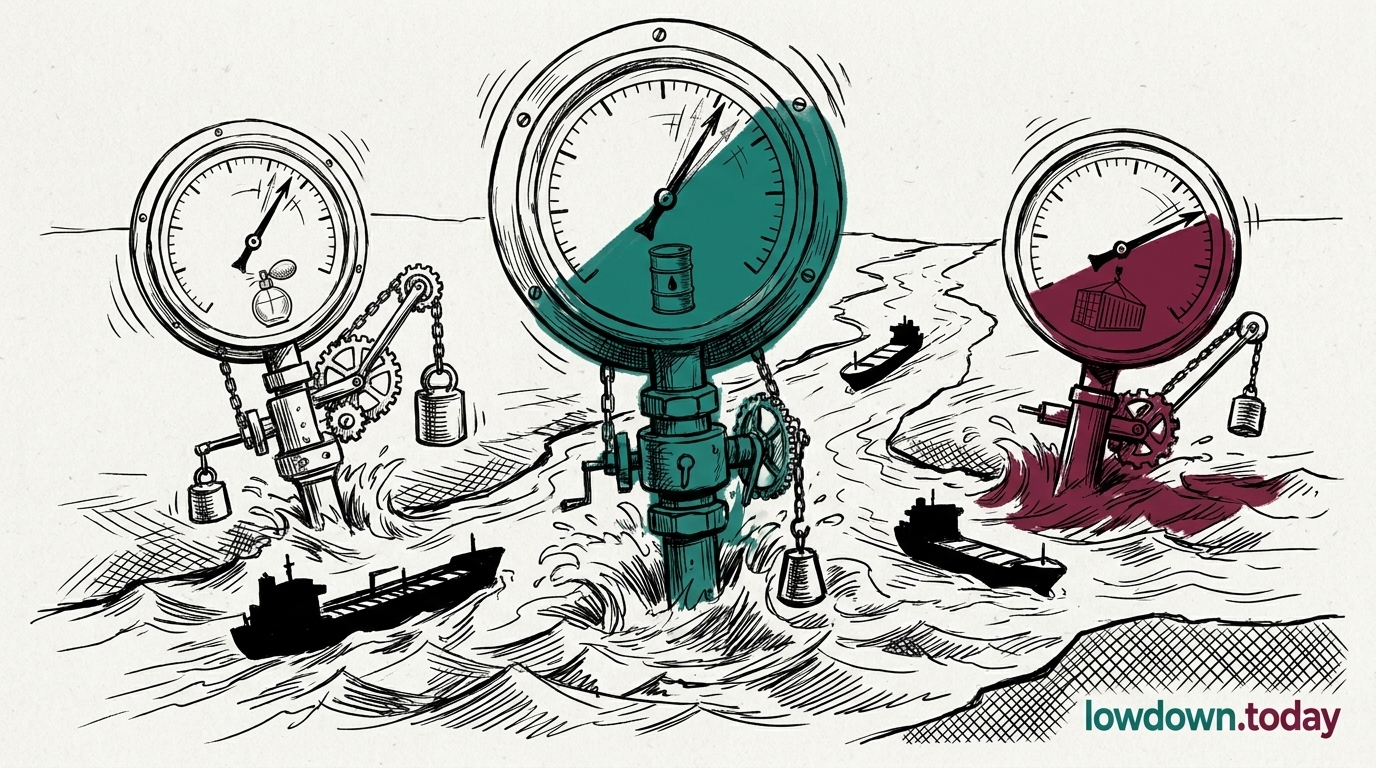
That spread widened to $5.61 on 17 July from $5.13 two days earlier , then held near $5.62 through Monday. Three sessions of escalation, and it stopped blowing out. The bid is being priced as a seaborne-delivery problem with a ceiling on it rather than an open-ended one. Cushing is inland; Strait of Hormuz cargoes are not, and the market has now put a number on that difference and left it there.

The Baltic Exchange freight assessment and London war-risk hull rates both repriced inside this same window, having sat out every flat-price move for the previous six weeks. Brent rose to $79.16 on a fourth US strike with tanker freight flatly refusing to confirm it . A flat-price rally that freight ignores retraces on the next communique. A rally that freight and war-risk underwriters have signed off on is embedded in landed cost until the loss record changes.

Deep Analysis

In plain English

Brent and WTI are the two main prices used to buy and sell oil around the world. Brent tracks oil that travels by sea, so it gets more expensive when ships face danger, like near the Strait of Hormuz between Iran and the Gulf states. WTI moves through pipelines in the US and does not face that risk. When Iran hit a Kuwaiti power plant on 17 July and the US kept bombing Iranian targets for a ninth straight night, sea-based Brent jumped further than land-based WTI, widening the gap between the two prices.

Deep Analysis
Root Causes

The spread's ceiling behaviour traces to a structural asymmetry, not sentiment: WTI delivers landlocked at Cushing, Oklahoma, so it carries no Strait of Hormuz exposure, while Brent prices cargo that must physically transit the 33km chokepoint.

The CFTC's Tuesday-cutoff, Friday-release cycle means the 17 July print already excluded the Kuwait strike that happened that same day, so the professional book the market is reading was stale before it was published.

What could happen next?
  • Consequence

    A Brent-WTI spread stabilising near $5.61-5.62 signals traders are pricing Hormuz risk as bounded rather than open-ended, which caps how far European fuel costs rise from this specific escalation.

  • Risk

    A further Hormuz casualty could push the spread past its current ceiling if underwriters treat it as evidence the risk band has shifted rather than plateaued.

First Reported In

Update #18 · Brent tops $90 and freight follows this time

CNBC· 20 Jul 2026
Read original
Different Perspectives
UK Maritime Trade Operations
UKMTO logged six armed men boarding a tanker 136 nautical miles east of Al Mukalla on 20 August and redirecting it toward Somalia. A vessel steered toward the Somali coast reads as an attempted seizure, a distinct hazard from the stand-off strikes the same lane has seen before.
Mohammad Bagher Ghalibaf
Iran's Majlis speaker received Iraq's Hormuz carve-out request in Baghdad on 19 August, a request that treats passage as Tehran's to grant. Ghalibaf's authority over that grant sits alongside the Revolutionary Guard's separate transit rules, which have moved independently of Iran's foreign ministry before.
Haibat al-Halbousi
Haibat al-Halbousi
Iraq's parliament speaker asked Iran for special consideration on Iraqi Hormuz oil exports during Ghalibaf's 19 August Baghdad visit. Iraq presses the request from a weak position: Iran's central bank is simultaneously demanding Baghdad release Iranian reserves parked in Iraqi accounts.
Federal Department of Economic Affairs, Education and Research
Switzerland's economics ministry updated the Article 21 forms governing lawful Iran money transfers on 19 August, with only the revised forms accepted from 26 August. Bern operates one of the few remaining legal Iran payment channels and has just set a hard cutover on its control point.
Motegi Toshimitsu
Motegi Toshimitsu
Japan's foreign minister said in Muscat on 20 August that Tokyo wants closer coordination with Oman on safe Hormuz and Bab el-Mandeb passage. Japan has no naval presence of its own in the strait, so it is routing the ask through the state negotiating with Iran instead.
Badr bin Hamad Al Busaidi
Oman's foreign minister joined Japan's in Muscat on 20 August to call for intensified coordination on Hormuz and Bab el-Mandeb navigation. Oman also runs the mediation track with Tehran, so the appeal travels through the same channel as the negotiation.