Skip to content
You can now search across every topic, entity and event.What's new
Iran Conflict 2026
23JUL

Iran airs AI Khamenei footage confirming gap

2 min read
19:27UTC

Iran's state broadcaster aired AI-generated footage of Mojtaba Khamenei in a war room because no authentic footage exists, a production choice that confirms rather than closes the gap.

ConflictDeveloping
Key takeaway

A state broadcasting AI footage of its leader confirms the footage gap, not fills it.

Iran state television broadcast an AI-generated video on Sunday showing Mojtaba Khamenei, Iran's Supreme Leader, entering a war room and surveying a map of Israel's Dimona nuclear research facility 1. No audio accompanied the footage.

If authentic footage existed, Tehran would use it. The production confirms the gap reported by the Soufan Center , which assessed that Khamenei is unconscious and unable to participate in decision-making, citing US and Israeli intelligence. The Times of Israel reported a competing assessment: disfigured but mentally sharp, taking part in meetings via audio conferencing. The Times of London described him as "incapacitated and receiving medical treatment in Qom." No in-person appearance has occurred since the 28 February strikes that killed his father, mother, wife, and son.

The operational consequences matter more than the health debate. Khamenei publicly authorised the ceasefire . If he cannot govern, the IRGC's 31 separate commands operate under the "Mosaic Defence Architecture" without centralised authority above them. Individual commanders can interpret ceasefire terms differently, refuse compliance, or escalate without authorisation.

Deep Analysis

In plain English

Iran's top leader is called the Supreme Leader. The current holder of that role is a man named Mojtaba Khamenei, who took the position in March 2026 after his father was killed in strikes. Think of the Supreme Leader as Iran's combination of head of state, commander-in-chief, and religious authority all in one. The problem is that Khamenei appears to have been seriously injured or incapacitated. There has been no verified footage of him since late February. When Iran's state television needed to show him, they used AI-generated video rather than real footage. There was no audio. Using a fake video of your own leader is significant because it tells you the real thing does not exist. If they had genuine footage of him looking healthy and in charge, they would use it. The AI video is a confirmation that they do not.

Deep Analysis
Root Causes

The AI video reflects a structural condition Iran's system was not designed to handle: a Supreme Leader incapacitated during active wartime. The 1979 constitution vests all armed forces command authority in the Supreme Leader personally; the Guardian Council's emergency provisions do not address a leader who is alive but non-functional.

The IRGC's mosaic defence architecture, comprising 31 semi-autonomous commands designed to survive decapitation, means the system can operate without central direction. It cannot, however, negotiate, authorise ceasefire terms, or make political commitments without a functioning Supreme Leader. The AI video is the regime's attempt to paper over a constitutional gap that has no formal resolution mechanism.

Escalation

The Khamenei incapacitation creates a diffuse escalation risk distinct from deliberate decision-making. The IRGC's 31 commands can interpret the ceasefire, the blockade, and Israeli actions in Lebanon through local command judgment rather than centralised authority. The risk is uncoordinated local responses that collectively breach the ceasefire without any single actor ordering it.

What could happen next?
  • Risk

    IRGC commands operating without centralised authority may breach ceasefire terms through uncoordinated local responses, producing escalation without a political decision behind it.

    Immediate · Medium
  • Consequence

    Any diplomatic commitment made by Iran, including the ceasefire Khamenei authorised, lacks verified executive authority, making it legally and politically contestable.

    Short term · Medium
  • Precedent

    Iran's use of AI-generated state media for a sitting head of state sets a precedent for synthetic political communication in authoritarian systems under wartime duress.

    Long term · Assessed
First Reported In

Update #67 · Trump blockades Iran on a tweet

Jerusalem Post· 13 Apr 2026
Read original
Different Perspectives
India
India
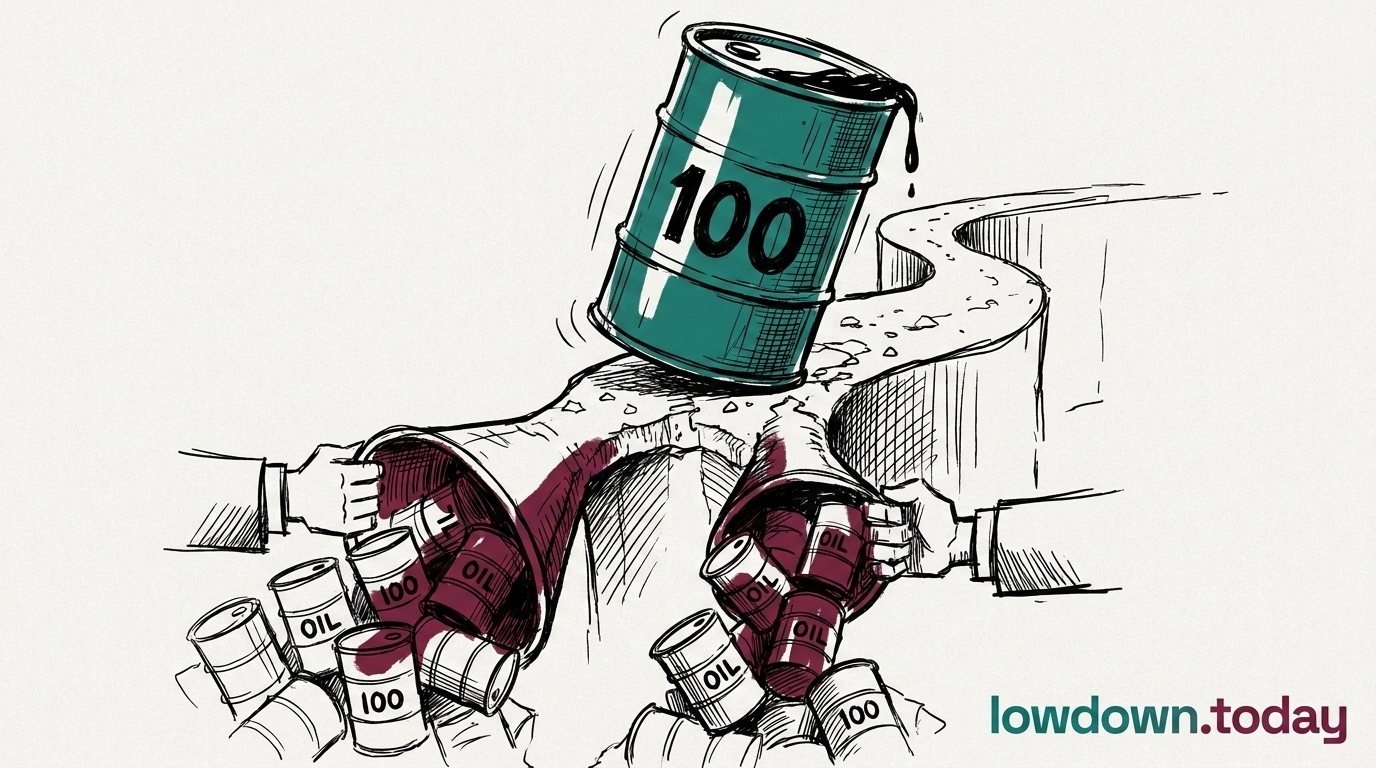
India buys more Saudi crude than any other country and has 2.5 million nationals working in the kingdom, so a $100 Brent and a live strike on Saudi tankers reach New Delhi through both fuel bills and remittance risk. Neither channel has an alternative route the way Saudi Arabia's own pipeline does.
Qatar
Qatar
Qatar co-authored the four-mediator ten-day ceasefire proposal alongside Egypt, Pakistan and Oman, centred on resuming Hormuz navigation, while separately pursuing its dated compensation claim against Iran at the UN Security Council filed on 21 July. Doha is mediating and litigating in the same week.
Israel
Israel
Israeli intelligence, reported by the Wall Street Journal, assesses Iran moved thousands of centrifuges and part of its roughly 440kg enriched-uranium stock into Pickaxe Mountain after the June 2025 strikes on its three main nuclear sites. Some of the US refuelling aircraft now deploying to the region are bound for Israeli bases and Ramon Airport.
Houthis
Houthis
Yahya Saree announced the missile and drone strikes on the Encelia and Layla on 22 July as enforcement of the embargo his forces had declared by radio warning alone two days earlier. Six vessels already turned back on the broadcast; the strike shows Houthi forces will use weapons once warnings stop working.
Saudi Arabia
Saudi Arabia
Saudi Arabia's state news agency confirmed only a fire on the Encelia's bow, with the crew safe; the Layla strike remains unconfirmed by Riyadh. The kingdom built its Petroline pipeline specifically to bypass Hormuz through the Red Sea, so the tanker fire lands on the route Riyadh had already spent billions escaping.
United States
United States
Washington is weighing both ten-day proposals but wants a longer truce than either offers, and moved F-16 and F-35 jets plus refuelling aircraft into the region while it decides. That deployment, not Trump's Pickaxe Mountain remarks, is the measurable US action, buying options for the day talks fail rather than betting on them.