Skip to content
You can now search across every topic, entity and event.What's new
Iran Conflict 2026
11JUL

ASML Q1 sales hold, China collapses to 19 per cent

4 min read
10:29UTC

ASML reported €8.8bn in Q1 2026 net sales on 15 April, but China's share of system shipments fell from 36 per cent in Q4 2025 to 19 per cent in a single quarter as tightened US DUV export restrictions bit.

ConflictDeveloping
Key takeaway

ASML's raised guidance cannot disguise the US export policy's structural reset of its R&D funding model.

ASML's Q1 2026 release from Veldhoven landed with: net sales of €8.8bn, net income of €2.8bn, gross margin of 53.0 per cent, and earnings of €7.15 per share. China accounted for 19 per cent of system sales in the quarter, down from 36 per cent in Q4 2025, a revenue drop of roughly €1.8bn driven by tightened US Deep Ultraviolet lithography export controls. ASML raised its full-year 2026 guidance to €36-40bn. The stock fell 6 per cent on results day, and a bipartisan group of US lawmakers proposed a bill within days of the report to tighten DUV sales to Chinese chipmakers further.

Chief Executive Christophe Fouquet said the 2026 guidance "accommodates potential outcomes of ongoing discussions around export controls", a phrasing that writes export policy into the company's forward numbers as a known risk rather than a contingent one. The raised guidance is the defensible counter-reading: underlying demand for EUV and qualified DUV tools remains strong enough to absorb a seventeen-percentage-point shift in geographic mix, and ASML's near-monopoly position on EUV production is not materially changed by a China revenue reset. On that view the share-price reaction prices political risk rather than operational weakness.

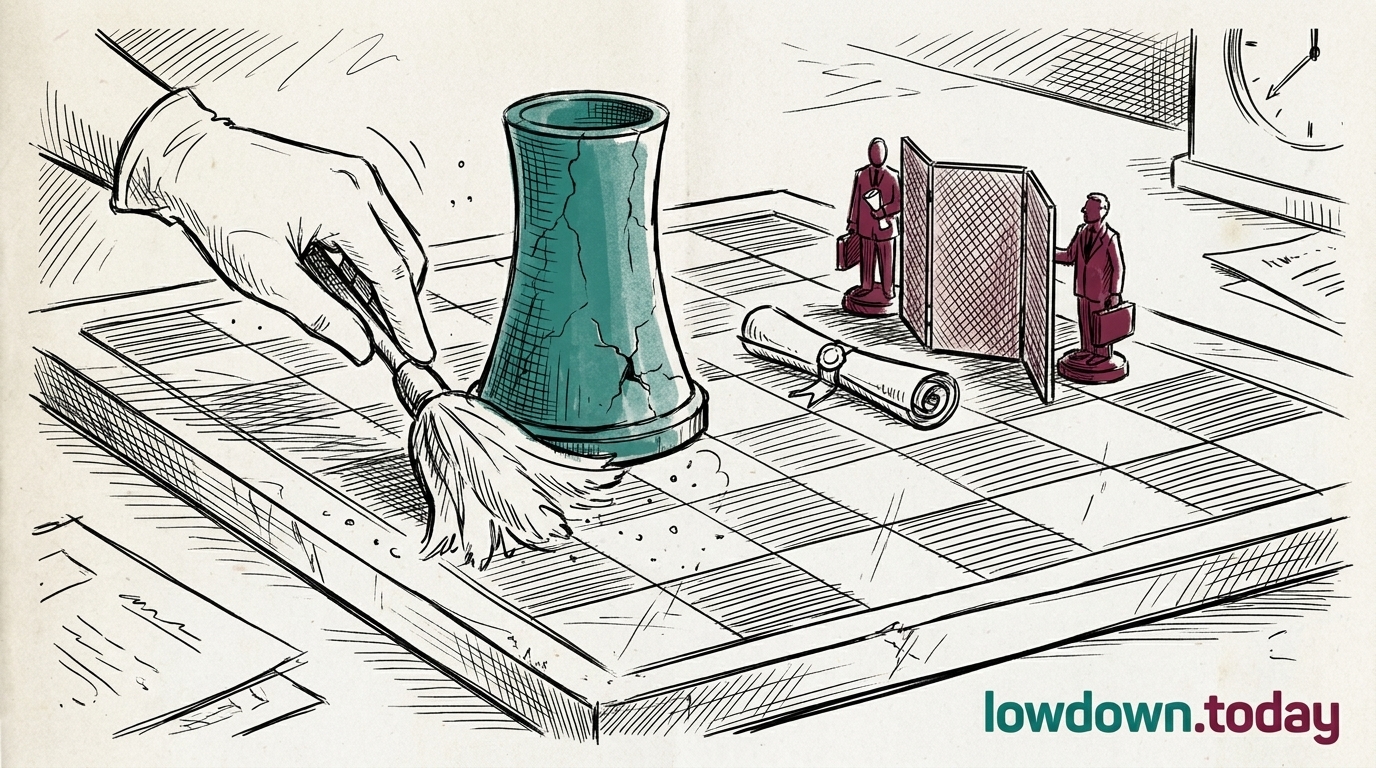
ASML's historical R&D funding model cross-subsidised leading-edge EUV development through mature-node DUV shipments, a significant share of which went to Chinese chipmakers. A seventeen-percentage-point shift in one quarter is a structural step-change rather than a trajectory, and if the proposed US bill becomes law the cross-subsidy shrinks further. European semiconductor sovereignty at the leading edge rests on a firm whose R&D cash flow is being reshaped by export controls set in Washington, and the Commission has no comparable capital instrument to replace the lost Chinese revenue inside the European industrial base .

Brussels has stopped restating the end-of-decade target of twenty per cent global semiconductor market share since the Intel Magdeburg cancellation and the GlobalFoundries Crolles suspension , and Italy's €211m photonic chips state aid is closer to a pivot than a replacement. With ASML's Chinese revenue thinning and no European alternative supplier of EUV scanners, the leading-edge layer of European semiconductor capacity now depends on a single firm whose quarterly numbers are a readout of US trade policy as much as of its own order book.

Deep Analysis

In plain English

ASML, based in the Netherlands, makes the machines that manufacture the world's most advanced computer chips. No other company makes the most advanced version of this equipment. The US has been restricting what ASML can sell to China, and those restrictions tightened in early 2026, meaning ASML sold far fewer machines to Chinese chipmakers than before, reducing China's share of ASML's revenue from 36 per cent to 19 per cent in a single quarter. The company's other customers in the US, South Korea and Taiwan are buying enough to keep overall revenue strong. The concern is that losing Chinese revenue reduces the cash available to develop the next generation of even more advanced machines.

First Reported In

Update #3 · Sovereignty summit, minus the sovereigns

ASML Investor Relations· 23 Apr 2026
Read original
Causes and effects
This Event
ASML Q1 sales hold, China collapses to 19 per cent
Europe's only leading-edge lithography supplier has lost roughly €1.8bn of quarterly Chinese revenue that historically cross-subsidised EUV research. A bipartisan US bill to tighten DUV rules further, proposed within days of the results, signals the decoupling is not yet complete.
Different Perspectives
Oil market and P&I insurers
Brent cleared $87 intraday only once CENTCOM's blockade became physical rather than declared, even though P&I Clubs had already excluded Hormuz war risk a week earlier on 7 July: capital hedged ahead of enforcement, but prices moved only after it.
UAE reporting
UAE reporting
UAE reporting placed the Omani tanker deaths at one seafarer against the International Maritime Agency's count of two, the first time in this war that a Gulf state's casualty figures have diverged from an international monitor's.
Jordan
Jordan
Iranian strikes reached Jordan again on 14 July as part of the Gulf-wide retaliation for the Hormuz blockade, extending the conflict's geographic footprint to a state with no direct stake in the strait itself.
Bahrain
Bahrain
Bahrain sounded air-raid sirens on 14 July during Iran's Gulf-wide retaliation, the same day CENTCOM's blockade order and fourth night of strikes pushed the conflict's physical reach into the wider Gulf littoral.
Kuwait
Kuwait
Kuwait intercepted Iranian missiles and drones on 14 July as Tehran's blockade retaliation reached Gulf states beyond Iran's immediate shoreline, confirming Kuwaiti airspace now sits inside Iran's retaliatory envelope.
Oman
Oman
Oman absorbed the war's first tanker casualties in its own waters on 14 July, with two supertankers disabled and seafarers killed, putting the sultanate's shipping lanes directly in the path of the blockade fight for the first time.