Skip to content
You can now search across every topic, entity and event.What's new
Iran Conflict 2026
28JUN

The dark fleet fakes an anchored ship

2 min read
12:05UTC

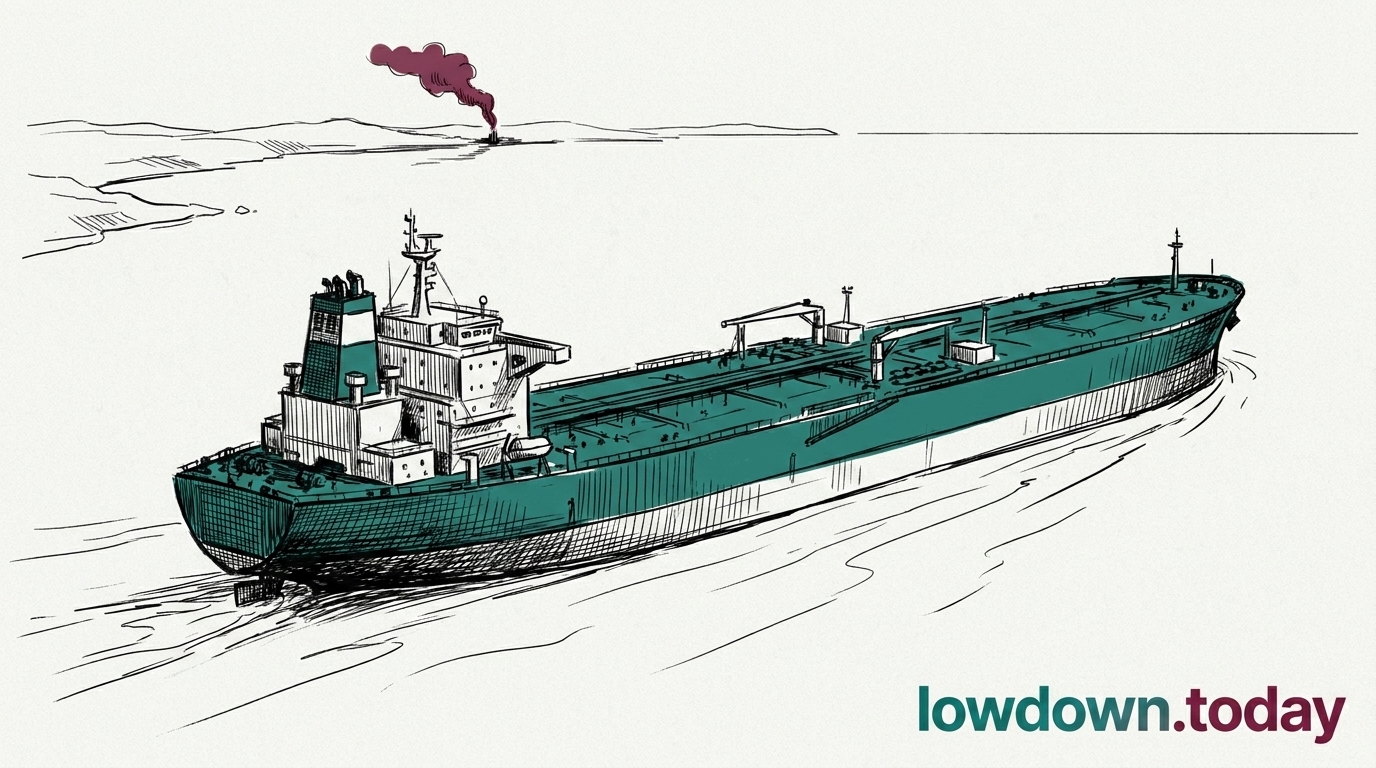
A sanctioned tanker loaded 1.87 million barrels at Kharg Island while faking an anchor-swing track that mimicked a parked ship, a spoof Windward says it had never documented before.

ConflictAssessed
Key takeaway

Iran's shadow tankers now fake the physics of anchoring, so only satellite imagery catches them loading crude.

An OFAC-sanctioned Guyana-flagged VLCC, a Very Large Crude Carrier, loaded an assessed 1.87 million barrels of Iranian crude at Kharg Island between 23 June and 4 July while broadcasting a fabricated position, according to Windward maritime intelligence 1. Kharg Island is Iran's main crude export terminal, and a VLCC carries about two million barrels, so this is close to a full cargo moved under sanctions. Rather than transmit a static false location, the 333-metre tanker faked an anchorage track that swung asymmetrically around a fixed point some 57 nautical miles to the west, mimicking the natural yaw of a ship riding its anchor chain.

The spoof exploits the rule enforcers use to flag suspect ships. An AIS, the Automatic Identification System transponder every vessel broadcasts, that sits perfectly motionless reads as suspicious; a slowly swinging track reads instead as a hull turning on its anchor in the current, so the automated filter clears it. Windward says it had not seen the pattern before this loading, and the fake was caught only when electro-optical satellite imagery contradicted the broadcast. Detecting evasion at Kharg now needs a photograph, no longer a signal alone.

The economic war runs underneath the kinetic one. Crude keeps loading even as OFAC winds down the waiver that let buyers pay for it , the same authorisation under which Iran had opened crude talks with Japan a week earlier . As the legal route to Iranian oil narrows, the covert one is adding techniques faster than stationary-position detection can follow.

Deep Analysis

In plain English

Ships are supposed to broadcast their location using a tracking system called AIS, which sanctions enforcers use to see which tankers are moving sanctioned oil. This tanker, flagged in Guyana and already under US sanctions, faked its AIS signal to look like it was anchored and not moving, while it was actually loading more than a million barrels of Iranian oil at Kharg Island, Iran's main oil export terminal. Analysts only caught the deception by comparing the fake signal against satellite photos, a method not seen used against this kind of trick before.

Deep Analysis
Root Causes

The approaching 17 July hard deadline on General License X1 creates a closing window that rewards concealment now: a tanker loading visibly before 17 July still risks OFAC designation, so operators have an incentive to mask the loading itself rather than simply accept sanctions exposure after the fact.

Electro-optical satellite imagery, not AIS data, caught the spoof, exposing a structural gap in sanctions monitoring: any system relying on a vessel's own broadcast position can be defeated by a vessel willing to fake it, which is why Windward needed a second, independent data source to catch this pattern at all.

First Reported In

Update #150 · Second US strike wave, first heavy toll

US Central Command· 9 Jul 2026
Read original
Causes and effects
This Event
The dark fleet fakes an anchored ship
A novel spoof that defeats stationary-position tracking pushes sanctions enforcement toward costly satellite imagery for every suspect cargo.
Different Perspectives
Oil market and P&I insurers
Brent cleared $87 intraday only once CENTCOM's blockade became physical rather than declared, even though P&I Clubs had already excluded Hormuz war risk a week earlier on 7 July: capital hedged ahead of enforcement, but prices moved only after it.
UAE reporting
UAE reporting
UAE reporting placed the Omani tanker deaths at one seafarer against the International Maritime Agency's count of two, the first time in this war that a Gulf state's casualty figures have diverged from an international monitor's.
Jordan
Jordan
Iranian strikes reached Jordan again on 14 July as part of the Gulf-wide retaliation for the Hormuz blockade, extending the conflict's geographic footprint to a state with no direct stake in the strait itself.
Bahrain
Bahrain
Bahrain sounded air-raid sirens on 14 July during Iran's Gulf-wide retaliation, the same day CENTCOM's blockade order and fourth night of strikes pushed the conflict's physical reach into the wider Gulf littoral.
Kuwait
Kuwait
Kuwait intercepted Iranian missiles and drones on 14 July as Tehran's blockade retaliation reached Gulf states beyond Iran's immediate shoreline, confirming Kuwaiti airspace now sits inside Iran's retaliatory envelope.
Oman
Oman
Oman absorbed the war's first tanker casualties in its own waters on 14 July, with two supertankers disabled and seafarers killed, putting the sultanate's shipping lanes directly in the path of the blockade fight for the first time.