Skip to content
You can now search across every topic, entity and event.What's new
Iran Conflict 2026
23JUN

VLCC forward freight stays 2x Atlantic

4 min read
11:42UTC

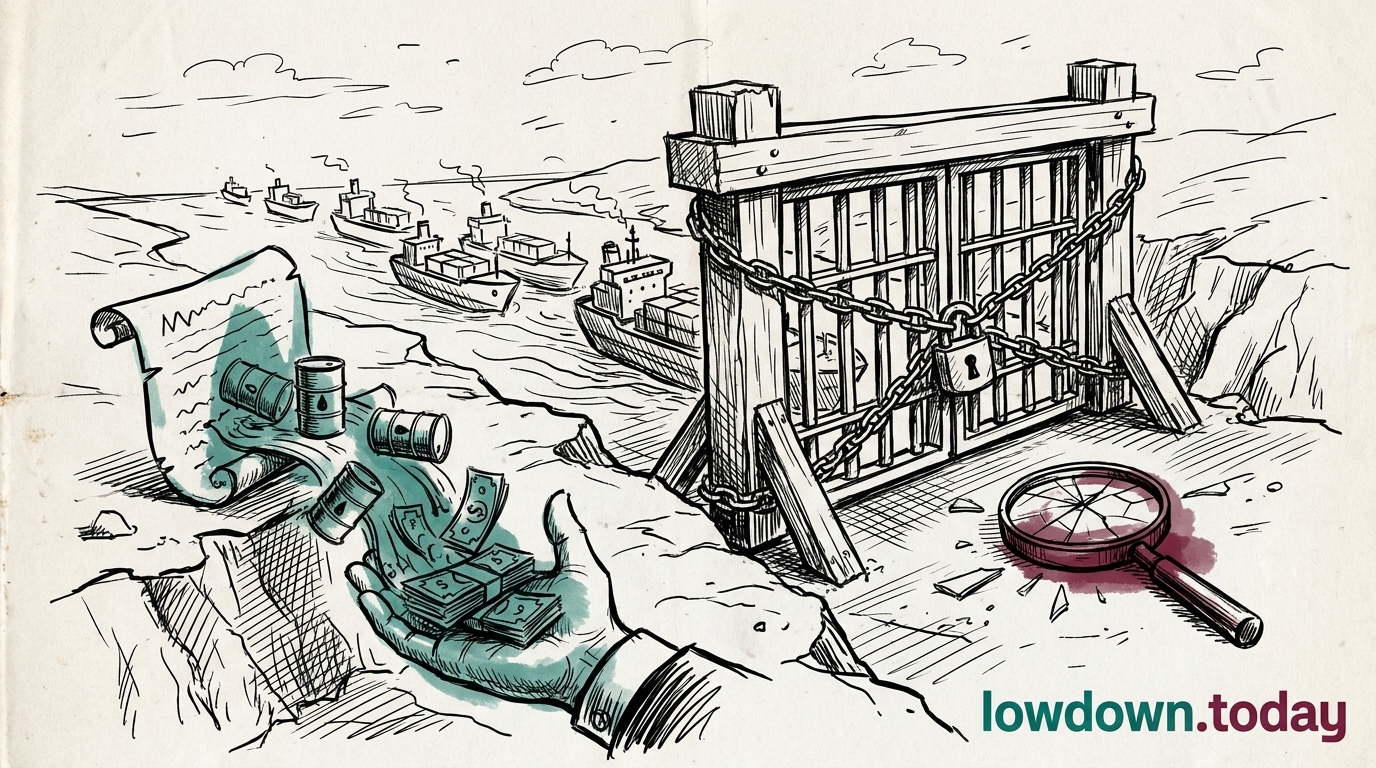
Lloyd's List assessed the TD3C Gulf-China VLCC 4Q26 forward freight near $181,163/day, roughly twice the US Gulf-China equivalent, a curve that refuses to price the clean Hormuz reopening the flat crude already booked.

ConflictAssessed
Key takeaway

Fourth-quarter Gulf VLCC freight at twice the Atlantic rate rejects the reopening the crude screen booked.

Lloyd's List assessed TD3C, the Baltic Exchange benchmark route for Very Large Crude Carriers from the Middle East Gulf to China, at a spot $412,888/day on 16 June, with the 4Q26 forward freight agreement near $181,163/day, roughly twice the US Gulf-China equivalent at $86,314/day 1. The dollar figures are assessed during a notional Hormuz closure rather than struck on actual fixtures; the load-bearing signal is the 2x MEG-to-Atlantic relationship, not the precise print.

A forward freight agreement is the freight market pricing the cost of moving a cargo months ahead, and this one is not decaying. The 4Q26 curve at twice the Atlantic basin is the shipping desk's own statement that it does not believe The Gulf disruption is over, even as flat crude prints three-month lows. The freight market priced the routing story more honestly than the crude screen, which front-ran a clean reopening the tonne-miles do not support.

The same physical scramble shows up closer to Europe. The Med Aframax bid that took TD19 to WS228 is the non-Hormuz sourcing scramble in the Mediterranean, paid for in the same tonne-miles. Crude flat price and forward freight are pricing two different futures: one a resolution, the other a sustained disruption. When they disagree this far, the freight curve is usually carrying the cargo the screen forgot.


Deep Analysis

In plain English

Shipping companies that carry oil in giant supertankers charge different prices depending on the route. The most important route for bringing Gulf oil to Asia is the Middle East to China run, priced on a benchmark called TD3C. A separate market lets traders buy and sell contracts for future shipping capacity on this route, called freight forward agreements (FFAs). Right now, the price for a supertanker on the Middle East-to-China route in the fourth quarter of 2026 is about twice what the same type of ship costs on the US-to-China route. That gap tells us the shipping market still expects the Middle East route to be disrupted or expensive well into late 2026, even though crude oil prices have fallen sharply on news of a potential peace deal. The crude oil price and the shipping market are giving opposite signals about how soon things will return to normal.

Deep Analysis
Root Causes

The 4Q26 FFA MEG premium over the Atlantic basin reflects two compounding structural factors: first, the Hormuz disruption has reoriented the global VLCC fleet toward longer voyages via Cape of Good Hope, reducing effective global VLCC supply and raising per-voyage freight costs on all routes; second, the MEG-China route is structurally more exposed to Hormuz than the US Gulf-China route, which loads from Houston, Corpus Christi, or offshore Gulf of Mexico without Hormuz transit.

The PGSA navigation-services toll represents a third, newer cost input embedded in the MEG route economics: any MEG-loading VLCC that transits the Strait of Hormuz now faces a toll of up to $2 million per vessel in yuan or stablecoins, adding approximately $0.50-0.70 per barrel on a 2 million-barrel VLCC cargo as a freight input that did not exist before May 2026.

First Reported In

Update #9 · Russia cliff landed while screens sold Iran

Lloyd's List· 18 Jun 2026
Read original
Different Perspectives
Turkiye
Turkiye
Erdogan followed the Pakistani delegation to Jeddah for an instrument that has not been signed. Ankara's entry widens Saudi Arabia's defence architecture beyond the existing Pakistan pact, adding a second non-Gulf military partner mid-conflict.
Oman
Oman
Muscat is the corridor's broker but has published nothing about the arrangement Fars describes on its behalf. The account leaves Oman administering outbound traffic only, a narrower role than the shared route its mediation has rested on since 1979.
Pakistan
Pakistan
Islamabad sent Sharif, Munir and Dar to Jeddah to widen a defence commitment it has honoured in cheaper registers since March, when Dar invoked the Saudi mutual defence pact. Jeddah tests whether that hedge becomes a binding trilateral instrument with Turkiye.
United States
United States
Washington rejected the Majlis Hormuz bill outright while CENTCOM's own tally kept climbing to 49 vessels redirected since 14 July. Both instruments tightened in the same week Trump promised the strait would reopen soon.
Iran
Iran
Iran's foreign ministry is selling a phased Hormuz corridor through Oman and denying any percentage cargo tariff, while its own Majlis is legislating fines to 20% and a bar on Israeli-linked cargo. The two accounts, from the same government, do not agree with each other.
Saudi Arabia
Saudi Arabia
Riyadh published a target forecast, not an attribution, for the campaign it says the Najran strike previewed. That keeps an Article 51 case available while it formalises a trilateral defence architecture with Pakistan and Turkiye.



