Skip to content
You can now search across every topic, entity and event.What's new
Iran Conflict 2026
21JUN

War-risk cover sets a hidden cost floor

2 min read
17:51UTC

Western war-risk insurance has returned to the Gulf at 3 to 4% of hull value against 0.25% before the war, adding roughly a dollar to a dollar fifty a barrel to every VLCC cargo and setting a cost floor flat Brent does not show.

ConflictDeveloping
Key takeaway

Returning war-risk cover embeds a dollar-plus-per-barrel cost floor on Gulf cargoes that flat Brent does not show.

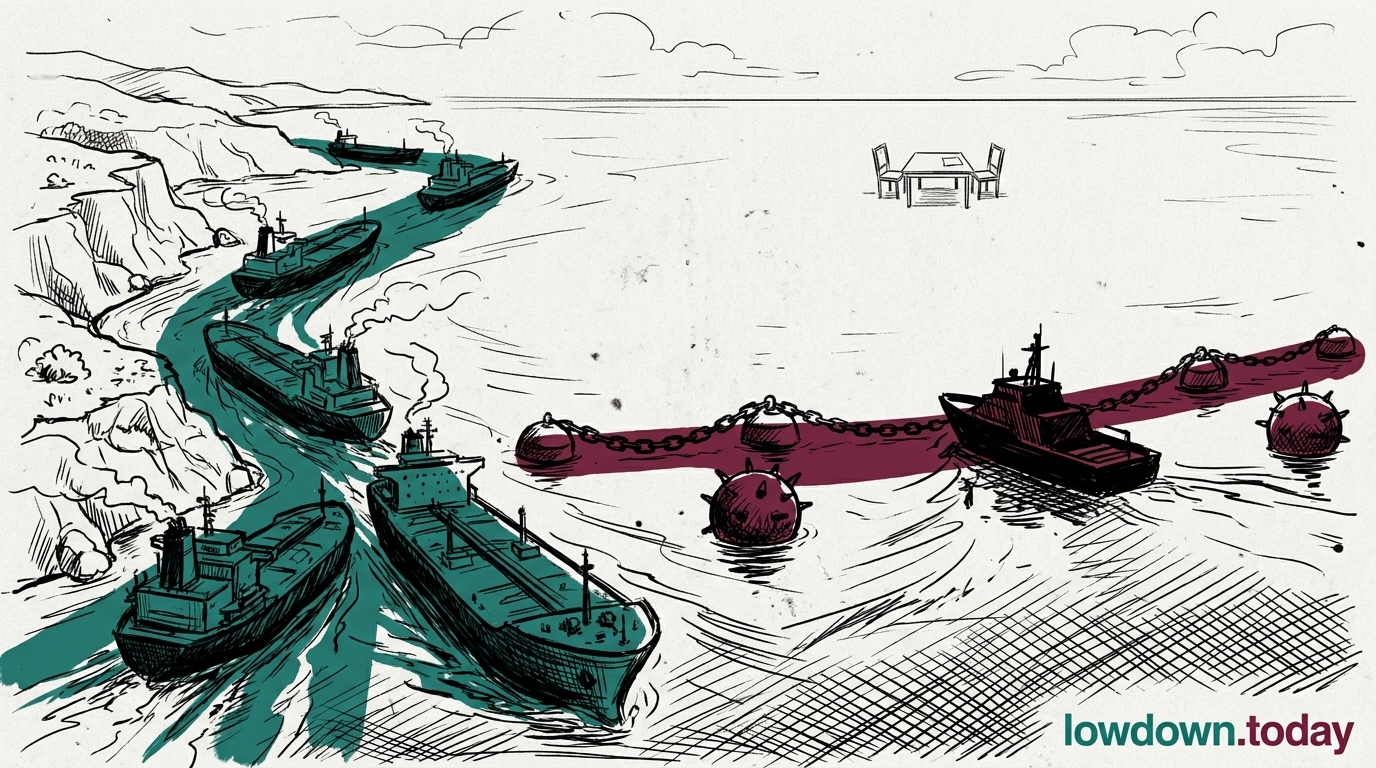
Western marine war-risk cover returned to The Gulf shipping corridor at 3 to 4% of hull value by 22 June, against 0.25% before the conflict, twelve to sixteen times the pre-war rate 1. War-risk insurance is the premium underwriters charge to cover a vessel crossing a conflict zone; at these levels the loading alone adds roughly $1 to $1.50 a barrel to the all-in delivered cost of a VLCC cargo. Mine clearance through Hormuz has not officially begun .

The transit counts and the mine-clearance timeline are the Iran desk's beat . A European freight desk carries the insurance loading directly, embedding a premium of a dollar or more a barrel into the delivered cost of every Gulf cargo. The flat Brent screen does not register that floor for eastern buyers, even as the screen treats the crisis as closed.

That embedded cost is part of why the forward freight curve has stayed anchored while the flat price fell: the tanker market is pricing the insurance and the physical risk, not the diplomacy. An insurance market still charging a war-risk multiple of this size is not one that believes the reopening is complete.


Deep Analysis

In plain English

Before a commercial tanker can sail, it needs two types of insurance. A hull and machinery policy pays the shipowner for physical damage to or total loss of the vessel. Protection and Indemnity (P&I) insurance pays for liability to third parties: crew injury, fuel spills, and damage to other vessels or port infrastructure. Banks that finance vessels and ports that accept them both require valid certificates for both types. Before the Hormuz conflict, war-risk insurance for Gulf transits cost roughly 0.25% of a vessel's hull value per voyage. On a large crude tanker worth $120 million, that was around $300,000 per crossing. This week, war-risk cover returned to the Gulf corridor at 3-4% of hull value, and P&I clubs have not yet reinstated standard terms for Hormuz transits at all. At 3-4%, the same $120 million tanker now carries $3.6 to $4.8 million in war-risk cost per voyage, translating to roughly $1-1.50 for each of the 2 million barrels on board. This extra cost does not show up in the $73 Brent crude price on the screen, but it is being paid by the buyers of Gulf crude on top of the headline price.

Deep Analysis
Root Causes

The 3-4% hull rate traces to three specific underwriting inputs that remain unresolved. First, the Lloyd's JWC "Additional Premiums" designation requires 30 consecutive days without a maritime incident in the listed area before a formal delisting review can begin; with 43 vessels still unaccounted for between CENTCOM and Kpler tracking as of 22 June, the JWC cannot start its 30-day incident-free clock because vessel status cannot be confirmed.

Standard P&I, North P&I, Gard, and Steamship Mutual have each issued Gulf withdrawal notices; without P&I cover a tanker cannot legally operate in any port requiring a valid club certificate.

Hull insurance pays for the vessel's physical structure; P&I pays for crew liability, pollution, and third-party damage, and no major bank financing a vessel will waive P&I as a loan covenant condition. A tanker operator who self-insures the hull still cannot satisfy port entry requirements or lender covenants without club membership.

Third, the 2023 Scandinavian Reinsurance Company (RNRC) precedent for Russian crude provides a structural parallel: after Western P&I clubs withdrew from Russian crude cargoes in 2022, Russia moved approximately 40 vessels to RNRC cover within three weeks; however, RNRC's capital reserves were insufficient to cover a catastrophic hull loss event, which is exactly the scenario P&I clubs are pricing at Hormuz.

The same capital-adequacy constraint applies to any non-Lloyd's substitute attempting to cover 270,000-tonne VLCC hull exposure in an active-conflict zone.

First Reported In

Update #11 · Crude longs flushed flat into a loaded week

Marine Insight· 26 Jun 2026
Read original
Different Perspectives
Hengaw
Hengaw
The Norway-based monitoring group reported the Urmia executions of Omid Behzad and Pouria Safvat, the only source to do so, consistent with its documented pattern of recording far more executions than the Iranian state acknowledges. Iran's government has not confirmed either execution.
Shipping and insurance underwriters
War-risk premiums price the Houthi campaign because the group announces its targets in advance, but a reopening Trump has promised without a published text gives underwriters no benchmark to reprice Hormuz cover against. Insurers want a text before they move rates, not a promise.
Houthi movement
Houthi movement
Spokesman Yahya Saree claimed strikes on two tankers in the Red Sea and Gulf of Aden on 5 August, only one of which UKMTO could confirm. The group's campaign against shipping continues on its own schedule, independent of any Hormuz arrangement further north.
Oman
Oman
Muscat has brokered the coordinates both Tehran and Washington's wire sources now describe differently, but has published no account of its own. Oman's position depends on treating Hormuz as a shared route, which is not what Iran is currently describing.
United States Central Command
CENTCOM raised its interdiction tally from 35 to 44 redirected vessels and disclosed its first boardings on 3 August, the day before Trump promised a reopening. The command's own enforcement record does not yet reflect the release the President has described.
Iran's Foreign Ministry
Spokesman Esmaeil Baghaei described the agreed Hormuz coordinates as a wholly new corridor under Iranian management, not a split of the existing route, days after his own deputy rejected Oman's lane proposal. Tehran wants the arrangement read as a change of ownership, not a compromise on access.



