Skip to content
You can now search across every topic, entity and event.What's new
Iran Conflict 2026
21JUN

Hezbollah strikes IDF base in Haifa

2 min read
17:51UTC

A Hezbollah strike on an IDF base in Haifa — with precision the group lacked in 2006 — drew massive Israeli retaliation and talk of a ground invasion that would stretch the IDF across three simultaneous wars.

ConflictDeveloping
Key takeaway

Striking an IDF military installation rather than civilian infrastructure is a deliberate doctrinal signal — demonstrating precision capability while maintaining Lebanese domestic political cover — but that same precision capability makes Hezbollah's missile units the IDF's highest-priority pre-emption targets.

Hezbollah struck an IDF base in Haifa overnight. Israel responded within hours, hitting Beirut's Dahieh district with at least 12 explosions that killed 31 people and wounded 149 . Mohammad Raad, head of Hezbollah's parliamentary bloc, was reportedly among the dead .

In the 2006 Lebanon War, Hezbollah fired unguided rockets into Haifa, hitting a rail depot, residential buildings, and a hospital. Striking a specific military installation suggests a different order of targeting capability. The IDF responded by declaring "no immunity" for any Hezbollah official, military figure, or supporter , and senior Israeli officials began openly discussing a ground invasion . The Times of Israel reported that Netanyahu told his cabinet Trump had authorised a new offensive against Hezbollah.

If a ground operation materialises, Israel will be fighting simultaneously in Iran, Gaza, and Lebanon. The last time the IDF fought on multiple fronts was the 1973 Yom Kippur War, a two-front conflict against Egypt and Syria that brought Israel closer to strategic defeat than at any point in its history. That was two fronts, not three.

In 2006, a 34-day war confined to Lebanon alone cost Israel 121 soldiers killed and ended with Hezbollah claiming survival as victory. The IDF's own Winograd Commission found the operation suffered from unclear objectives and underestimation of the adversary. No Israeli official has yet articulated what a ground campaign in Lebanon would achieve that air strikes have not, or how the IDF would sustain a third theatre while prosecuting the air war over Iran and maintaining operations in Gaza.


Deep Analysis

In plain English

Hezbollah fired a guided missile at an Israeli military base in Haifa, a major city roughly 100 kilometres from Lebanon. This is significant on two levels: first, Hezbollah can now accurately hit targets that far into Israel — this is not random rocket fire but a guided weapon striking a specific military installation. Second, by choosing a military base rather than a civilian area, Hezbollah is sending a calculated message: 'we can hit you hard and precisely, but we are not targeting civilians.' It is a demonstration of capability designed to deter an Israeli ground offensive without giving Israel the civilian-casualty pretext to justify one.

Deep Analysis
Synthesis

The Haifa strike reveals a strategic paradox: Hezbollah's demonstration of precision capability makes it a more credible deterrent but simultaneously makes its precision missile units the most compelling pre-emption targets in any Israeli ground offensive. The asset that provides the most deterrence is also the most exposed — and the IDF now has confirmed intelligence on its operational status.

Root Causes

Hezbollah cannot appear passive to its Lebanese Shia constituency while its Iranian patron is under existential attack. A strike on a military target represents the minimum credible response satisfying domestic constituency demands without triggering the full IDF ground offensive that Hezbollah's degraded command and control network — significantly damaged in 2024 Israeli operations — may not be able to withstand.

Escalation

Hezbollah's targeting choice is escalatory in range and capability but de-escalatory in target selection — consistent with the group's historical doctrine of calibrated response. However, the leadership that crafted that doctrine (Nasrallah, killed in 2024 Israeli strikes) is gone. New Secretary-General Sheikh Naim Qassem has not yet established credibility for managed escalation, and internal pressure from Hezbollah's Iranian Revolutionary Guard advisers — whose own command structure is simultaneously being destroyed — may push toward less calibrated responses in subsequent exchanges.

What could happen next?
  • Meaning

    Hezbollah's precision strike on a military target rather than civilian infrastructure is a deliberate signal of capability-with-restraint, establishing deterrence while maintaining the domestic Lebanese political cover necessary to forestall calls for the Lebanese state to disarm the group.

    Immediate · Assessed
  • Risk

    The revealed precision capability means Hezbollah can credibly threaten IDF command centres, logistics nodes, and intelligence facilities throughout northern Israel — qualitatively changing the attrition calculus for an IDF ground offensive compared with 2006.

    Immediate · Assessed
  • Risk

    New Hezbollah leadership under Qassem lacks Nasrallah's 30-year institutional credibility for managed escalation; the risk of miscalculation in subsequent exchanges is higher than in any previous Hezbollah-Israel confrontation.

    Short term · Suggested
  • Consequence

    The confirmed precision missile strike provides Israel with a military justification for targeting Hezbollah's guided munitions infrastructure as a first-priority objective in any ground offensive, potentially framing the invasion as pre-emptive defence rather than aggression.

    Short term · Suggested
First Reported In

Update #9 · IRGC HQ destroyed; Britain quits coalition

Al Jazeera· 2 Mar 2026
Read original
Causes and effects
Different Perspectives
Shipping and insurance industry
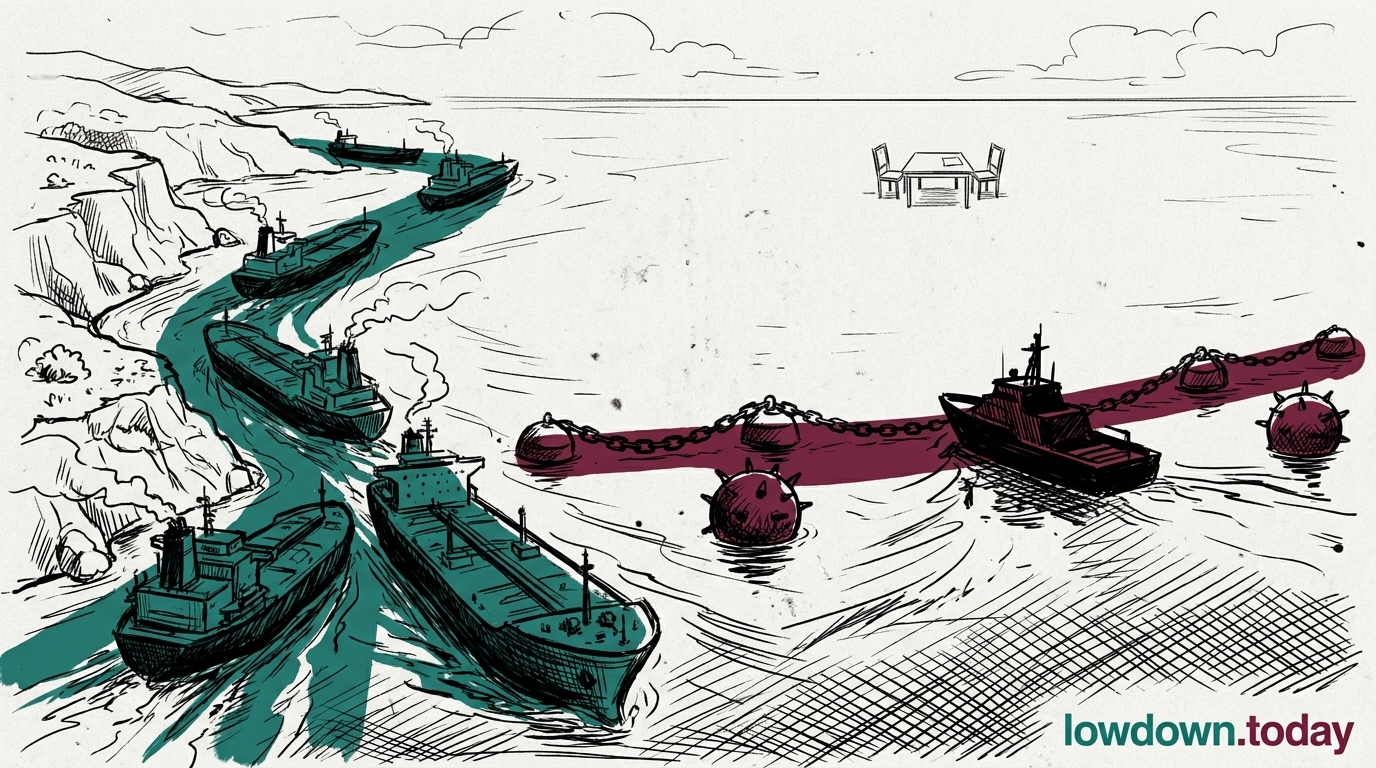
UKMTO counted about 20 US-facilitated Hormuz transits a day to 11 September against only 6 visible on AIS, with traffic still around 90% below the 138-a-day pre-war baseline. War-risk underwriters cannot price hulls they cannot see, or resolve whether the tanker El Gaia hit a mine, as Iran claims, or a missile and drone, as CENTCOM says.
European refiners
European refiners
European refiners, including Poland's Orlen, absorbed a roughly $26 gap between Dated Brent at $130.80 on 15 September and ICE Brent futures settling at $103.87 on 18 September, a spread that widened from $13.45 on 9 September rather than newly opening. Their futures hedges no longer cover what they now pay for physical barrels.
Saudi Arabia
Saudi Arabia
Saudi Aramco zeroed European term customers' October allocations and rerouted roughly 60 million barrels to Asia through Ras Tanura and Sohar, using Red Sea and Gulf terminal capacity built years ago to cut Hormuz exposure. Riyadh reallocated existing supply rather than negotiating a shortfall with Europe.
Qatar
Qatar
Qatar's energy minister Saad al-Kaabi told Bloomberg at the Qatar Economic Forum on 20 September that Bessent's two-year Hormuz-obsolescence forecast is wrong, and that Doha has deliberately built no bypass pipeline. Qatar's gas exports run through one waterway by choice, not oversight.
Iran (foreign ministry and Majlis)
Iran's foreign ministry and 130 Majlis deputies moved toward NPT withdrawal this week, with lawmaker Hossein-Ali Haji Deligani filing a triple-urgency bill on 20 September that Speaker Qalibaf has not yet scheduled. Tehran treats treaty membership as leverage still on the table, not yet spent.
Russia and China
Russia and China
Moscow and Beijing vetoed the Panel of Experts' renewal, maintaining Resolution 2231 lapsed in October 2025 and the 2025 snapback was never validly triggered, so the sanctions architecture the Panel enforces has no current legal standing. Both governments frame the veto as upholding law, not shielding Tehran.



