Skip to content
You can now search across every topic, entity and event.What's new
Iran Conflict 2026
17JUN

22 nations demand Hormuz reopened

4 min read
09:37UTC

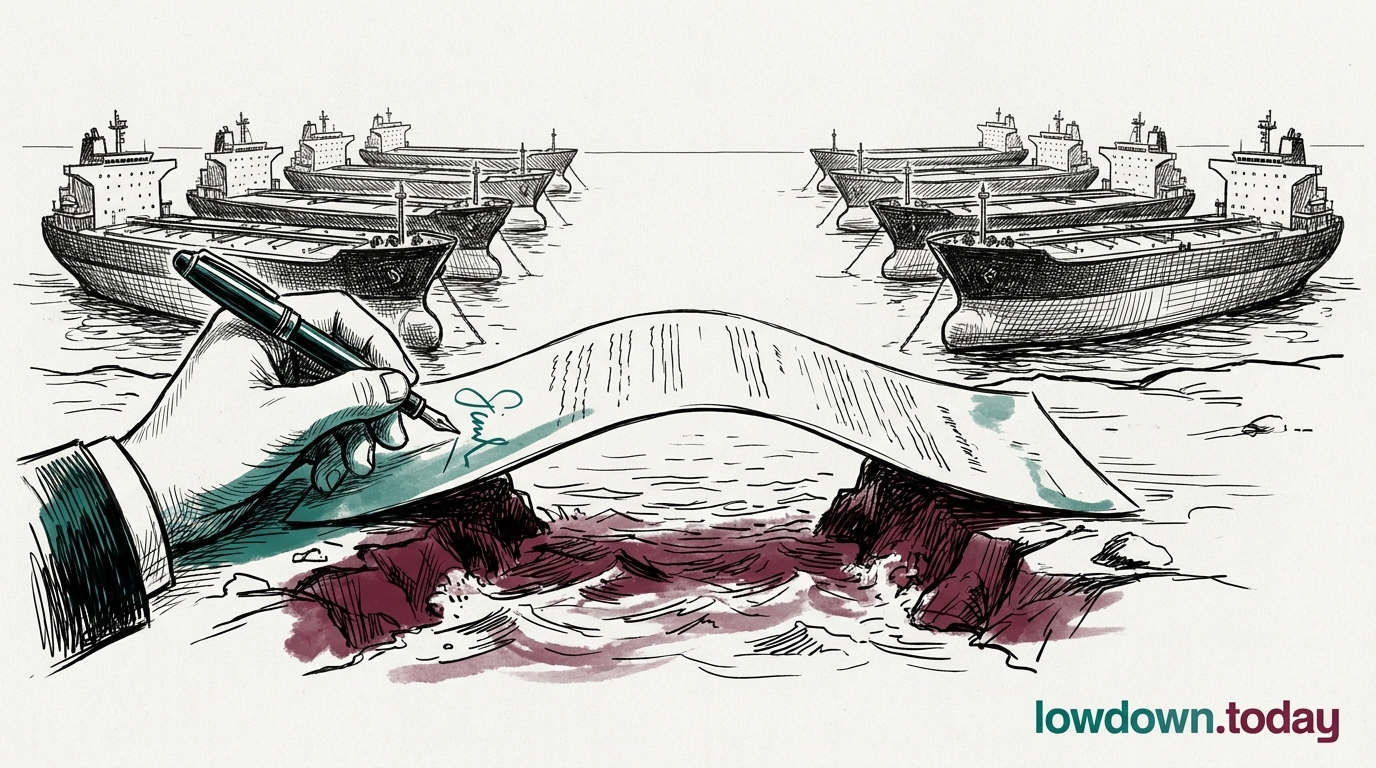
The Hormuz coalition tripled in size this week. It still has not produced a single vessel.

ConflictDeveloping
Key takeaway

Coalition declarations have tripled; warship commitments remain at zero.

Twenty-two countries — spanning NATO members and Indo-Pacific partners including Australia, Japan, and South Korea — issued a joint statement demanding Iran "immediately cease its threats, the placement of mines, drone and missile attacks, and any attempt to obstruct commercial navigation" in the strait of Hormuz 1. The Coalition tripled from the seven signatories who issued a similar statement days earlier .

The language escalated. The operational commitment did not. No signatory pledged warships, aircraft, or any military asset. The statement expressed "readiness to contribute to appropriate efforts" — identical phrasing to two prior joint declarations, neither of which produced a single vessel. Three statements in one week; zero hulls.

The arithmetic has a short, traceable history. When Trump called on five specific allies — Australia, Japan, the United Kingdom, Germany, and France — to form a Hormuz escort Coalition, all five formally declined within 72 hours . Trump responded by calling NATO allies "COWARDS" and a "PAPER TIGER" , then floated leaving the alliance altogether . The 22-nation statement answers that pressure with breadth rather than depth — more signatures on the same unfulfilled commitment. Germany's foreign minister had already stated flatly: "We will not participate in this conflict" . Nothing in Saturday's communiqué contradicts her.

The gap between words and warships has a quantifiable cost. The IEA's March report found global oil supply has fallen 8 million barrels per day — the largest disruption on record. More than 3,000 vessels sit stranded across the Middle East. the strait carries roughly one-fifth of the world's traded oil. During the 1987–88 Tanker War, Washington organised Operation Earnest Will to escort reflagged Kuwaiti tankers through similar Iranian threats; allied naval participation was limited even then, but the US at least secured a multilateral framework and several partners contributed minesweepers and frigates. In 2019, after Iran seized the British-flagged Stena Impero, the UK assembled the International Maritime Security Construct with half a dozen partners within weeks. Today the stakes are orders of magnitude larger — an 8 million barrel-per-day supply loss versus sporadic tanker seizures — yet the international response remains confined to communiqués. The US Navy is actively engaged; CENTCOM reports more than 130 Iranian naval vessels destroyed and A-10 ground-attack aircraft hunting fast boats in the strait 2. Every other navy is watching from port.


Deep Analysis

In plain English

Imagine twenty-two people signing a letter demanding a neighbour stop blocking the road — but nobody steps outside to actually move the car. That is what this statement represents. More nations have signed than in any prior declaration during this crisis. Yet the Strait remains closed, because signatures do not escort tankers. Committing naval vessels involves legal exposure, military risk, and domestic political cost that no signatory has been willing to accept. The statement's language — 'readiness to contribute to appropriate efforts' — is deliberately non-binding. It allows governments to signal alignment with the US position whilst accepting none of the liability that deployment would create.

Deep Analysis
Synthesis

Three declarations in one week — each stronger in language, each larger in membership, each operationally vacant — have documented a structural failure of the collective security architecture for freedom of navigation. UNCLOS Article 58 enshrines the right; it contains no enforcement mechanism against a state actor willing to absorb diplomatic costs. Iran has now empirically tested and confirmed this gap at scale, establishing a replicable model for future maritime coercion by other actors.

Root Causes

No signatory faces the UN Charter's Article 51 threshold for collective self-defence — their shipping interests are affected but their territory has not been directly attacked. Without UNSC authorisation (blocked by Russian and Chinese vetoes) or a NATO Article 5 trigger, no legal framework compels deployment. Post-Iraq and post-Afghanistan war-weariness among European militaries reinforces this structural constraint, making any first-mover nation politically exposed domestically.

Escalation

The coalition has reached a structural ceiling: nations willing to sign without deploying have already signed. Additional declarations will not expand the operational base. Iran will likely interpret the sustained gap between statement and deployment as empirical confirmation that maritime pressure carries no enforcement risk from this group.

What could happen next?
  • Risk

    Iran may interpret the sustained operational gap as confirmation that maritime pressure generates no enforcement response, incentivising continued Strait interference.

    Immediate · Assessed
  • Consequence

    The IEA's 400 million barrel SPR release cannot restore supply chains that require physical vessel movement through a contested Strait, regardless of reserve volume.

    Short term · Assessed
  • Precedent

    Three declarations without enforcement permanently weakens the credibility of future joint statements on freedom of navigation as a deterrent instrument.

    Long term · Suggested
  • Risk

    Signatories that declared without deploying face domestic credibility questions if the crisis escalates and they are seen to have made empty commitments.

    Short term · Suggested
First Reported In

Update #44 · Trump: 48 hours to destroy Iran power grid

GOV.UK· 22 Mar 2026
Read original
Different Perspectives
Lloyd's Market Association
War-risk underwriters price the Houthis' Red Sea attacks because the group announces its targets in advance, but the unclaimed Damietta drone gives insurers a hit with no author to price against. An attack nobody claims costs shipping more than one that is claimed, since premiums are set against a known pattern, not raw damage.
US Central Command
US Central Command
CENTCOM has announced no strike on Iran since resuming bombing on 30 July within hours of an IRGC salvo on Jordan, and centcom.mil did not respond to requests to confirm any pause. The command has gone quiet before while a larger operation was being weighed, so silence alone proves nothing about what it has or has not done.
Hengaw
Hengaw
Hengaw recorded at least 67 executions in Iran during July, of which the state acknowledged only eight, and reported the 1 August execution of protest detainee Arvin Kheirkhahan at Shahrud with no advance notice to his family. A family's first notice of a death sentence is now usually the instruction to collect a body.
Egypt
Egypt
Egypt's government asked media on 2 August to report the Damietta attack accurately, named no author, and said no findings will be published before its own investigation concludes. Cairo holds the debris and jurisdiction over an attack on its own soil, and naming a culprit now would pull it into a dispute it has avoided for five months.
Iran's Foreign Ministry
Araghchi called the Hormuz talks with Oman final-stage on 2 August, four days after his own deputy rejected Oman's lane proposal, and denied the Damietta drone strike as an Israeli false flag while two Iranian officials privately claimed it for Tehran. Iran's public position now contradicts itself on both files at once.
Bahrain and Kuwait
Bahrain and Kuwait
Bahraini and Kuwaiti aircraft flew their own strikes on Iranian depots in July with Emirati air cover behind them, and Ynetnews reports some Gulf capitals wanted the 2 August strike to proceed rather than stop. States that have already taken fire see a closing window on Iranian weakness, not a reason to pause.



