Skip to content
Briefings are running a touch slower this week while we rebuild the foundations.See roadmap
Iran Conflict 2026
8JUN

Kuwait armed the day Iran hit it

2 min read
09:58UTC

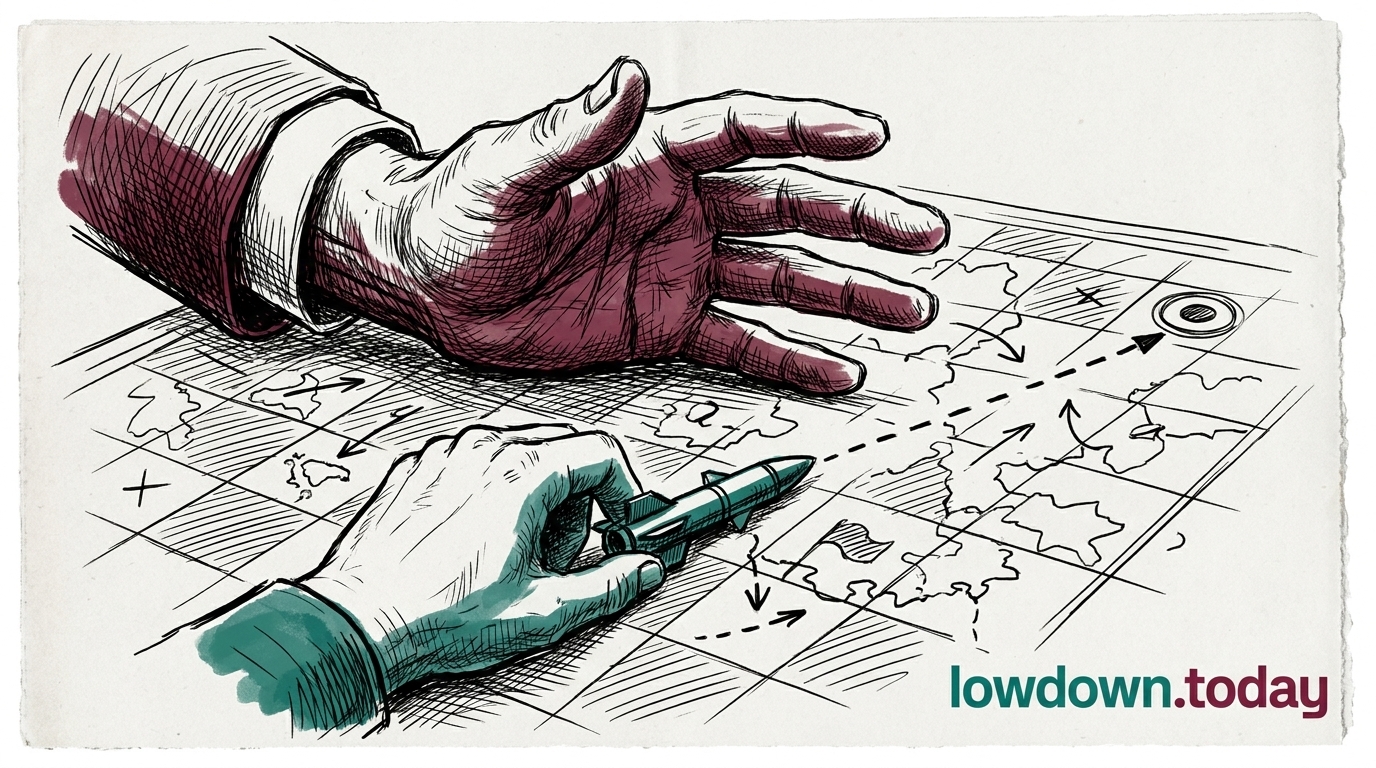
The US State Department cleared a $1.98bn counter-drone sale to Kuwait on 6 June, days after an IRGC drone hit Kuwait's airport. It is the one piece of Iran-related paper Washington has signed in nearly 100 days.

ConflictAssessed
Key takeaway

Washington armed Kuwait against Iranian drones within days while signing nothing to govern the war.

The US State Department approved a $1.98bn counter-drone sale to Kuwait on Saturday 6 June, supplied through Anduril and built around its Anvil intercept system 1. The DSCA (Defense Security Cooperation Agency, the US Defense Department body that runs Foreign Military Sales) notified Congress days after the IRGC (Islamic Revolutionary Guard Corps) drone that hit Kuwait's airport on 3 June , and after Kuwait expelled two Iranian diplomats .

State framed the sale as routine and said it "will not alter the basic military balance in the region". An administration that clears a $1.98bn arms case this quickly is not a slow one.

Set that against the war itself. On the blockade, the nuclear talks, and the fighting, Washington has signed no Iran instrument for close to 100 days . The single piece of Iran-related paper that moved this week armed a Gulf ally rather than governing the conflict that put the ally at risk. The Anvil is an autonomous counter-drone interceptor; the sale buys Kuwait a defence against exactly the weapon that struck it, on US delivery timelines that run behind the threat.

Deep Analysis

In plain English

When a country wants to buy US military equipment, the US government must notify Congress of the sale, which usually takes weeks or months. This time it took three days, immediately after Iran used drones to attack Kuwait's airport (ID:3884). Anduril is a Silicon Valley defence startup, not one of the traditional military contractors like Lockheed or Raytheon. Its Anvil system is an autonomous drone-killing drone: it detects an incoming hostile drone and flies into it to destroy it. The speed of this sale and the choice of a new-generation contractor signals Washington treating Kuwait's air defence gap as urgent rather than routine.

Deep Analysis
Root Causes

The sale is the direct institutional response to two structural failures documented across this conflict. First, CENTCOM's blockade has destroyed Iran's revenue base but has not deterred IRGC tactical strikes, which have escalated from drone harassment to ballistic missiles at civilian terminals . Second, US emergency resupply of PAC-3 rounds excluded Kuwait from the 2 May authorisation, creating a visible gap the IRGC has been probing since 31 May .

The Anduril choice reflects a post-2022 Pentagon policy of fast-tracking non-traditional defence contractors into FMS (Foreign Military Sales) pipelines. Anduril's Lattice AI backbone means Anvil systems network with CENTCOM's existing sensor grid without requiring new infrastructure.

Escalation

The sale accelerates Gulf counter-drone capability, but not quickly enough to close the current gap. Anduril systems require 6-18 months for operational integration. In the interim Kuwait retains interim PAC-3 cover at a depleted magazine. The IRGC's overnight seven-missile salvo (event index 3) demonstrates it is pressing the gap now, not waiting. The risk is a window of 6-12 months during which Kuwait's defence margin is thinner than the sale implies.

What could happen next?
  • Consequence

    Anduril secures its first major FMS contract, accelerating US procurement policy away from traditional prime contractors for autonomous systems.

    Short term · Assessed
  • Risk

    A 6-18 month delivery gap leaves Kuwait in a transitional vulnerability window while the IRGC's salvo tempo is actively accelerating.

    Short term · Assessed
  • Precedent

    Three-day DSCA Congressional notification establishes a speed benchmark for crisis-driven FMS approvals that other Gulf states will cite in future requests.

    Medium term · Reported
First Reported In

Update #119 · Trump's Iran deal: 95% done, 0% signed

Press TV· 6 Jun 2026
Read original
Different Perspectives
Bahrain / Gulf partners
Bahrain's PAC-3 interceptor magazine sits at 87% depletion after absorbing IRGC salvos aimed at US bases; no resupply is scheduled before 2027, concentrating the intercept burden on US assets and Israeli Iron Dome and Arrow-3.
IAEA / Vienna process
IAEA officials cited proliferation concerns over 440.9 kg of HEU unaccounted for after 97 days without inspector access; the Board session that opened 8 June cannot retroactively close the evidentiary gap its own resolution documents.
China
China
China absorbed the Shanghai Qianye designation by OFAC and opposes censure at the IAEA Board, arguing the verification gap was created by strikes rather than Iranian non-compliance, a framing it shares with Russia to protect the non-Western bloc's Board votes.
Russia
Russia
Putin reaffirmed at SPIEF on 6 June his offer to hold Iran's uranium stockpile as custodian, a proposal the IAEA's 97-day verification gap now renders undeliverable: no one can transfer or confirm a stockpile that has not been inspected.
United States / Trump administration
Trump publicly asked Netanyahu not to retaliate and described a deal as 95% done; Rubio then acknowledged enrichment terms could take months. The 24-hour gap between the request and the Mahshahr strike removes the credible-restraint argument from US diplomatic leverage with Tehran.
Israel / Netanyahu government
Netanyahu struck the Mahshahr complex and missile sites inside Iran within 24 hours of Trump's public no-retaliation request, a second kinetic override of US counsel that confirms Israel will not allow Tehran to dictate the terms of the exchange.