Skip to content
Briefings are running a touch slower this week while we rebuild the foundations.See roadmap
Iran Conflict 2026
4JUN

Iran hits Kuwait airport on victory day

2 min read
11:25UTC

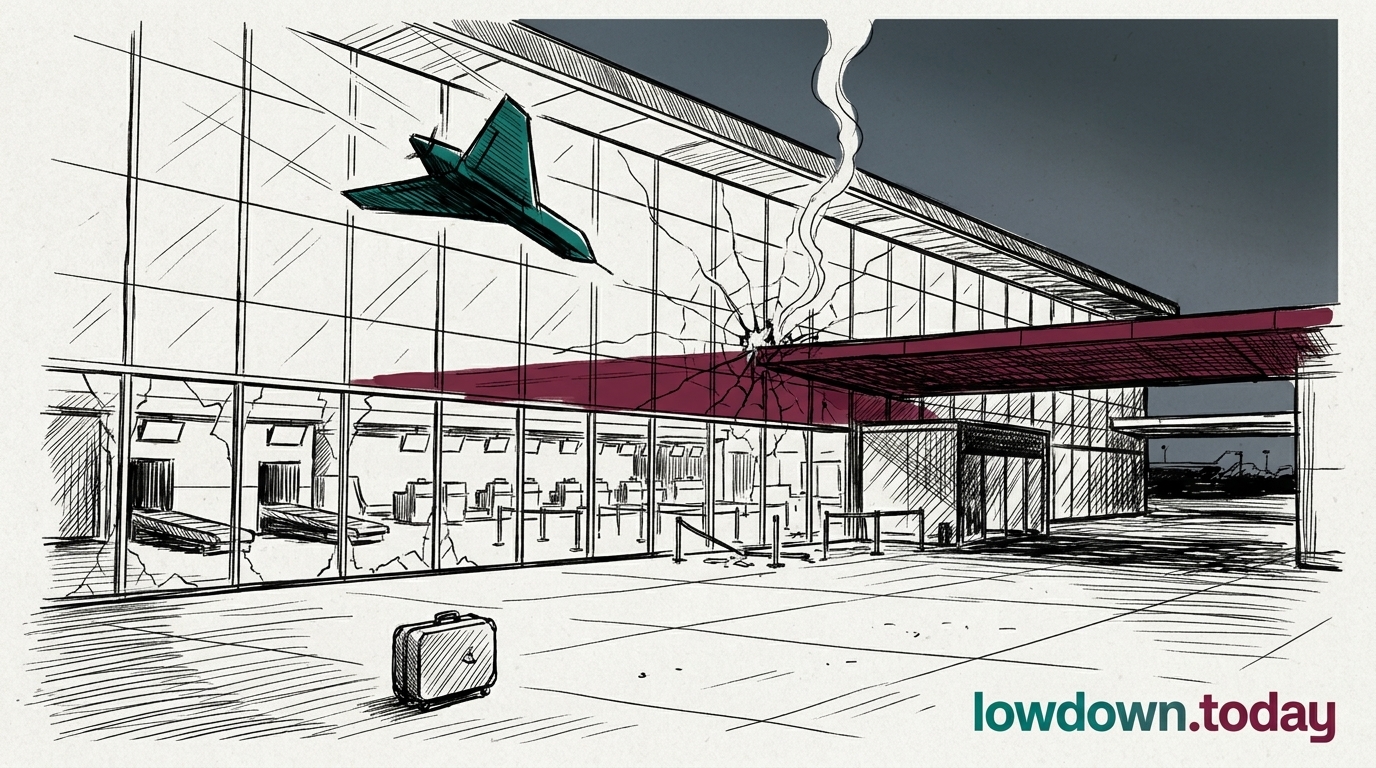
Iran struck a QatarEnergy tanker in Qatari waters and set Kuwait's airport fuel storage ablaze on the same day Trump declared the war won. Three US-aligned Gulf states absorbed Iranian strikes within hours of the Oval Office address.

ConflictAssessed
Key takeaway

Iran struck Qatar and Kuwait on Trump's victory day, demonstrating the war continues regardless of Washington's withdrawal framing.

Iranian drones struck fuel storage tanks at Kuwait International Airport on 1 April, sparking a large fire, while Iran simultaneously struck a QatarEnergy fuel oil tanker in Qatari territorial waters. The timing was deliberate: the strikes occurred while Trump was delivering his Oval Office victory address.

Iran did not hold fire while Trump spoke. Striking Qatar's state energy company in Qatari territorial waters, where Al Udeid Air Base is also located, and setting Kuwait's airport fuel tanks burning for several hours on the same day Trump declared the hard part done is a precise operational statement. Kuwait had already condemned Iran's killing of an Indian national at a desalination plant on 30 March , and had suffered a prior airport strike in the conflict's earlier days.

The pattern mirrors the industrial escalation against Gulf aluminium plants : maximum disruption, zero casualties, insufficient provocation to draw Gulf states into the war as belligerents. A QatarEnergy tanker struck with a second missile that entered the engine room unexploded is not an accident; it is a calibrated demonstration that Iran can hit the target and choose whether to detonate. Iran had explicitly threatened UAE infrastructure over Kharg Island operations , establishing the coercive intent behind these strikes.

Kuwait condemned the attack as 'blatant' but has not moved toward belligerent status. Iran has found the threshold: damaging enough to send a signal, restrained enough to avoid the trigger that would widen the war.

Deep Analysis

In plain English

On the same day the US president said the war was nearly over, Iran attacked two of America's Gulf allies. A missile hit a Qatari oil tanker in Qatari waters ; a second missile went into the engine room without exploding, which is how you signal you could have done far more damage but chose not to. Iranian drones also set fire to Kuwait's airport fuel tanks for nearly three days. Both Qatar and Kuwait host American military bases. Iran is telling these countries: we can reach you, we can hurt you, and we choose how much damage to cause. Neither country has joined the war. That is exactly the calculation Iran is making.

Deep Analysis
Root Causes

Gulf states hosting US military infrastructure are legitimate targets under Iran's declared war doctrine. Qatar's Al Udeid and Kuwait's operations support is integral to the US campaign, making their energy infrastructure militarily justifiable targets in Iran's framing.

Escalation

Iran has established a sustainable pattern of Gulf state strikes that cause economic damage without triggering military retaliation. The risk is that cumulative damage eventually crosses a threshold that compels a Gulf state response, particularly if Saudi Arabia or the UAE conclude the US umbrella is withdrawing.

What could happen next?
  • Risk

    Sustained strikes on Qatari LNG infrastructure could trigger a separate energy supply shock independent of the Hormuz oil disruption.

    Short term · Reported
  • Consequence

    Gulf states may reassess hosting US forces if Iran's targeting of their infrastructure continues and Washington withdraws before Hormuz reopens.

    Medium term · Reported
  • Precedent

    Striking a tanker inside a sovereign state's territorial waters establishes a precedent that no Gulf state's waters are safe zones.

    Long term · Assessed
First Reported In

Update #54 · Trump declares victory and withdrawal

Al Jazeera· 1 Apr 2026
Read original
Different Perspectives
China
China
Beijing's MOFCOM Blocking Rules constrain OFAC enforcement on the mainland; China has not corroborated Trump's verbal account of any bilateral summit, and the rial's failure to hold its Rubio bounce, combined with the IRGC's stablecoin rail closure, increases Chinese yuan-denominated oil-payment exposure through Hormuz.
Israel
Israel
IDF Chief Zamir said on 3 June there is no ceasefire for his forces even as Israel signed the Washington Lebanon framework requiring Hezbollah withdrawal south of the Litani; a UNIFIL peacekeeper was killed by mortar near Marjayoun on the same day, exposing the gap between the diplomatic framework and a ground advance that has not stopped.
Bahrain
Bahrain
The IRGC struck Bahrain on 3 June as its sirens sounded and its PAC-3 magazine neared exhaustion; excluded from Rubio's 2 May emergency resupply, Bahrain received a 50-round Federal Register notice on 1 June on an 18-month delivery timeline, meaning it is defending the US Fifth Fleet headquarters on the last rounds it has.
Qatar
Qatar
Qatar offered $6bn under OFAC Licence L-2 restrictions and sent Ghalibaf's delegation home empty-handed; the $6bn ceiling is a legal constraint, not a negotiating floor, and Rubio's no-sanctions-relief testimony means Qatar cannot revise it without White House action that has not been requested.
Kuwait
Kuwait
Kuwait expelled two Iranian diplomats within 24 hours of the airport strike, the strongest and fastest Kuwaiti diplomatic move of the conflict, while keeping the full mission in place to preserve a communication channel; it has now invoked Article 51 self-defence, filed a formal protest, and expelled diplomats, exhausting its formal toolkit short of full rupture.
United States
United States
Trump narrated a weekend deal while the channel Rubio described under oath, Khamenei's written-only couriers with a 3-to-5-day lag, cannot answer at that speed; CENTCOM called the airport strike deliberate, calculated and unjustified. The House 215-208 vote gave Congress its first on-record war-powers position against the deployment Trump has run without a signed instrument for 96 days.