Skip to content
Briefings are running a touch slower this week while we rebuild the foundations.See roadmap
European Tech Sovereignty
27MAY

China condemns the blockade it uses

3 min read
15:19UTC

Lowdown Newsroom

TechnologyDeveloping
Key takeaway

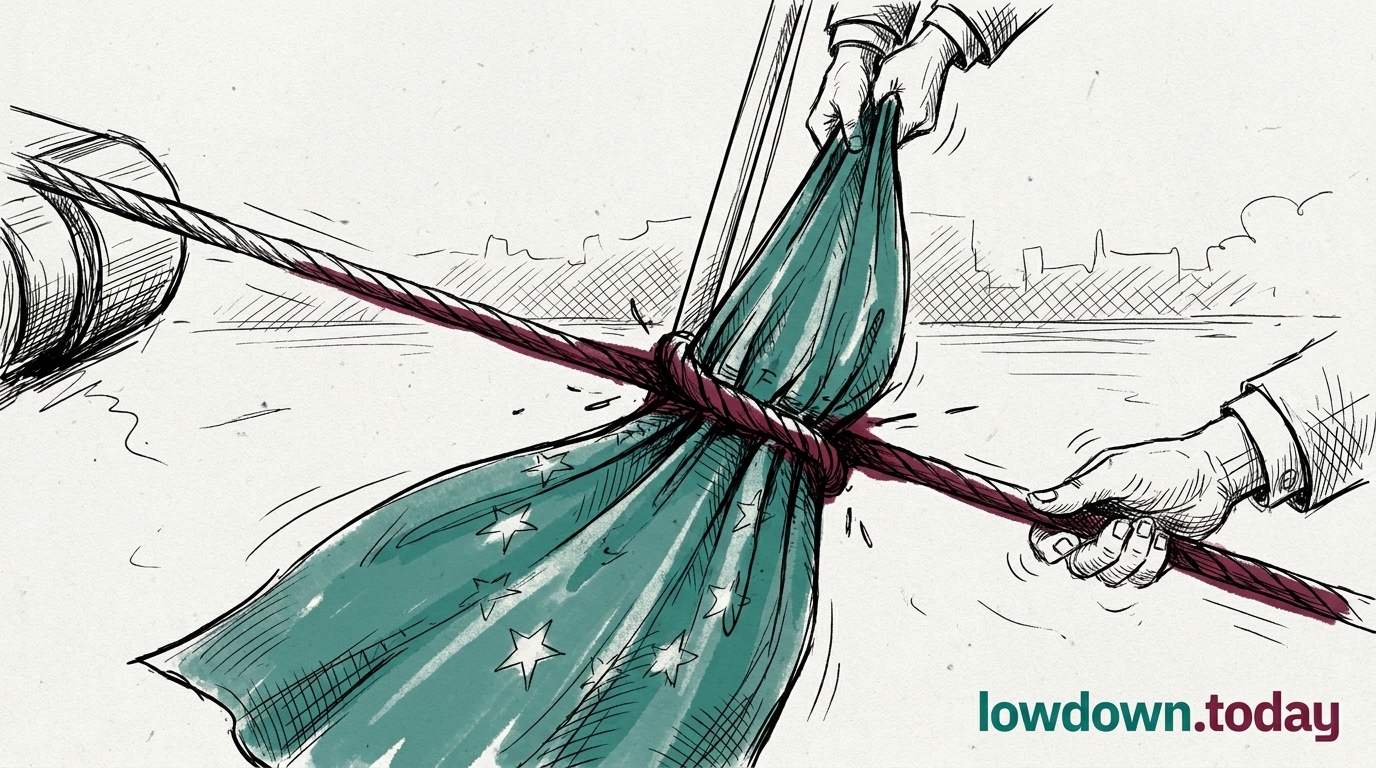
Beijing protests the blockade in public and uses it in private, and the carve-out keeps both true.

Guo Jiakun, spokesman for the Chinese Foreign Ministry, called the US blockade 'dangerous and irresponsible' on Monday and said it 'will only exacerbate tensions and undermine the already fragile ceasefire agreement.' A second statement the following day repeated the language. Beijing, Guo said, would 'make efforts to help restore peace and stability.' Between the two statements, the Chinese-owned, US-sanctioned tankers Rich Starry and Elpis transited the strait of Hormuz under CENTCOM's non-Iranian-port carve-out without incident. China has filed no formal sanctions challenge.

Beijing's annual oil imports from Iran are roughly a sixth of total crude purchases, the volume that would have given a formal legal challenge both motive and standing. The diplomatic protest and the commercial transit are the same event from different angles. Beijing is arguing against the blockade in public while its tankers use the operational order's gaps in private. The rhetorical register is escalating; the operational register is not. China's leverage sits in what moves, not what is said.

The dual posture is stable only while the carve-out holds. If CENTCOM widens its operational order to include non-Iranian-port traffic, Beijing's quiet mode ends. A formal Chinese challenge at that point would move from press briefing to UN procedural filing and would test the blockade's legality in a way the unsigned presidential posture cannot defend. The same ambiguity that currently lets Chinese crude cross freely is the ambiguity that keeps Beijing's response below the threshold that would force a reckoning over the Pacific. Both sides benefit from the fog, for now.

Deep Analysis

In plain English

China's government publicly called the US blockade 'dangerous and irresponsible' two days running. Across the same two days, two Chinese-owned tankers that the US had already sanctioned for carrying Iranian oil sailed straight through the Strait of Hormuz; because the US military's written order only blocked ships going to Iranian ports, not all Chinese-owned ships. So China is doing two things at once: complaining loudly about the blockade in public, while quietly using the gap the US military left open to keep buying discounted Iranian oil. This is not contradictory from Beijing's perspective; protesting the principle while exploiting the practice is a consistent Chinese foreign policy approach. The tanker transits are the more important signal: they demonstrate that US secondary sanctions, without matching naval enforcement, have no coercive weight over Chinese commercial operations.

Deep Analysis
Root Causes

The structural condition enabling China's dual-register response is CENTCOM's non-Iranian-port carve-out, which was written precisely to avoid triggering Chinese-flag-state incidents. CENTCOM's lawyers understood that boarding a PLA-connected tanker in international waters without a presidential directive or UNSC mandate would create a bilateral incident with no legal defence. By excluding non-Iranian-port traffic, CENTCOM preserved the status quo on China while appearing to execute a blockade.

China's structural incentive is straightforward: Iranian oil at a discount provides roughly 15 per cent of its total crude imports. The dark-fleet architecture Beijing developed since 2022; sanctioned vessels operating outside Western insurance and financial systems; was specifically designed to absorb this kind of commercial environment. The blockade's carve-out is an accidental gift to a supply chain China has been building for four years.

What could happen next?
  • Consequence

    CENTCOM's non-Iranian-port carve-out creates a structural exception for China's dark-fleet operations that cannot be closed without a presidential directive Beijing would contest as an act of economic warfare

    Immediate · 0.85
  • Risk

    If CENTCOM widens its operational order to include non-Iranian-port sanctioned traffic, China's response calculus shifts from quiet protest to potential countermeasures against US commercial interests

    Short term · 0.65
  • Precedent

    China's demonstrated ability to transit US-sanctioned vessels through a US-enforced blockade establishes a template for future secondary-sanctions evasion via dark-fleet architecture in any theatre

    Long term · 0.8
First Reported In

Update #69 · Cooper joins the instrument gap

Chinese Foreign Ministry· 15 Apr 2026
Read original
Causes and effects
This Event
China condemns the blockade it uses
Beijing's rhetorical escalation is running in the opposite direction from its operational posture, because the carve-out CENTCOM wrote lets Chinese tankers transit without any commercial cost to contesting it.
Different Perspectives
ASML / European tech industry
ASML's Q2 2026 guidance came in €300m below consensus as China DUV revenue collapsed 17 percentage points; the company's CEO wrote US export-control outcomes directly into 2026 guidance. European tech firms named on the USTR retaliation list alongside SAP, Siemens and Spotify face the same calculus: US trade exposure constrains what Brussels can legislate on their behalf.
France / Anne Le Henanff
Le Henanff chaired the G7 Digital Ministerial at Bercy on 29 May with CAIDA off the agenda, pivoting France's presidency to AI safety principles it had not designed the week around. France backs CAIDA but cannot override Berlin's tariff calculus, so the ministerial produced no new French-led commitment.
Germany / Federal government
Berlin's automotive sector faces up to $200bn in threatened US tariffs, a commercial exposure that dwarfs any benefit CAIDA's public-sector cloud rules would deliver to German digital firms. Federal silence inside the College of Commissioners functions as a block under consensus adoption rules without requiring a formal veto.
USTR / Ambassador Andrew Puzder
Puzder's public warning on 25 May that CAIDA is inconsistent with the EU-US trade framework was the first time Washington made its bilateral pressure visible before a Commission adoption vote rather than after. The USTR Section 301 determination on 24 July provides the enforcement backstop.
European Commission / Henna Virkkunen
Virkkunen framed the third slip as a procedural delay in finalising a 400-page text without addressing Puzder's trade-framework red line publicly. The Commission enforces existing law against Google while losing the legislative timeline on CAIDA, exposing an asymmetric position: enforcement holds; new sovereignty legislation does not.
OpenForum Europe / open-source community
The EUR 350m Sovereign Tech Fund has no Commission host, no budget line, and no commissioner's name attached six weeks after the April conference, while Germany is already paying maintainers to staff international standards bodies. The CRA open-source guidance resolves contributor liability but leaves the financial-donations grey area open with the 11 September reporting clock running.
