Skip to content
You can now search across every topic, entity and event.What's new
European Oil Markets
15JUN

Managed money flushes crude book flat

3 min read
11:33UTC

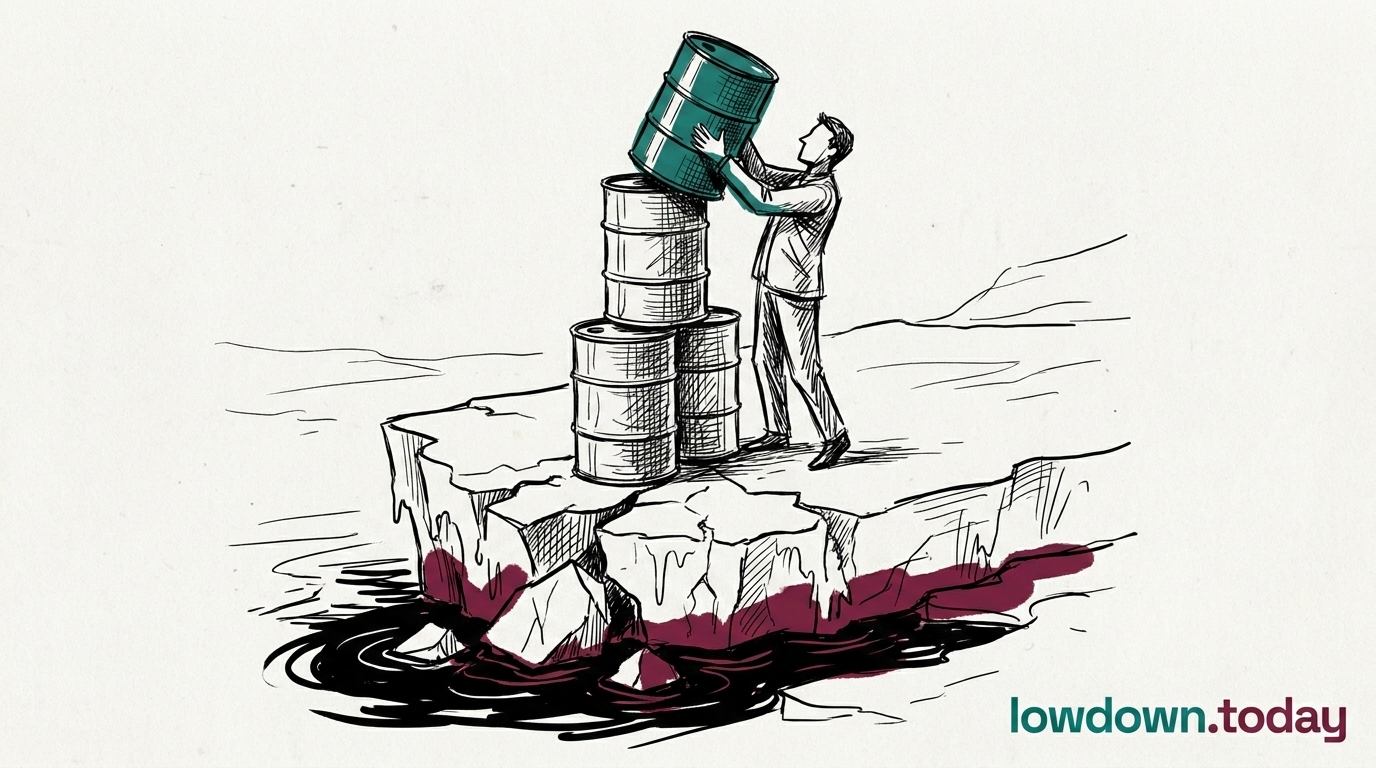
Managed money cut its ICE Brent net long to 8,130 contracts in the week to 16 June, near-neutral just as Brent broke to a fresh three-month low. A clean book has no length left to liquidate and no cushion to absorb a shock.

EconomicDeveloping
Key takeaway

Flat positioning into a loaded fortnight converts ordinary catalysts into gap risk, whichever way price breaks.

Managed money cut its ICE Brent net long to 8,130 contracts in the week to 16 June, recovering from a 57,280-contract net short just three weeks earlier, while NYMEX WTI money managers stayed short at 23,666 contracts, the CFTC reported on Monday 22 June 1. The Commitments of Traders release, delayed two days by the Juneteenth holiday, leaves the crude book at near-neutral. The dual crude net long that rebuilt in early June did not survive the selloff.

Three weeks ago the same book sat short with Brent at $92.69 . The screen has since marked the entire Iran risk premium out of crude after OFAC authorised Iranian crude sales 2. A book this clean has no length left to liquidate, and no crowded short to fuel a mechanical rally on a bullish shock.

Three catalysts now sit inside a single fortnight. ISAB Priolo, the Lukoil refinery in Sicily, faces a sanctions deadline this weekend. US distillates have just posted their first build in weeks. An August double-expiry of GL X and the Islamabad framework, the US-Iran memorandum signed 15 June that set a 60-day diplomatic clock, waits beyond. Each lands into the lightest crude book since the winter, where a clean position amplifies a move rather than damping it.


Deep Analysis

In plain English

Hedge funds and commodity trading advisers use oil futures contracts to bet on whether crude prices will rise or fall. The US Commodity Futures Trading Commission (CFTC) publishes a weekly report called the Commitments of Traders (COT) showing how these funds are positioned. Until three weeks ago, these funds had built a large bet that ICE Brent, the main global oil price benchmark, would fall. That net short reached 57,280 contracts on the sell side. Over the past three weeks those bets were closed out, and the book moved to a slight net long of 8,130 contracts, almost exactly neutral. The CFTC data is published each Friday for positions held the prior Tuesday. With positioning now near-neutral, any surprise news, positive or negative, can move Brent sharply because there are few established positions acting as a buffer against the initial move. The next fortnight contains three specific deadlines that could move prices significantly in either direction: the ISAB Priolo refinery ownership deadline on 28 June, the GL X Iranian supply window running to 21 August, and the August double-expiry of the Islamabad diplomatic framework.

Deep Analysis
Root Causes

The 65,000-contract swing from -57,280 to +8,130 in three weeks traces to a sequential unwinding of three overlapping bull theses, each built at a different price level between 2 June and 22 June. The Hormuz risk premium, which drove Brent to a $97.82 peak, was the first layer; the US-Iran MOU of 15 June started unwinding it.

The Russian supply disruption premium, which the GL 134C lapse was expected to tighten further, failed to produce visible market tightening as an observable disruption; that layer also came off. GL X on 22 June completed the carry-out of the remaining long inventory.

NYMEX WTI at -23,666 net short shows the institutional paired position (long Brent / short WTI for the Brent-WTI spread trade) remains directionally short on the US leg. Managers running this paired structure face losses if the catalyst fortnight resolves bullishly and WTI short-covering chases Brent higher; the asymmetry runs one direction: a bullish surprise squeezes WTI short-covers into a book with no absorbing longs above current levels.

What could happen next?
  • Risk

    With managed-money near-neutral on Brent, a bullish surprise on the ISAB, GL X, or Islamabad catalysts faces no short-covering buffer to amplify the move; the first directional session will set the entry point for the next structural position, making the 22-26 June catalyst window the pivotal price-discovery moment for Q3 positioning.

  • Consequence

    NYMEX WTI remaining net short at -23,666 while Brent reached marginal long creates a $3-5/bbl Brent-WTI spread vulnerability: if WTI shorts cover in a bullish catalyst, the spread compresses, punishing managers holding the paired long-Brent/short-WTI structure.

First Reported In

Update #11 · Crude longs flushed flat into a loaded week

CFTC· 26 Jun 2026
Read original
Different Perspectives
Sanctions compliance officer reviewing a Lukoil International GmbH bid
OFAC's amended FAQ 1224 gives a compliance desk its first published standard: full severance from Lukoil and a US-jurisdiction blocked account for sale proceeds. The conditions name neither ISAB nor Italy, so a Priolo Gargallo-linked bid answers a different question than a Neftochim Burgas or Petrotel Ploiesti one.
Managed-money funds on Brent Last Day
CFTC data for the week to 21 July showed managed money flipping 74,400 contracts to a net long of 15,665 against 1,410 short on the Brent Last Day contract, code 06765T. A fund that held that short through July has now covered it, and the spent short base raises the bar for the next leg higher.
Saudi crude exporters
Saudi-linked tanker transits through Bab el-Mandeb fell to about 7.5 a day after the 24 July underwriting withdrawal, pushing more barrels onto the longer route round the Cape or through the Yanbu terminal. Every diverted barrel ties up a ship for longer, and a fleet that turns slower charges more.
Tanker owners on the Bab el-Mandeb route
Lloyd's-market syndicates withdrew war-risk cover from Saudi-linked hulls on 24 July, leaving owners of that class of vessel to sail Bab el-Mandeb uninsured or not at all. Tanker transits on the route fell to roughly 7.5 a day, and cover, once withdrawn, does not return on a shipowner's timetable.
Eni
Eni
Eni's board approved second-quarter results on 29 July, swinging refining EBIT to a EUR0.08bn profit from a year-earlier loss even as group profit doubled, and named Red Sea freight cost as a cap on that improvement. A refiner absorbing higher shipping costs on Saudi-linked crude while its numbers improve treats the freight line as a drag, not a crisis.
Asian buyers (India, Japan, China, South Korea)
Asian refiners are absorbing 62% of Yanbu's 3.75m b/d flow, the bulk of Saudi Arabia's rerouted crude now clearing east rather than into the Atlantic basin. That destination split leaves Asian buyers more exposed to any single Yanbu-specific disruption than under the kingdom's normal multi-terminal export pattern.



