Skip to content
You can now search across every topic, entity and event.What's new
European Oil Markets
23JUL

China in Hormuz safe-passage talks

3 min read
19:27UTC

What began as Chinese vessels quietly switching AIS flags to transit the Strait has become a formal diplomatic arrangement — one that could split global energy access in two.

EconomicDeveloping
Key takeaway

China is converting its position as Iran's indispensable economic partner into a de facto maritime security guarantee — rewriting Gulf strategic architecture through a commercial instrument rather than military presence.

Reuters reported on Saturday, citing three diplomatic sources, that China is now in direct formal negotiations with Iran to guarantee safe passage for crude oil and Qatari LNG through the strait of Hormuz. The talks formalise what had been an improvised arrangement: Chinese-linked vessels quietly transiting the strait using AIS flag-switching while Western-flagged shipping sat at anchor after every major P&I club cancelled war risk cover .

The progression from ad hoc workaround to diplomatic negotiation followed a precise sequence. When the P&I insurance deadline passed at midnight on 5 March, more than 150 vessels were stranded in the Gulf of Oman and Arabian Sea . Trump's promised DFC insurance programme and Navy convoy escorts remain non-operational. Beijing waited for both failures — the commercial insurance collapse and the US Navy's inability to escort — before moving from quiet flag-switching, exemplified by the vessel Iron Maiden's AIS-broadcast transit , to formal state-to-state talks. The strategic patience of China's first week was not passivity. It was positioning.

Iran's calculus is straightforward. China is its most important remaining economic relationship and the only major power not aligned against it in this war. Refusing Chinese passage would cost Tehran its last significant ally. For Beijing, the arrangement achieves through one week of war what decades of naval expansion in the Indian Ocean could not: a legitimate, negotiated role as The Gulf's energy security guarantor. The Saudi backchannel to Iran, re-activated with 'increased urgency' through the Chinese-brokered 2023 rapprochement framework , now operates in a context where China holds material leverage over both parties.

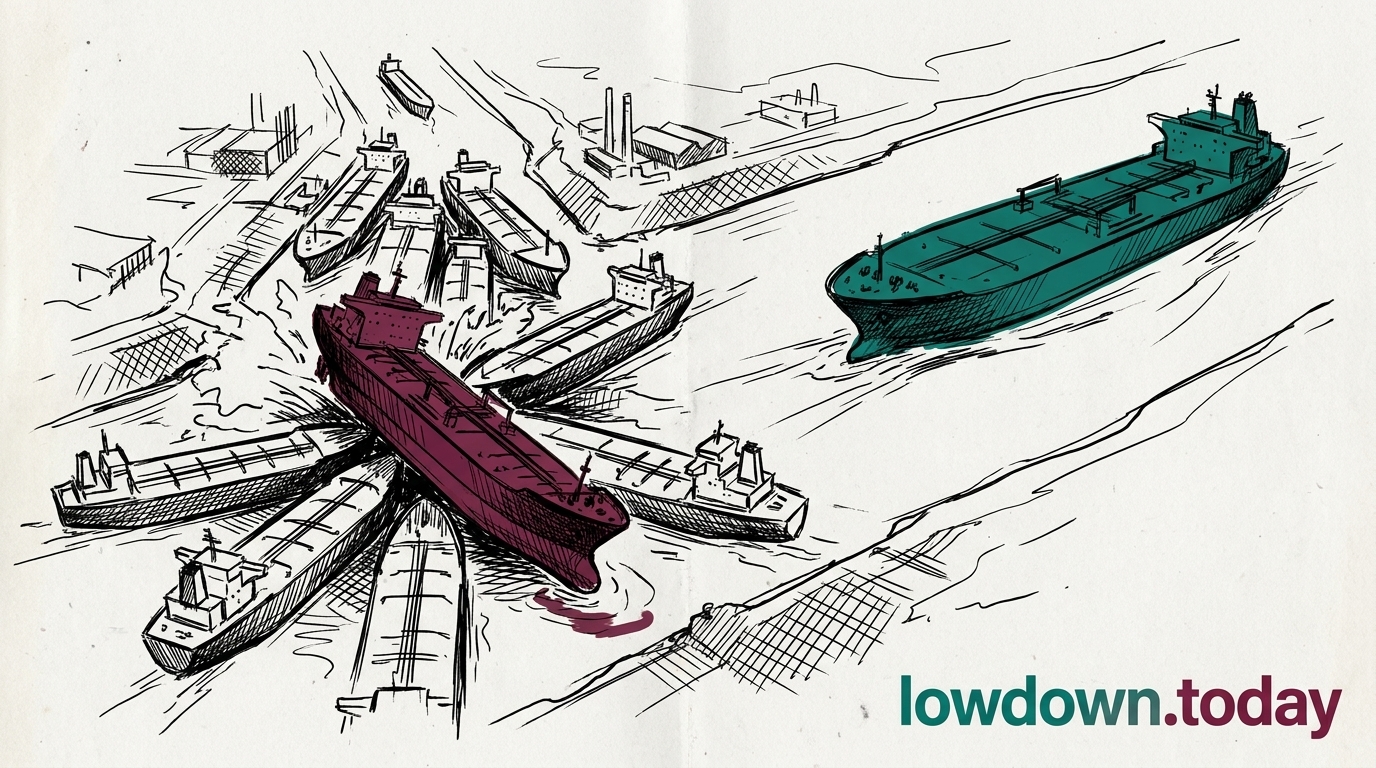
The consequences fall hardest on countries outside the arrangement. India imports 85% of its crude by sea through waters increasingly under Chinese diplomatic management — and New Delhi has still not issued a formal protest over the sinking of IRIS Dena in waters it considers strategically important . If roughly 60% of Gulf oil flowing to Asia resumes at terms Beijing sets while the share bound for Western markets remains blocked, the result is not a blockade in the traditional sense. It is a filter — and China controls who passes through it.


Deep Analysis

In plain English

China has been quietly keeping Iran's economy afloat by buying its oil despite Western sanctions, making it Iran's most important remaining customer. Now, with the Strait of Hormuz effectively closed to Western shipping, China is negotiating a deal with Iran to keep that waterway open specifically for Chinese ships. If formalised, China and Iran together would control who gets through: Chinese ships yes, everyone else no. No military confrontation was required to achieve this — it follows naturally from the economic relationship China spent five years building.

Deep Analysis
Synthesis

The arrangement represents a new category of great-power competition: strategic positioning achieved through commercial instruments in real time during another party's active conflict. Beijing is not intervening militarily; it is extracting a durable structural advantage from the conflict's side effects while maintaining plausible deniability as a neutral commercial actor.

Escalation

Formalisation would give China a structural interest in Iran not being militarily defeated — since Iran's defeat ends the arrangement and removes Chinese preferential access. This creates a passive Chinese deterrent against any operation threatening Iranian regime survival, without Beijing firing a shot or making an explicit commitment.

What could happen next?
  • Consequence

    India, which imports 85% of its crude by sea, faces a binary choice: seek its own bilateral passage agreement with Iran — implying sanctions-busting — or absorb a sustained energy cost premium relative to Chinese competitors.

    Short term · Assessed
  • Precedent

    A formalised two-tier Hormuz establishes the first case of a major commercial chokepoint operating under bilateral rather than multilateral rules, setting a precedent for similar arrangements at Malacca, Bab-el-Mandeb, or the Taiwan Strait.

    Long term · Suggested
  • Risk

    Chinese commercial vessels transiting under a formal guarantee become de facto hostages to the arrangement's stability; any Iranian action damaging Chinese shipping would collapse the deal and Iran's last major economic relationship simultaneously.

    Medium term · Suggested
  • Meaning

    The negotiation signals that China has calculated Iranian regime survival is probable enough to be worth locking in preferential access now rather than hedging for a post-conflict settlement.

    Immediate · Suggested
First Reported In

Update #27 · Israel kills 41 on failed 1986 airman raid

Bloomberg· 7 Mar 2026
Read original
Different Perspectives
US money managers (CFTC-tracked)
US money managers had trimmed WTI net long positioning into July's rally, doubting the Hormuz premium would hold without freight or war-risk confirmation, and the crude stock build reported for the week to 17 July gives that scepticism a fundamentals basis. The 25 July CFTC data will show whether Brent's move above $100 changed their calculus.
Asian distillate buyers (Singapore)
Singapore's distillate holders kept retaining middle-distillate barrels as the East-West arbitrage window narrowed further this week, a pattern that sharpened as Fujairah light distillates hit a record low. Cargoes are being held rather than released west into the tightening Mediterranean market.
Bulgaria
Bulgaria
Bulgaria secured the removal of Lukoil founder Vagit Alekperov and Patriarch Kirill from the 21st package, with President Rumen Radev calling a personal listing 'shooting ourselves in the foot'. Sofia is protecting its position in Lukoil's EUR 3bn compensation claim over the 2023 Neftohim Burgas nationalisation.
Russia
Russia
Russia loses the roughly $14 a barrel of legal headroom the price-cap formula would have released toward $58, even as Urals continues trading below Moscow's $59 budget floor. The shadow-fleet insurance workaround that lets sanctioned crude clear above $44 in practice remains untouched by the freeze itself.
European Union
European Union
The EU adopted its 21st sanctions package on 23 July, freezing the $44 Russia oil cap for 12 months rather than letting the formula drift it toward $58, and listed shadow-fleet support vessels for the first time. The package cleared only after three failed Coreper votes.
Marine war-risk underwriters (Lloyd's-linked syndicates)
War-risk syndicates lifted southern Red Sea hull premiums 150% to about 0.75% of hull value after the 20 July blockade declaration, still a seventh of the roughly 5% Hormuz band. Underwriters reset on realised loss, not declared threat, so the 23 July Encelia and Layla strikes set up the next re-mark.