Skip to content
You can now search across every topic, entity and event.What's new
European Oil Markets
16JUL

Insurers and mines keep Hormuz shut

3 min read
09:39UTC

BIMCO's chief safety officer Jakob Larsen called Hormuz transits "still very risky" on 18 June as foreign-flag traffic stayed away and war-risk cover withheld.

EconomicDeveloping
Key takeaway

Washington lifted the only closure it controlled; insurers and mines keep the strait shut.

Jakob Larsen, chief safety officer at the Baltic and International Maritime Council (BIMCO), the world's largest shipping body, said on 18 June that Strait of Hormuz transits were "still very risky" 1. His verdict came hours after CENTCOM lifted its blockade , and it explains why the lift changed almost nothing on the water.

Foreign-flag commercial traffic stayed away on 18 June. Transit ran at 5 to 10 per cent of pre-war volume, almost entirely Iranian domestic-flag ships, which means fewer than ten vessels a day crossing a channel that once carried over a hundred 2. London war-risk cover, withdrawn in March, had not returned. Premiums for the few crossings still being underwritten had run to 3 to 8 per cent of hull value, up to $8m a passage, against 0.25 per cent before the war 3.

Mines laid across the channel would take 40 to 50 days to sweep at the conservative estimate, up to six months for a full clearance 4, so the oil cannot physically return for weeks even with the blockade gone. The Conwartime clause in standard charter contracts, which lets a captain refuse a passage judged too dangerous, remained triggered across the Gulf.

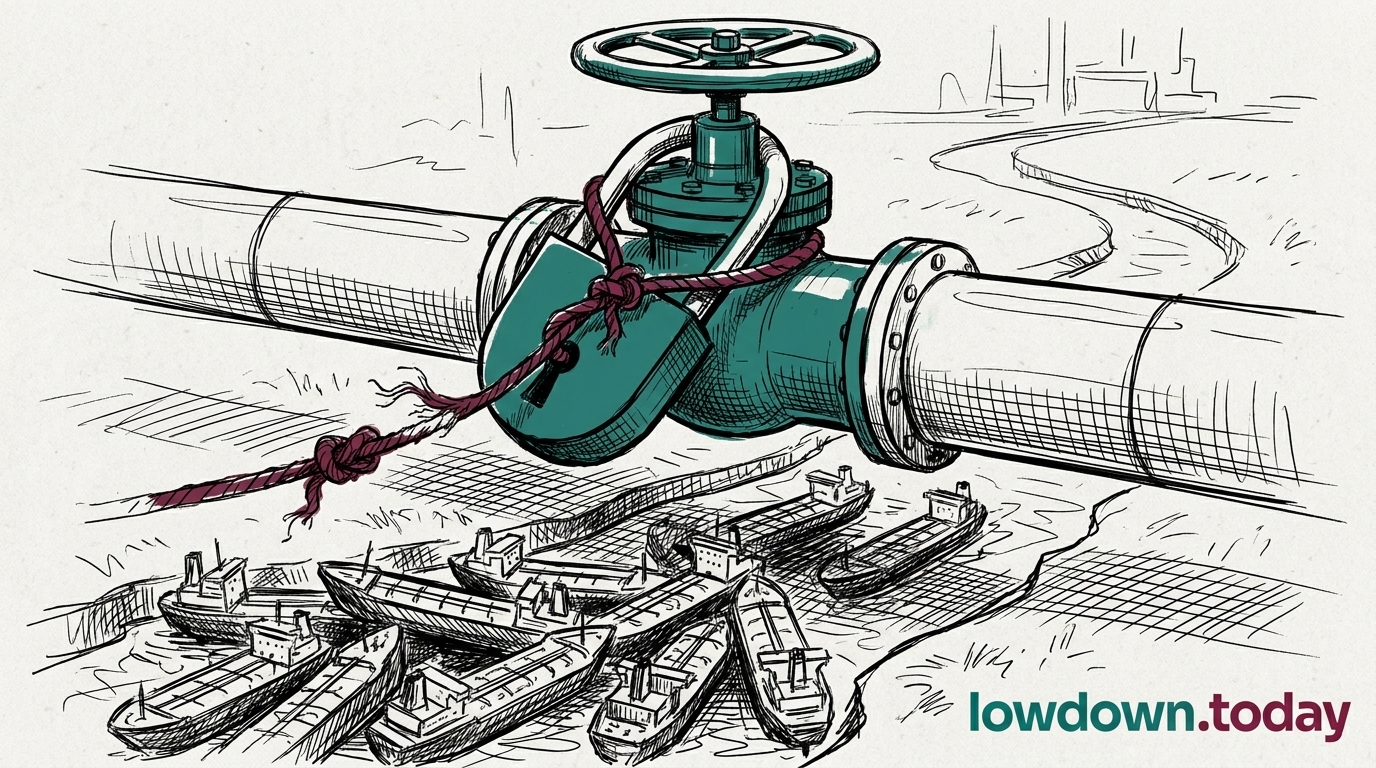
Three separate actors hold three separate locks on the strait: the US Navy, the London insurers, and whoever laid the mines. CENTCOM opened the naval lock and left the other two untouched. The International Group of Protection and Indemnity Clubs in London covers roughly 90 per cent of ocean-going tonnage, and its war-risk exclusion, not the US fleet, is now the operative closure. Zero new foreign-flag transits followed Trump's signature , because the levers that remained never answered to him.

Deep Analysis

In plain English

On 18 June, the US Navy formally stopped enforcing the blockade. But mines and London war-risk insurers remain in place, keeping commercial tankers out. Insurance companies in London have refused cover for ships trying to cross since 5 March 2026. Mine-laying by Iran's Revolutionary Guard means the water has not been certified safe. The International Group of P&I Clubs requires either a UN Security Council resolution or government certification before reinstating cover. Neither has been issued. As of 18 June, no extra Gulf oil had physically moved.

Deep Analysis
Root Causes

The London insurance market's Hormuz exclusion predates CENTCOM's blockade by five weeks: P&I cover evaporated on 5 March 2026, when Joint Hull Committee guidance and 72-hour cancellation notices took effect. This sequence matters because the actuarial exclusion is independent of the military conflict's trajectory.

The mine dimension compounds the insurance problem. Lloyd's war-risk de-listing triggers on physical certification of cleared water, not on diplomatic agreements. Until the IRGC or a coalition minesweeping operation produces a verified cleared lane, no P&I club can restore cover without breaching its own underwriting standards.

The CONWARTIME clause adds a third layer: even if a ship owner decided to send a vessel regardless of war-risk cover, the captain retains a legal right under Conwartime 2004 to refuse the voyage if conditions are 'too dangerous.' BIMCO's stated position on 18 June gives every captain grounds for refusal that will survive legal challenge from charterers.

Escalation

The gap between the diplomatic and physical states of Hormuz creates conditions for misread signals. Tehran may interpret foreign-flag absence as Western hostility rather than insurance market caution, and may use continued closure as justification for slowing compliance on other MOU commitments. The mine clearance timeline is the structural pacing factor for whether the MOU's 60-day Phase 2 window produces meaningful progress.

What could happen next?
  • Consequence

    Commercial oil and LNG flows through Hormuz will remain near zero for a minimum of 40-50 days after mine clearance begins, assuming the IRGC cooperates with the process, which it has not committed to as of 18 June.

    Short term · Assessed
  • Risk

    If the P&I re-entry condition (UN resolution or government certification) is not met within the MOU's 60-day window, the strait may remain commercially closed even after the nuclear and sanctions provisions are theoretically resolved.

    Medium term · Assessed
  • Opportunity

    Coalition minesweeping operations, if authorised, would be the fastest path to insurer re-entry and commercial flow restoration; this gives the US and European navies a concrete deliverable to offer in Phase 2 talks.

    Short term · Reported
First Reported In

Update #132 · Trump lifted the blockade, not the strait

CNBC· 19 Jun 2026
Read original
Different Perspectives
Indian refiners
Indian refiners
Indian refiners kept lifting discounted Urals as the India/Baltic price split widened past $9-10 a barrel, a gap that only grows as GL X1's Iranian wind-down cuts an alternative discounted grade off the market by 17 July. Cheaper Russian feedstock is being locked in while it lasts.
Chinese refiners
Chinese refiners
Chinese refiners gain leverage as the Urals-Brent discount widens, since Beijing's state buyers already source discounted Russian barrels near the fiscal floor unaffected by Western insurance costs. A wider discount, if it holds past 23 July, lets them lock in cheaper term contracts regardless of the cap's outcome.
US money managers (CFTC-tracked)
Managed money trimmed WTI net length into the rally, positioning that reflects doubt the Hormuz premium survives without freight or war-risk confirmation. The Brent-WTI spread widening almost entirely on the Brent leg supports that scepticism about a broad-based repricing.
OPEC+ (Saudi-led subgroup)
Saudi Arabia is defending market share through a fourth straight 188kbd August hike even as OPEC's own July MOMR cut 2026 demand growth for the fourth consecutive month. At a $108-111 fiscal breakeven, every added barrel costs Riyadh revenue it cannot recoup, so the hike reads as a positioning signal, not a demand bet.
Greek shipping registries
Greece, backed by Cyprus and Malta, is pushing a three-month cap-freeze compromise against the Commission's freeze to January 2027 ahead of the 23 July vote. Athens' and Valletta's combined tanker registrations mean a shorter review gives their insurers more frequent chances to reprice risk on Russian cargoes.
Russia (Deputy PM Alexander Novak)
Novak extended the diesel export restriction to producers on 8 July, the first producer-binding curb of the war, protecting the domestic pump price ahead of any refinery repair timeline. Urals still trades below Russia's $59 budget floor even as Brent gained, so the ban trades export revenue for fiscal stability at home.
