Skip to content
You can now search across every topic, entity and event.What's new
European Oil Markets
6JUL

Iran claims progress, media says no rush

2 min read
09:52UTC

Tehran's Foreign Ministry says points were agreed; IRGC-aligned media says Hormuz stays closed until a deal suits Iran.

EconomicDeveloping
Key takeaway

Iran's Foreign Ministry signals openness while the IRGC signals control of Hormuz as leverage.

Iran's Foreign Ministry stated after the talks that "the two sides agreed on a number of points" without specifying which. Its spokesperson added: "Diplomacy never comes to an end." The language was conciliatory, leaving the door open to further rounds.

Fars News Agency, which is close to the IRGC, ran a harder line: "Iran is in no hurry, and until the US agrees to a reasonable deal, there will be no change in the status of the strait of Hormuz." Iranian state television described the session as "the third round of negotiations," a framing that implies two prior sessions were held without being publicly acknowledged.

The two messages serve different audiences. The Foreign Ministry's tone is aimed outward, at Pakistan, the EU, and other mediators who need a signal that further talks are possible. Fars News speaks inward and to the IRGC's own constituency: the strait stays closed, Iran holds the leverage, there is no urgency. Parliament speaker Ghalibaf had already codified three ceasefire violations and two preconditions before arriving in Islamabad , setting the rhetorical floor below which no Iranian official can go without facing domestic blowback.

The "third round" claim is the most interesting detail. If two prior rounds occurred before the 11 April public opening at the Serena Hotel, they were conducted without any non-Iranian source reporting them. That would mean the Islamabad format had been tested in secret before it was unveiled, and it still failed.


Deep Analysis

In plain English

After the talks ended, Iran's Foreign Ministry said 'the two sides agreed on a number of points' but did not say what those points were. At the same time, Iran's state television, which reflects harder-line IRGC opinion, said the US had walked away due to 'overreach' and that Iran was 'in no hurry' to deal. These are two different institutions sending two different signals. The Foreign Ministry is signalling that diplomacy is still possible. The IRGC-aligned media is signalling that Iran has leverage and does not need to make concessions. The Iranian state TV claim that Islamabad was 'the third round' is particularly telling: it implies there were at least two rounds of talks before 11 April that were never publicly acknowledged. If true, both sides have more diplomatic contact than the public record shows.

Deep Analysis
Root Causes

The divergence between the Foreign Ministry and IRGC-aligned media reflects an institutional split inside the Iranian system that predates this conflict.

The Foreign Ministry under Araghchi represents a diplomatic professional class that sees negotiation as Iran's long-term interest. The IRGC-aligned media represents a faction whose institutional power and budget depend on a permanent state of confrontation with the US.

What could happen next?
  • Consequence

    Iran's unspecified 'agreed points' claim creates a public information vacuum that both sides can fill with incompatible narratives, making it harder to build the domestic political case in either country for resuming talks.

  • Risk

    If Tasnim's claim that Iran tabled joint framework initiatives is accurate and goes unconfirmed, it establishes a false record that Iran made no moves, which could be used domestically to justify a return to hostilities.

First Reported In

Update #66 · Islamabad collapses: 10 days to expiry

Fars News Agency· 12 Apr 2026
Read original
Causes and effects
This Event
Iran claims progress, media says no rush
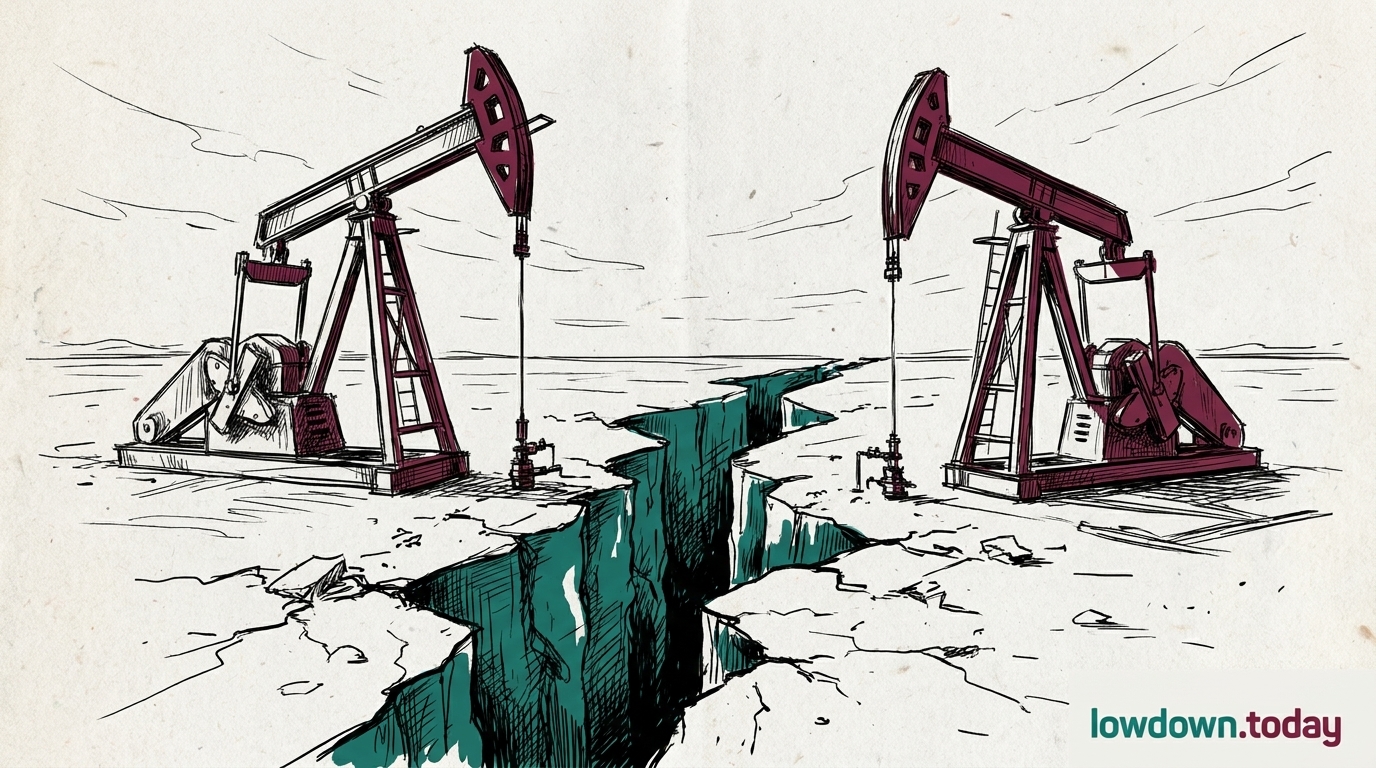
The split between the Foreign Ministry's softer language and Fars News's harder line reveals competing signals from within the Iranian state about what Islamabad means.
Different Perspectives
Greek shipping registries
Flag states dominating the tanker fleet await the EU's 15 July cap-freeze vote. A formula unlock toward $75 would loosen the ceiling squeezing insurance and crewing costs on their registered hulls.
US money managers
US money managers
NYMEX WTI managed-money net long fell 23% to +64,041 in the week to 7 July, trimming length into the rally on doubt the Hormuz premium survives without freight or war-risk confirmation.
European refiners (ARA)
ARA refiners are capturing an $80/bbl US diesel crack as Russian gasoil loadings collapsed to 234kbd before Novak's 31 July export ban even bites, widening the arbitrage straight into refining margins.
OPEC+
OPEC+
The seven-member group confirmed a fourth consecutive 188kbd August hike on 5 July, defending market share even though Saudi Arabia's $108-111/bbl breakeven means every added barrel costs Riyadh revenue it cannot recoup.
Indian refiners
Indian refiners
Refiners kept lifting discounted Urals as the India/Baltic split widened past $9-10 a barrel on 7 July. A wider Urals-Brent gap means cheaper feedstock locked in against Baltic buyers.
Russia
Russia
Urals traded $48.95-55.12 on 12-13 July, below Moscow's $59 budget floor even as Brent gained $6. Oil and gas fund roughly 30% of federal revenue, and Novak's diesel export ban is rationing a shrinking export base.