Skip to content
You can now search across every topic, entity and event.What's new
European Oil Markets
3JUL

CEPA scale check: 0.46% of Russian oil

3 min read
10:26UTC

David Axe at CEPA, citing RUSI research, assessed Ukraine's 130 oil strikes in 2025 produced $863 million of damage against roughly $189 billion in annual Russian oil revenue.

EconomicDeveloping
Key takeaway

Ukraine's oil strike campaign delivers footage; the revenue figures sit on the wrong side of the scale.

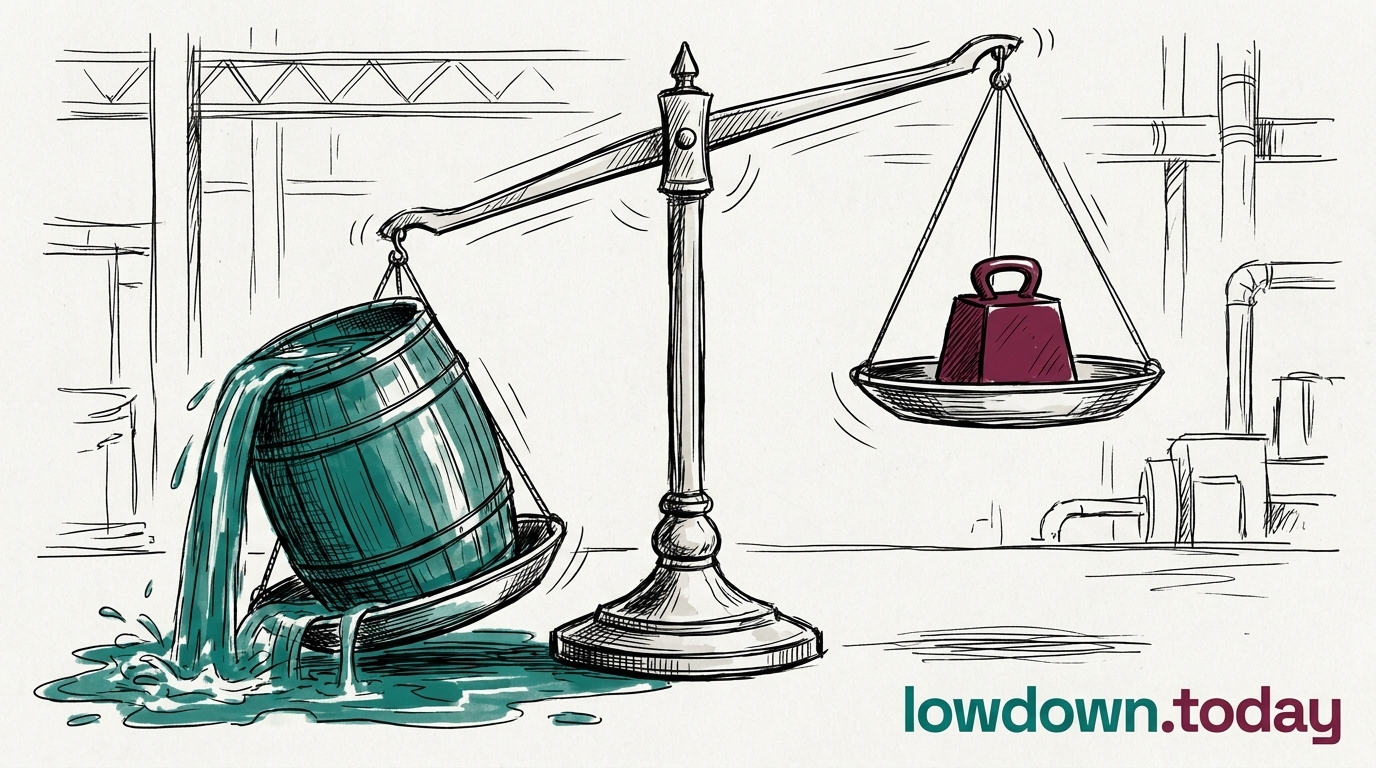
David Axe at CEPA (Center for European Policy Analysis), citing RUSI research published this month, assessed that Ukraine's 130 refinery and port strikes in 2025 delivered only a 6% export reduction against 2024 1. Cumulative damage came to $863 million against roughly $189 billion in annual Russian oil revenue, or 0.46% of the base.

That is roughly the cost of three weeks of Patriot operations in the Middle East, set against a rounding error in Moscow's books. At that tempo, Ukraine would need over two centuries of strike operations to match a single year of Russian oil revenue. Ukrainian targeteers pick lightly-defended terminals for visible damage, leaving hardened core infrastructure intact. Footage does most of the work the revenue figures do not.

Two separate considerations compound the scale problem. Fire Point, the Ukrainian consortium manufacturing the Flamingo cruise missile , is reportedly under investigation by NABU (Ukraine's National Anti-Corruption Bureau). Only nine Flamingos have been fired in six months, against the hundreds that any serious strike campaign against hardened infrastructure would require. And the Iran war separated price from volume in a way the infrastructure campaign cannot control: Urals rode the Hormuz premium while Baltic throughput was recovering. When Kyiv asks for Patriots for ballistic defence while launching its own drones at pipelines Chevron part-owns, the two trade-offs sit on the same ledger.


Deep Analysis

In plain English

Ukraine has been hitting Russian oil refineries and export terminals in a campaign aimed at cutting the revenue that funds Russia's military. A new report from the Center for European Policy Analysis and RUSI found that 130 such strikes across 2025 reduced Russia's oil exports by only 6% and caused $863 million in total damage. Russia earns roughly $189 billion per year from oil. So the entire year of strikes damaged the equivalent of 0.46% of annual revenue. To put that in context, Russia earns back that amount in about 42 hours. The Iran war's oil price spike likely generated more revenue for Russia in a single week than Ukraine's entire 2025 strike campaign cost Russia in a year.

What could happen next?
  • Meaning

    The CEPA finding reframes the Baltic and Black Sea oil campaigns as primarily having operational-denial value, not economic attrition value; Ukraine's justification for the campaign must shift accordingly.

    Immediate · 0.78
  • Risk

    If the Fire Point/NABU investigation reveals systematic corruption in Ukraine's precision strike procurement, it will complicate Western partner willingness to fund further anti-infrastructure weapons deliveries.

    Short term · 0.62
  • Opportunity

    The 6% export-volume reduction, while small in revenue terms, represents real capacity constraints on specific refinery outputs (aviation fuel, diesel) that have strategic value beyond headline revenue figures.

    Medium term · 0.55
First Reported In

Update #12 · Three narrowings of US support for Kyiv

Center for European Policy Analysis· 11 Apr 2026
Read original
Causes and effects
This Event
CEPA scale check: 0.46% of Russian oil
Load-bearing counter-evidence against the narrative that Ukraine's strike campaign is constraining Russian oil revenue.
Different Perspectives
Indian refiners
Indian refiners
Indian refiners kept lifting discounted Urals as the India/Baltic price split widened past $9-10 a barrel, a gap that only grows as GL X1's Iranian wind-down cuts an alternative discounted grade off the market by 17 July. Cheaper Russian feedstock is being locked in while it lasts.
Chinese refiners
Chinese refiners
Chinese refiners gain leverage as the Urals-Brent discount widens, since Beijing's state buyers already source discounted Russian barrels near the fiscal floor unaffected by Western insurance costs. A wider discount, if it holds past 23 July, lets them lock in cheaper term contracts regardless of the cap's outcome.
US money managers (CFTC-tracked)
Managed money trimmed WTI net length into the rally, positioning that reflects doubt the Hormuz premium survives without freight or war-risk confirmation. The Brent-WTI spread widening almost entirely on the Brent leg supports that scepticism about a broad-based repricing.
OPEC+ (Saudi-led subgroup)
Saudi Arabia is defending market share through a fourth straight 188kbd August hike even as OPEC's own July MOMR cut 2026 demand growth for the fourth consecutive month. At a $108-111 fiscal breakeven, every added barrel costs Riyadh revenue it cannot recoup, so the hike reads as a positioning signal, not a demand bet.
Greek shipping registries
Greece, backed by Cyprus and Malta, is pushing a three-month cap-freeze compromise against the Commission's freeze to January 2027 ahead of the 23 July vote. Athens' and Valletta's combined tanker registrations mean a shorter review gives their insurers more frequent chances to reprice risk on Russian cargoes.
Russia (Deputy PM Alexander Novak)
Novak extended the diesel export restriction to producers on 8 July, the first producer-binding curb of the war, protecting the domestic pump price ahead of any refinery repair timeline. Urals still trades below Russia's $59 budget floor even as Brent gained, so the ban trades export revenue for fiscal stability at home.