Skip to content
You can now search across every topic, entity and event.What's new
European Energy Markets
31JUL

Vance Arrives for First Iran Talks

2 min read
09:44UTC

JD Vance, US Vice President

EconomicDeveloping
Key takeaway

Both delegations are structurally compromised before the first session begins.

JD Vance arrived in Islamabad on Friday leading a 30-member US delegation to the Serena Hotel for Saturday's opening session, the first principal-level bilateral contact between the United States and Iran since 1979. The JCPOA (Joint Comprehensive Plan of Action) was negotiated through multilateral channels with no direct meetings at this level. Saturday's format, if it holds, is structurally new.

Steve Witkoff and Jared Kushner are back in the room. Their removal was the concession that unlocked the ceasefire , yet The White House reinstated both, a signal that either the terms will not favour Tehran or that domestic US optics outweigh Iranian red lines. Abbas Araghchi, Iran's Foreign Minister, confirmed attendance but said he arrives "with complete distrust."

The Iranian delegation now includes Mohammad Bagher Ghalibaf, who rejected the ceasefire framework on 9 April , creating a de facto Majlis (parliamentary) veto inside the negotiating room. With no shared legal text, no verification mechanism, and a compromised venue, Saturday must produce something written to have lasting effect. Rhetorical agreement without text is indistinguishable from the current state of affairs.


Deep Analysis

In plain English

The US vice president flew to Pakistan to meet Iranian officials face to face — something that has not happened at this level in nearly 50 years. But two of the Americans in the room were previously kicked out of earlier talks at Iran's insistence, and one of the Iranian officials publicly rejected the ceasefire just two days ago. The meeting is the most senior US-Iran contact since 1979, happening under the worst structural conditions of any such meeting in that period.

Deep Analysis
Root Causes

Iran's requirement that Witkoff and Kushner be excluded from talks stemmed from their association with the Abraham Accords and Gulf normalisation deals that Tehran reads as explicitly anti-Iranian regional architecture. Reinstating them signals the White House does not consider Iranian domestic political sensitivities a binding constraint.

The 47-year gap in direct US-Iran engagement reflects structural enmity rooted in the 1979 hostage crisis, the US support for Iraq in the 1980-1988 war, and Iran's categorisation as a state sponsor of terrorism. Neither side has the institutional machinery or diplomatic staff fluent enough in the other's political culture to conduct fast-moving bilateral talks reliably.

Escalation

High risk of talks producing no shared text, compressing all remaining diplomacy into 11 days before the 22 April ceasefire expiry.

What could happen next?
  • Risk

    A failed Saturday session leaves only 11 days to the 22 April ceasefire expiry with no legal framework and no fallback process.

    Immediate · Assessed
  • Consequence

    Witkoff and Kushner's reinsertion has already been read by Tehran as proof the White House is not bound by its own prior concessions — eroding the credibility of any new US commitment made in Islamabad.

    Short term · Assessed
  • Precedent

    If principal-level talks proceed without a shared agenda or mediating text, they establish a pattern where seniority substitutes for process — and where failure can be mutually blamed on the other side.

    Medium term · Assessed
First Reported In

Update #64 · Islamabad talks open already cracked

Bloomberg· 10 Apr 2026
Read original
Different Perspectives
Spain's LNG terminal operators
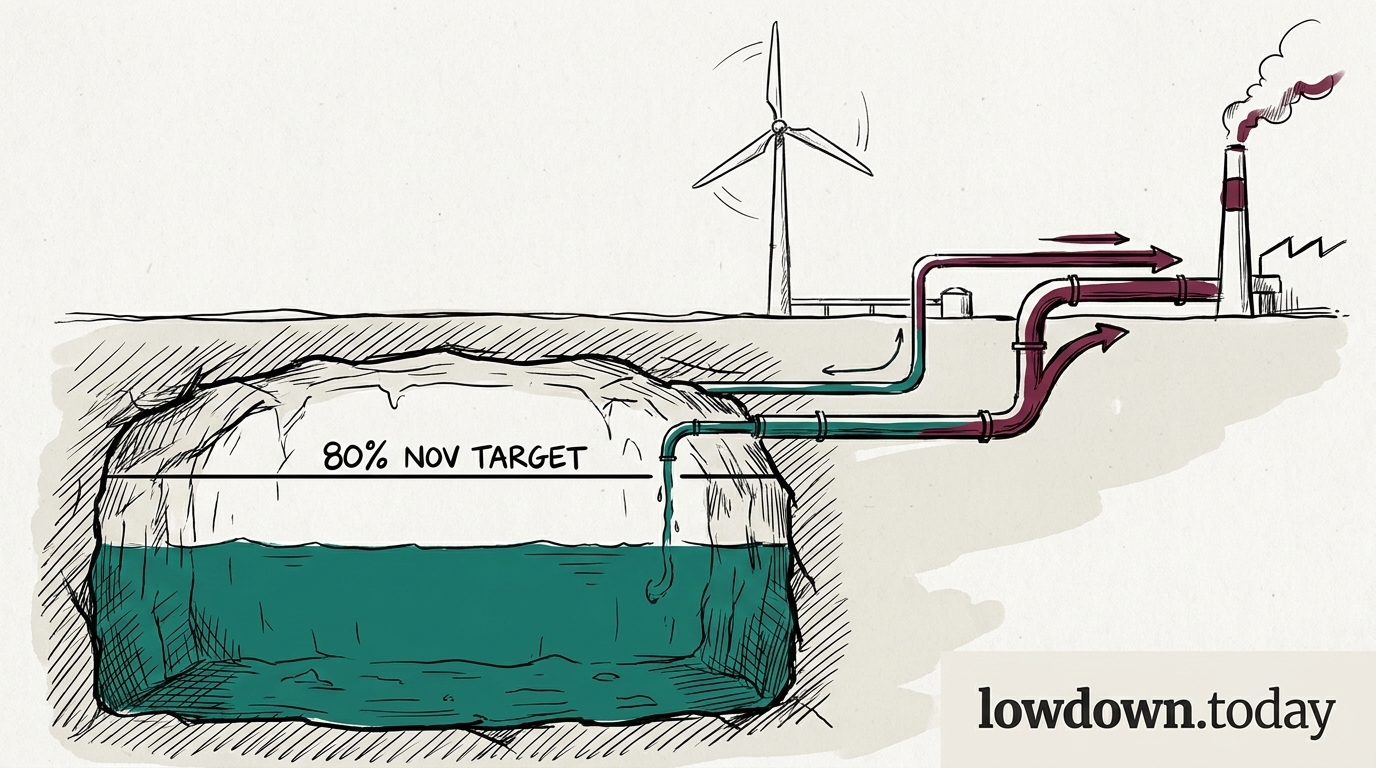
Spain's 9,145 GWh terminal inventory is the largest single stock in the EU LNG network, an option value that can reroute cargoes wherever the winter strip pays best rather than a cavern gas obligation tied to a fixed date. That flexibility matters more as Germany's cavern shortfall pushes more of the winter security question onto import infrastructure.
European Commission
European Commission
Brussels holds the bloc to 90% on a flexible window while Germany, holding roughly a quarter of EU storage capacity, tracks toward missing its own lower 80% figure by 21 points. A national shortfall this size in the anchor market matters more to bloc security than the flexible timetable alone can absorb.
French power exporters and CRE
French day-ahead rose in step with Germany but by less, reopening a EUR 7-17 premium that makes northward export flows commercially attractive again after the EUR 43.09 discount evaporated in days. CRE separately authorised RTE and Enedis to buy flexibility locally, betting the coming winter's binding constraint is grid congestion rather than a shortage of firm capacity.
TTF trading desk
TTF trading desk
A visible national shortfall like Germany's 21-point gap is a directional signal, not noise, for a desk holding the summer-winter spread. TTF's flat EUR 58-60 range through this week's German price swings says the market has not yet chosen to reprice refill risk into the front of the curve.
German cavern and CCGT operators
German caverns kept buying prompt gas at TTF near EUR 58-60 through the inversion; the wind collapse to 2.4 GW then flipped the spark spread to plus EUR 29 and put turbines back in the same queue. Every day turbines win that bid, injection at a third of the 877 GWh/day pace needed falls further behind.
Slovakia
Slovakia
Slovakia says it dropped its hold-out on the 21st sanctions package only after Ursula von der Leyen personally signed written gas-price and supply guarantees. The Council of the European Union's own 17,238-character release on the package names neither Slovakia nor any guarantee, leaving Bratislava's account unconfirmed by the institutional record.



