Skip to content
You can now search across every topic, entity and event.What's new
European Energy Markets
31JUL

Vahidi's IRGC writes the diplomatic track

2 min read
09:44UTC

Major General Ahmad Vahidi and his hardline IRGC faction have seized operational control of Iran's military posture and negotiating delegation, sidelining civilian moderates including Foreign Minister Abbas Araghchi, according to GlobalSecurity.org analysis on 22 April.

EconomicAssessed
Key takeaway

Iran now runs two foreign policies on the same day, and the one with boarding parties has operational priority.

Major General Ahmad Vahidi and his hardline IRGC faction have taken operational control of Iran's military posture and negotiating delegation, GlobalSecurity.org reported on 22 April, sidelining civilian moderates including Foreign Minister Abbas Araghchi 1. The 17-18 April Hormuz open-then-close sequence, when the Foreign Ministry announced a reopening and the corps reversed it inside hours, set the pattern. The 22 April boardings confirmed it.

Vahidi rejected negotiations on Day 53 , telling IRGC deputies the corps opposes any settlement while the US blockade stands. Baqaei declared on 19 April that Iran's enriched uranium was non-transferable ; on Day 54 the corps translated that rhetorical line into boarding parties executed under the four-condition Tabnak order .

The split runs on institutional rails. The Majlis's 221-0 vote on 11 April to suspend IAEA cooperation, delivered through Speaker Mohammad Bagher Ghalibaf's bloc, gave the corps legal cover for what it now executes on the water. Any Araghchi signature at Islamabad, Oslo or Vienna is a starting offer the corps will choose whether to honour.


Deep Analysis

In plain English

Iran has two separate military structures. The regular army follows the elected government's orders. The IRGC, or Islamic Revolutionary Guard Corps, follows the Supreme Leader directly and has accumulated enormous economic and political power since Iran's 1979 revolution. Major General Ahmad Vahidi leads the IRGC's hardline faction. On 22 April his group effectively took control of both Iran's military operations and the diplomatic team that normally negotiates with foreign governments. Vahidi's faction pushed Foreign Minister Araghchi out of the decision-making loop on military and negotiating matters. This matters for any peace deal because the IRGC controls the ships, the ports, and the mines in the Strait of Hormuz. Even if Iran's civilian government signs an agreement, the corps can ignore it. Any deal that doesn't have explicit IRGC buy-in is unlikely to hold.

Deep Analysis
Root Causes

Iran's 1979 constitution created a parallel military structure in the IRGC that answers to the Supreme Leader directly, bypassing the elected government and conventional army chain of command. Over four decades the corps accumulated economic assets worth an estimated $200 billion: port operations, construction, and petrochemical contracts. A deal that reopens Hormuz to neutral shipping ends the corps's monopoly on the authorised transit channel it established via the Tabnak four-condition order.

Araghchi's admission that no surviving facility can enrich uranium at threshold levels surrendered Iran's primary nuclear bargaining chip without IRGC authorisation. The corps treats that concession as illegitimate because Araghchi lacks command authority over the nuclear programme he offered to constrain.

First Reported In

Update #77 · Pentagon: six months to clear Hormuz mines

GlobalSecurity.org· 23 Apr 2026
Read original
Different Perspectives
Spain's LNG terminal operators
Spain's 9,145 GWh terminal inventory is the largest single stock in the EU LNG network, an option value that can reroute cargoes wherever the winter strip pays best rather than a cavern gas obligation tied to a fixed date. That flexibility matters more as Germany's cavern shortfall pushes more of the winter security question onto import infrastructure.
European Commission
European Commission
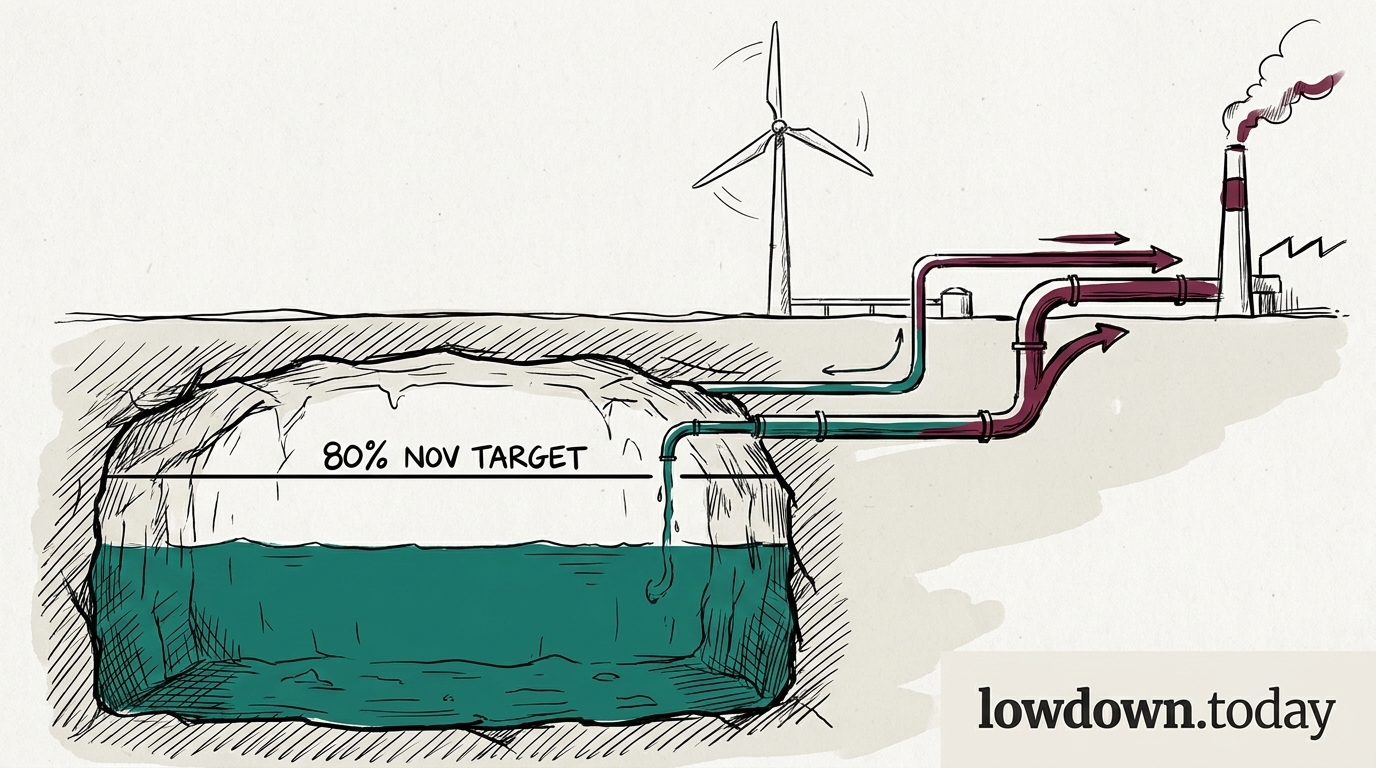
Brussels holds the bloc to 90% on a flexible window while Germany, holding roughly a quarter of EU storage capacity, tracks toward missing its own lower 80% figure by 21 points. A national shortfall this size in the anchor market matters more to bloc security than the flexible timetable alone can absorb.
French power exporters and CRE
French day-ahead rose in step with Germany but by less, reopening a EUR 7-17 premium that makes northward export flows commercially attractive again after the EUR 43.09 discount evaporated in days. CRE separately authorised RTE and Enedis to buy flexibility locally, betting the coming winter's binding constraint is grid congestion rather than a shortage of firm capacity.
TTF trading desk
TTF trading desk
A visible national shortfall like Germany's 21-point gap is a directional signal, not noise, for a desk holding the summer-winter spread. TTF's flat EUR 58-60 range through this week's German price swings says the market has not yet chosen to reprice refill risk into the front of the curve.
German cavern and CCGT operators
German caverns kept buying prompt gas at TTF near EUR 58-60 through the inversion; the wind collapse to 2.4 GW then flipped the spark spread to plus EUR 29 and put turbines back in the same queue. Every day turbines win that bid, injection at a third of the 877 GWh/day pace needed falls further behind.
Slovakia
Slovakia
Slovakia says it dropped its hold-out on the 21st sanctions package only after Ursula von der Leyen personally signed written gas-price and supply guarantees. The Council of the European Union's own 17,238-character release on the package names neither Slovakia nor any guarantee, leaving Bratislava's account unconfirmed by the institutional record.



