Skip to content
You can now search across every topic, entity and event.What's new
European Energy Markets
31JUL

Storage 35.4% met, 80% trajectory missed

4 min read
09:44UTC

EU aggregate gas storage reached 35.4% on Tuesday 12 May, clearing the marquee threshold flagged in update #8, yet the 7-to-12 May injection pace of 0.22 pp/day stayed below the 0.257 pp/day floor the bloc needs for 80% by 1 November.

EconomicDeveloping
Key takeaway

Crossing 35.4% on Brussels's calendar does not rescue a season tracking to land near 73% on 1 November.

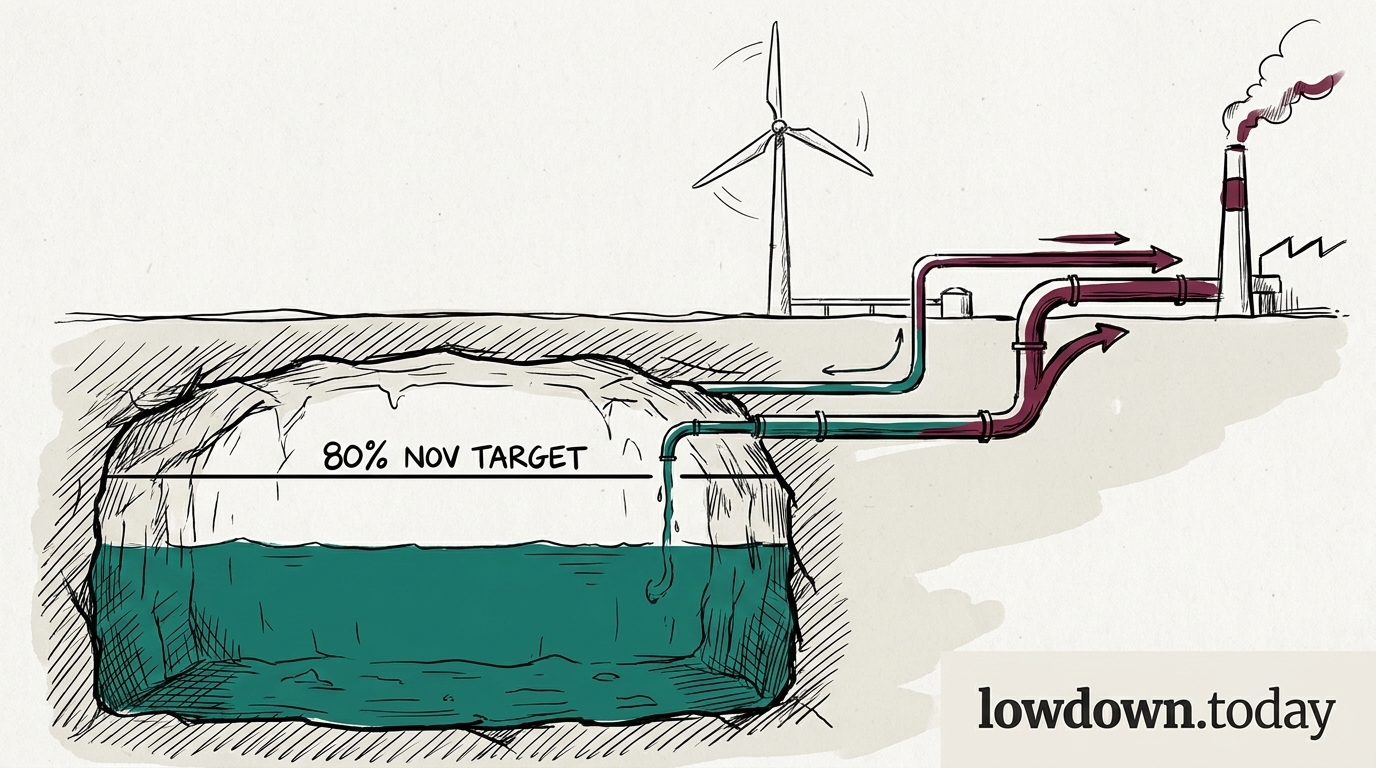
EU aggregate gas storage crossed 35.05% on Sunday 10 May and reached 35.4% on Tuesday 12 May, clearing the marquee threshold flagged at 34.3% in update #8 . GIE AGSI+ is the authoritative daily storage data source for EU underground caverns; the wires read the print as a clean positive on 10-11 May. The arithmetic underneath does not.

From 7 to 12 May the EU added roughly 1.1 percentage points across five days, a pace of 0.22 pp/day. The floor needed to hit 80% by 1 November, the reduced statutory target the European Commission cut from 90% in April , is 0.257 pp/day. EnergyRiskIQ's parallel arithmetic for the original 90% target requires 3,472 GWh/day of bloc-wide injection, a rate the EU is not running at and shows no sign of reaching 1. Holding the current pace lands the bloc near 73% on 1 November, a shortfall of roughly 36 TWh against the official mandate.

This is the third consecutive briefing where the headline data point has landed inside the official success bound while the rate of change has disqualified the year. Update #6 framed the gap . Update #8 narrowed it to 0.248 pp/day . Update #9 confirms the gap persists at 0.22 to 0.25 even with Germany injecting 959 GWh on 4 May and a season-high 745 GWh on 25 April still in the rearview. Peripheral estates have carried the injection load while Germany sits at roughly 27 to 30% twelve days into May, materially below the bloc average.

The path of least resistance from here is silent acceptance of a sub-target outcome rather than a fresh legal cut. The 80% number was already a politically negotiated retreat from 90% , and a second formal cut requires Council unanimity that the members who blocked the original 90% will not provide. Bruegel's three-scenario refill model resolved at EUR 26 billion at EUR 45/MWh TTF; at EUR 47.23 the cost line creeps higher inside an unchanged regasification ceiling of approximately 145 bcm per winter season. The structural deficit Germany opened in winter is not closing on a calendar that allows it to close.


Deep Analysis

In plain English

European countries store natural gas underground in large caverns during summer, then draw from those reserves to heat homes and power industry through winter. The EU set a target: have the caverns 80% full by 1 November. As of 12 May, the caverns are only 35.4% full. At the current rate of 0.22 percentage points per day, Europe would reach about 73% by 1 November, leaving a gap of roughly 36 TWh against the statutory 80% target. That gap is equivalent to about two fully loaded LNG tankers per week that Europe would need to import but cannot procure at the current filling pace. Germany's caverns are only about 27-30% full, well behind the EU average, pulling down the bloc-wide rate. If prices spike in winter as a result, energy bills for households and businesses could rise, and factories that use a lot of gas may cut production.

Deep Analysis
Root Causes

Germany's structural under-injection through April and early May is the primary driver. Germany entered the 2026 injection season at the lowest fill since 2018, and its average pace since 13 April of 0.179 pp/day has weighed on the bloc average despite peripheral estate contributions.

Germany's storage deficit opened during winter 2025-26 when its swing-producer role (absorbing demand peaks and supply shortfalls) depleted cavern stocks faster than the post-2022 injection ceiling allowed recovery.

The Dutch contribution compounds the problem. GasTerra depleted Norg (59 TWh) and Grijpskerk (24 TWh) to structural zero before the NAM handover, leaving Bergermeer as the sole active Dutch injection facility against an EBN state mandate of EUR 233m. The two largest continental injection estates are both under-pacing; peripheral gains in France and Spain carry the headline number but cannot compensate at scale.

The 36 TWh shortfall against the 80% target translates to approximately two LNG cargoes per week through the summer injection window. At EUR 47.23 TTF, procuring that substitution volume costs roughly EUR 26bn at the Bruegel lower-bound, rising as TTF approaches EUR 55 on the forward strip. That cost lands on member states whose fiscal capacity is already stretched by the EUR 11bn in untargeted VAT and excise cuts tracked by Bruegel through May.

What could happen next?
  • Risk

    A 73% storage landing on 1 November raises acute cold-snap gas-shortage risk in Q1 2027 that a 73% starting position cannot buffer as effectively as the statutory 80% floor.

    Short term · 0.78
  • Consequence

    German and Dutch chronic under-pacing means peripheral estates (France, Spain, Poland) carry the bloc headline; if any peripheral estate slows, the aggregate pace collapses without a German acceleration.

    Immediate · 0.82
  • Risk

    The EUR 55.21 twelve-month TTF forward prices in tighter winter conditions; a failure to close the 36 TWh gap through July would revise that forward sharply higher, compressing industrial margins further.

    Medium term · 0.71
First Reported In

Update #9 · Storage 35% met, 80% trajectory still missed

EnergyRiskIQ· 12 May 2026
Read original
Causes and effects
This Event
Storage 35.4% met, 80% trajectory missed
The threshold-met, pace-missed pattern is now the third consecutive briefing reading; at current injection pace the EU lands near 73% by 1 November against an 80% statutory target, a shortfall of roughly 36 TWh.
Different Perspectives
Spain's LNG terminal operators
Spain's 9,145 GWh terminal inventory is the largest single stock in the EU LNG network, an option value that can reroute cargoes wherever the winter strip pays best rather than a cavern gas obligation tied to a fixed date. That flexibility matters more as Germany's cavern shortfall pushes more of the winter security question onto import infrastructure.
European Commission
European Commission
Brussels holds the bloc to 90% on a flexible window while Germany, holding roughly a quarter of EU storage capacity, tracks toward missing its own lower 80% figure by 21 points. A national shortfall this size in the anchor market matters more to bloc security than the flexible timetable alone can absorb.
French power exporters and CRE
French day-ahead rose in step with Germany but by less, reopening a EUR 7-17 premium that makes northward export flows commercially attractive again after the EUR 43.09 discount evaporated in days. CRE separately authorised RTE and Enedis to buy flexibility locally, betting the coming winter's binding constraint is grid congestion rather than a shortage of firm capacity.
TTF trading desk
TTF trading desk
A visible national shortfall like Germany's 21-point gap is a directional signal, not noise, for a desk holding the summer-winter spread. TTF's flat EUR 58-60 range through this week's German price swings says the market has not yet chosen to reprice refill risk into the front of the curve.
German cavern and CCGT operators
German caverns kept buying prompt gas at TTF near EUR 58-60 through the inversion; the wind collapse to 2.4 GW then flipped the spark spread to plus EUR 29 and put turbines back in the same queue. Every day turbines win that bid, injection at a third of the 877 GWh/day pace needed falls further behind.
Slovakia
Slovakia
Slovakia says it dropped its hold-out on the 21st sanctions package only after Ursula von der Leyen personally signed written gas-price and supply guarantees. The Council of the European Union's own 17,238-character release on the package names neither Slovakia nor any guarantee, leaving Bratislava's account unconfirmed by the institutional record.



