Skip to content
You can now search across every topic, entity and event.What's new
European Energy Markets
8MAY

EU storage at 34.3% before 12 May test

3 min read
11:12UTC

EU aggregate gas storage reached 34.3% on 7 May, an injection pace of 0.248 pp/day that sits 0.009 pp/day below the 0.257 pp/day floor needed for 80% by 1 November.

EconomicDeveloping
Key takeaway

The 12 May 35% test is now four working days away with the pace 0.009 pp/day inside the November floor.

EU aggregate gas storage reached 34.3% on 7 May, GIE AGSI+ (Aggregated Gas Storage Inventory) data shows, a 1.24 percentage-point gain on the 33.06% reading from 2 May . The implied pace, 0.248 pp/day, sits 0.009 pp/day inside the 0.257 pp/day floor that update #7 set as the threshold for clearing 80% by 1 November . The 35% threshold sits 0.7 pp away with four working days before the 12 May WATCH FOR resolves.

GIE AGSI+ is the EU's transparency feed for member-state and facility-level fill, published daily. The pace floor is not arbitrary: it is what the 1 November target requires from a 33.06% start. Below it, every session adds a forward-curve problem the front month cannot reflect, because the gap compounds rather than resolves.

At the 0.248 pp/day pace, the 35% threshold crosses on 10 or 11 May. A holiday-weekend deceleration or any aggregate slip pushes that crossing past the 12 May test. Bruegel's EUR 26 billion refill model assumes the floor is met, not stress-tested for the inverse case where merchant operators face inverted spreads. Germany's structural shortfall is the composition risk inside the aggregate, and the next event takes that down to facility level.


Deep Analysis

In plain English

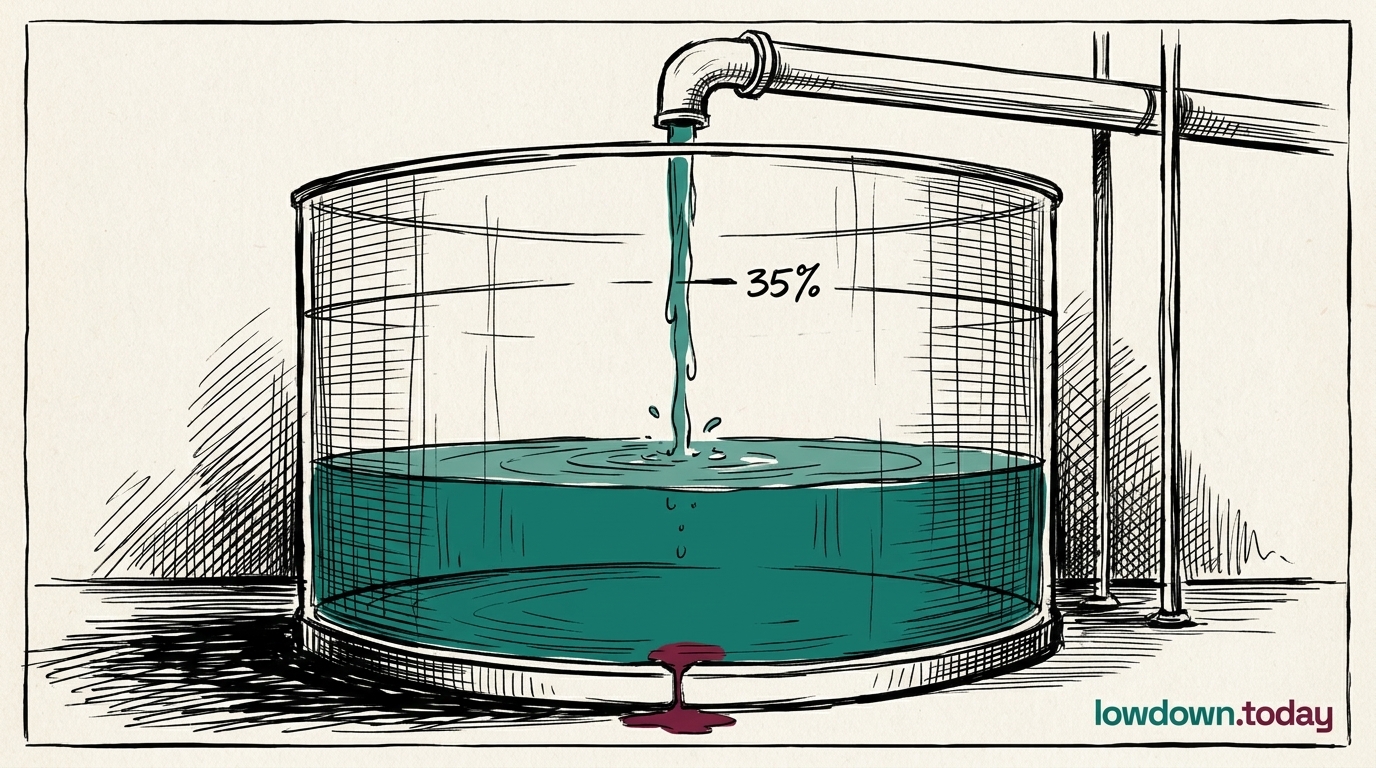
Each year, European countries spend the warm months pumping natural gas into underground storage tanks to prepare for winter. There is a target: reach 80% full by 1 November. Think of it like filling a reservoir before a dry season. As of 7 May, the fill level is 34.3%, rising at 0.248 percentage points per day. To reach 80% by November, Europe needs 0.257 points per day. The gap is small, nine thousandths of a percentage point, but it compounds each day it persists. On 12 May there is a test date: if storage has not crossed 35% by then, it signals the shortfall is structural rather than a slow week. Structural means fixing it becomes progressively harder because the required catch-up rate increases daily.

Deep Analysis
Root Causes

The 0.257 pp/day floor was set against a storage baseline of 33.06% on 2 May with 183 days remaining to 1 November. The required pace follows directly from that starting point. What makes the shortfall structural rather than seasonal is the removal of the gas storage levy on 1 January 2026, the instrument that previously shifted merchant incentives toward injection at spreads where commercial logic would otherwise favour withdrawal or deferred commitment.

Without the levy, injection pace is a function of the summer–winter TTF spread adjusted for storage capacity rental, injection energy cost, and financing cost. At EUR 44/MWh TTF front-month against a EUR 52–55/MWh Cal-26 Q4 implied level, the spread may not clear the all-in injection cost for high-marginal-cost cavern operators.

Bruegel's EUR 26bn refill model bakes in the floor being met; it does not stress-test the case where below-floor pace is the market-clearing outcome rather than the deviation.

What could happen next?
  • Risk

    If EU aggregate pace stays at 0.248 pp/day through June, the November fill projects to 73-75%, below the 80% threshold, triggering Commission emergency review procedures.

    Medium term · 0.7
  • Consequence

    Below-floor pace removes the core assumption in Bruegel's EUR 26bn refill model (ID:2822); the inverse scenario where the same spend buys 73% rather than 80% fill has not been publicly costed.

    Short term · 0.8
  • Precedent

    The removal of the gas storage levy on 1 January 2026 is the first test of whether the EU can achieve its November fill target on commercial incentives alone, without the levy's injection subsidy.

    Long term · 0.85
First Reported In

Update #8 · Storage 34.3 as 12 May test nears; Hammerfest silent

EnergyRiskIQ (aggregating GIE AGSI+)· 8 May 2026
Read original
Different Perspectives
EU carbon and storage regulators
EUA carbon broke EUR 81/tonne on 13 July as the ETS Market Stability Reserve's scheduled withdrawals met fresh fuel-switching demand from France's nuclear curtailment. Brussels' mandatory storage-fill rule kept German and French injection running regardless of the TTF swings, the mechanism working as designed four years after the 2022 shock.
Equinor
Equinor
Equinor returned its Asgard field from maintenance on 11 July, lifting Gassco's exit nominations to 319.8 mcm/day just as TTF round-tripped on Hormuz risk. The restart gave Norway spare pipeline capacity to help Europe absorb the gas rally without drawing down storage, reinforcing its role as the post-2022 swing supplier.
Germany
Germany
Germany briefly became the cheaper leg of the FR-DE spread on 12 July as French reactors went offline, while its own storage injection tripled to 723 GWh on 11 July under the EU's mandatory fill rule. Berlin's CCGT fleet absorbed the extra load at a time when EUA's climb past EUR 81 is raising its own marginal cost too.
EDF
EDF
EDF took Chooz, Golfech and Bugey fully offline on 12 July under river-cooling discharge limits, then secured a temperature exemption for Bugey to 20 July rather than wait for the rivers to cool. The government's willingness to relax the environmental ceiling shows French grid security now outweighs the permit breach when reactor hardware itself is undamaged.
Storage and injection-pace desk
EU storage sat at 51.1% on 8 July, still running below the pace needed for an 80% November target, and the JKM-TTF Asia premium of roughly USD 1.4-2.4/MMBtu was already pulling marginal cargoes east before Qatar's withdrawal compounded the gap. October's top-up remains the binding constraint, not this week's price level.
EDF / France
EDF / France
EDF added Chooz to its heat-curtailment watch list as a precaution against the second heat dome peaking 9-14 July, alongside standing warnings at Blayais, Bugey, Golfech and Saint-Alban. No output cut has been confirmed at any site as of 10 July.
