Skip to content
You can now search across every topic, entity and event.What's new
European Energy Markets
31JUL

Bruegel puts refill bill at EUR 35bn

3 min read
09:44UTC

The Brussels think tank's estimate is the most precise public figure for the 2026 injection campaign: 55% above 2025, requiring 180 extra LNG cargoes.

EconomicDeveloping
Key takeaway

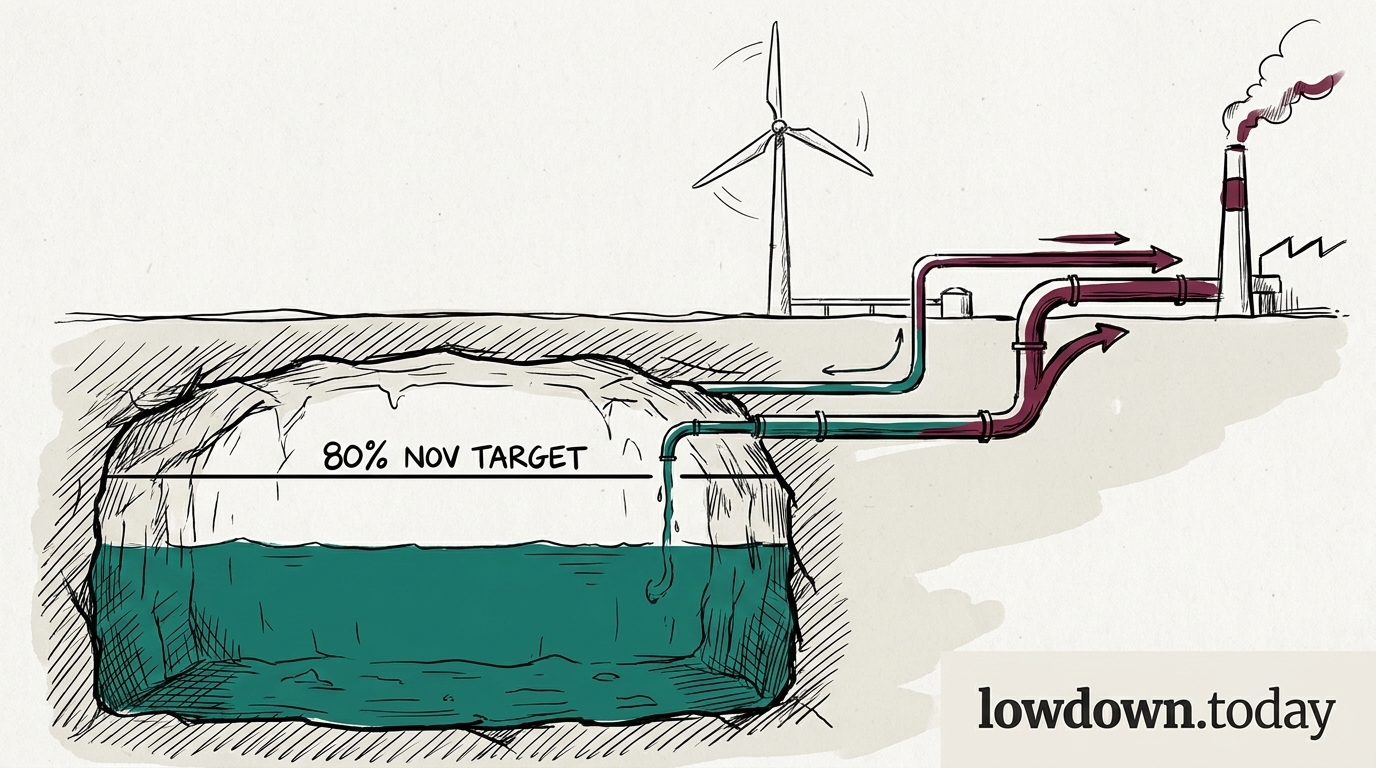
Reaching 80% storage requires 180 extra LNG cargoes at an estimated EUR 35 billion, 55% above 2025.

Bruegel, the Brussels-based economic think tank, estimated the cost of refilling EU gas storage to the revised target at EUR 35 billion at EUR 60/MWh, 55% above last year's equivalent costs. Europe needs approximately 180 additional LNG cargoes compared to last summer to reach the revised target by November. A gas price doubling from pre-crisis levels would add EUR 100 billion to the EU's annual import bill, which was EUR 117 billion last year.

Bruegel's policy recommendation includes an untested lever: a buyer coalition with Japan and South Korea, which together with the EU represents 60% of global LNG demand. Coordinated purchasing could counteract the cargo-by-cargo bidding war that currently favours sellers. No such coalition has been attempted at this scale, and the coordination challenges between three blocs with different regulatory frameworks and procurement cycles are substantial.


Deep Analysis

In plain English

A Brussels-based economic research organisation called Bruegel has calculated what it will cost Europe to refill its gas storage this summer. The answer is approximately EUR 35 billion, using current gas prices, and that is just to reach the newly lowered 80% target. Bruegel has also suggested that Europe should try to negotiate as a block with Japan and South Korea, the other major gas importers, to avoid all three bidding against each other for the same limited supply. If they compete separately, prices go up for everyone.

Deep Analysis
Root Causes

The EUR 35 billion refill cost reflects a structural illiquidity in the global LNG spot market. Unlike oil, where OPEC can release swing production within weeks, LNG supply is constrained by liquefaction train capacity that was committed 5-7 years earlier.

The US LNG expansion projects approved in 2019-21 (Sabine Pass Train 6, Calcasieu Pass, Plaquemines LNG) are coming online in 2025-26, but their output is 70-80% pre-committed under long-term contracts. The true spot market available to the EU is therefore a fraction of total Atlantic LNG output.

What could happen next?
  • Opportunity

    A coordinated EU-Japan-South Korea LNG buyer coalition could reduce spot cargo costs by 5-10% through demand aggregation, saving up to EUR 2-3.5 billion on the 180 additional cargo requirement.

  • Risk

    If all 180 additional cargoes must be sourced as spot, uncoordinated member state purchasing will replicate the 2022 competitive premium, pushing actual refill costs above Bruegel's EUR 35bn central estimate.

First Reported In

Update #1 · Europe's thinnest gas cushion since 2018

Bruegel· 13 Apr 2026
Read original
Different Perspectives
Spain's LNG terminal operators
Spain's 9,145 GWh terminal inventory is the largest single stock in the EU LNG network, an option value that can reroute cargoes wherever the winter strip pays best rather than a cavern gas obligation tied to a fixed date. That flexibility matters more as Germany's cavern shortfall pushes more of the winter security question onto import infrastructure.
European Commission
European Commission
Brussels holds the bloc to 90% on a flexible window while Germany, holding roughly a quarter of EU storage capacity, tracks toward missing its own lower 80% figure by 21 points. A national shortfall this size in the anchor market matters more to bloc security than the flexible timetable alone can absorb.
French power exporters and CRE
French day-ahead rose in step with Germany but by less, reopening a EUR 7-17 premium that makes northward export flows commercially attractive again after the EUR 43.09 discount evaporated in days. CRE separately authorised RTE and Enedis to buy flexibility locally, betting the coming winter's binding constraint is grid congestion rather than a shortage of firm capacity.
TTF trading desk
TTF trading desk
A visible national shortfall like Germany's 21-point gap is a directional signal, not noise, for a desk holding the summer-winter spread. TTF's flat EUR 58-60 range through this week's German price swings says the market has not yet chosen to reprice refill risk into the front of the curve.
German cavern and CCGT operators
German caverns kept buying prompt gas at TTF near EUR 58-60 through the inversion; the wind collapse to 2.4 GW then flipped the spark spread to plus EUR 29 and put turbines back in the same queue. Every day turbines win that bid, injection at a third of the 877 GWh/day pace needed falls further behind.
Slovakia
Slovakia
Slovakia says it dropped its hold-out on the 21st sanctions package only after Ursula von der Leyen personally signed written gas-price and supply guarantees. The Council of the European Union's own 17,238-character release on the package names neither Slovakia nor any guarantee, leaving Bratislava's account unconfirmed by the institutional record.



