Skip to content
You can now search across every topic, entity and event.What's new
European Energy Markets
31JUL

Germany triples injection rate into ban day

3 min read
09:44UTC

Germany's storage estate flipped to net injection on Wednesday 22 April and accelerated to a season-high 745 GWh on Saturday 25 April, taking national fill to 24.39% from 23.27% on 13 April.

EconomicDeveloping
Key takeaway

Germany's storage flipped without policy intervention; the summer-winter spread did the work.

Germany's gas storage estate flipped to net injection on Wednesday 22 April and accelerated to a season-high 745 GWh on Saturday 25 April, with national fill reaching 24.39%, up from 23.27% on 13 April 1. The four-day acceleration profile ran 57, 93, 482, then 745 GWh, taking the estate from a marginal injector on Wednesday to running flat on the dominant European storage market by the weekend.

Germany is the largest gas storage market in the European Union and the anchor for northwest Europe's summer-winter spread; if the German estate underfills, the rest of the bloc cannot fully rebalance into November. The Bundesnetzagentur (Germany's Federal Network Agency, the gas and electricity regulator) reported a national injection ceiling of 4.3 TWh per day earlier this month , so the 745 GWh print on ban day is roughly 17% of physical capacity. The estate has another 3.5 TWh per day of headroom if commercial spreads support it.

That headroom matters because there was no policy intervention behind the move. AccelerateEU, the European Commission's package published on 22 April, added no storage injection mechanism; the German storage levy was scrapped in January with no replacement instrument; VNG AG's federal-intervention call from earlier this month loses urgency unless the rate slips again in May. The signal for procurement teams is that the summer-winter forward spread finally cleared injection economics for commercial operators on the same week the Russian LNG ban entered force. The remaining question is whether the 24-25 April pace holds through May, when peripheral injectors that carried April need the German anchor to take share back.


Deep Analysis

In plain English

Germany has the largest underground gas storage network in the EU, a series of caverns and depleted gas fields that hold gas during summer, when demand is low, to cover the high-demand winter months. Think of it like filling a tank before a cold snap. Germany started filling its storage again on 22 April after a winter of heavy withdrawals. By 25 April it was injecting 745 gigawatt-hours per day, the highest daily rate of the year so far. The injection ceiling, the maximum the pipes and caverns can physically accept, is about 4,300 GWh per day, so there is plenty of physical room left if commercial conditions support it.

Deep Analysis
Root Causes

Germany's storage estate bottomed at 21% in late March 2026 (the lowest winter-exit since 2018) because two structural factors compounded: first, the cessation of Russian pipeline supply after the TurkStream interdiction attempt forced Germany to consume stored gas faster than pipeline flows could replenish it through Q4 2025; second, the Bundesnetzagentur's early warning status (active since July 2025) did not trigger mandatory injection, it only requires operators to report positions.

The flip to net injection on 22 April came four days into the commercial injection season, which typically opens when April hub forward prices cross above May delivery prices. The acceleration to 745 GWh by 25 April reflects operators responding to spot-to-forward spreads rather than any regulatory mandate.

What could happen next?
  • Opportunity

    If summer-winter TTF spreads hold above EUR 6/MWh through June, German operators have commercial incentive to accelerate injection toward the 2-3 TWh/day range, which would push Germany to 60%+ fill before September.

  • Risk

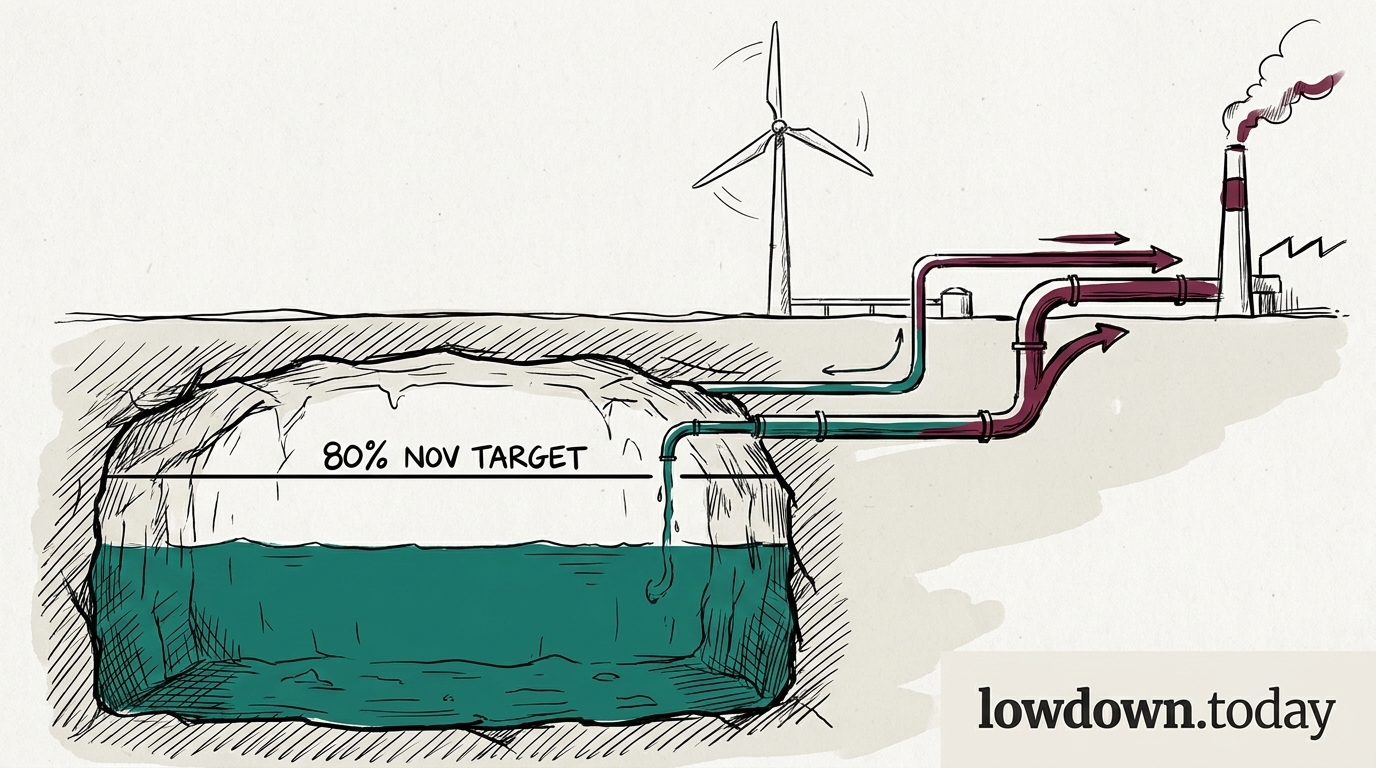
    The 745 GWh rate uses only 17% of physical capacity, meaning a spread compression event (TTF summer rally closing the contango) could halt injection well short of the 80% November target.

First Reported In

Update #5 · Ban day muted; Germany doubles injection rate

Gas Infrastructure Europe· 26 Apr 2026
Read original
Causes and effects
This Event
Germany triples injection rate into ban day
Procurement desks tracking whether Germany would absorb the Russian LNG ban without state intervention got their answer, and the answer was the spread, not policy.
Different Perspectives
Spain's LNG terminal operators
Spain's 9,145 GWh terminal inventory is the largest single stock in the EU LNG network, an option value that can reroute cargoes wherever the winter strip pays best rather than a cavern gas obligation tied to a fixed date. That flexibility matters more as Germany's cavern shortfall pushes more of the winter security question onto import infrastructure.
European Commission
European Commission
Brussels holds the bloc to 90% on a flexible window while Germany, holding roughly a quarter of EU storage capacity, tracks toward missing its own lower 80% figure by 21 points. A national shortfall this size in the anchor market matters more to bloc security than the flexible timetable alone can absorb.
French power exporters and CRE
French day-ahead rose in step with Germany but by less, reopening a EUR 7-17 premium that makes northward export flows commercially attractive again after the EUR 43.09 discount evaporated in days. CRE separately authorised RTE and Enedis to buy flexibility locally, betting the coming winter's binding constraint is grid congestion rather than a shortage of firm capacity.
TTF trading desk
TTF trading desk
A visible national shortfall like Germany's 21-point gap is a directional signal, not noise, for a desk holding the summer-winter spread. TTF's flat EUR 58-60 range through this week's German price swings says the market has not yet chosen to reprice refill risk into the front of the curve.
German cavern and CCGT operators
German caverns kept buying prompt gas at TTF near EUR 58-60 through the inversion; the wind collapse to 2.4 GW then flipped the spark spread to plus EUR 29 and put turbines back in the same queue. Every day turbines win that bid, injection at a third of the 877 GWh/day pace needed falls further behind.
Slovakia
Slovakia
Slovakia says it dropped its hold-out on the 21st sanctions package only after Ursula von der Leyen personally signed written gas-price and supply guarantees. The Council of the European Union's own 17,238-character release on the package names neither Slovakia nor any guarantee, leaving Bratislava's account unconfirmed by the institutional record.



