Skip to content
You can now search across every topic, entity and event.What's new
European Energy Markets
31JUL

Russia Blows Annual Deficit Target in One Quarter

4 min read
09:44UTC

Russia's Q1 2026 budget deficit reached 4.6 trillion rubles against a 3.8 trillion full-year target, per Meduza's 7 May analysis, while GDP contracted 0.3 per cent year on year against a 1.3 per cent government forecast.

EconomicDeveloping
Key takeaway

Moscow can finance the war or the social peace at this burn rate, but not both.

Russia's Q1 2026 budget deficit reached 4.6 trillion rubles, ahead of the government's full-year target of 3.8 trillion rubles, per Meduza's 7 May economic analysis 1. Q1 gross domestic product (GDP) contracted 0.3 per cent year on year against the government's own 1.3 per cent forecast, putting Russia in technical contraction. April oil and gas revenues fell to 855.6 billion rubles, down 21.2 per cent year on year and extending the 38.3 per cent year-on-year drop for January to April . The liquid share of the National Wealth Fund (NWF) sits at 3.89 trillion rubles, down 60 per cent from the 9.74 trillion at the invasion's start.

Maxim Reshetnikov, Russia's Economic Development Minister, had told Meduza on 17 April that internal reserves were 'largely exhausted' . The Q1 numbers put that warning on a single three-month window: the year-target overshoot is no longer a projection, it is the published quarterly print.

The central-bank rate sits at 14.5 per cent. Rate cuts risk capital flight, rate hikes choke business activity, which means Russia has effectively exhausted monetary policy as a tool. Enterprise overdue debt has reached 8 trillion rubles, 3.8 per cent of GDP, so Russian firms are not paying bills on time at scale 2. The cash-flow squeeze inside the Russian economy is now showing up in inter-firm credit as well as at the federal level .

None of that necessarily breaks the war effort. Russia financed a 38 per cent defence-budget share in 2025 and absorbed worse than minus 0.3 per cent contractions in 2009 and 2020 without political consequence. The NWF still has liquid headroom and the Finance Ministry retains domestic debt capacity. What the Q1 print does close is the option to do everything at once: Moscow can fight or negotiate at this burn rate, but financing both fronts plus civilian wage indexation plus inter-firm liquidity support is the part that does not pencil.


Deep Analysis

In plain English

Russia spent more in the first three months of 2026 than it had planned to spend in the entire year. Its budget deficit reached 4.6 trillion rubles in just one quarter, against a full-year target of 3.8 trillion. The economy also shrank by 0.3 per cent compared to a year earlier. Russia's sovereign wealth fund, a pot of money set aside from oil revenues for emergencies, has shrunk 60 per cent since the invasion started and now holds roughly $49 billion in liquid assets. Businesses across Russia are not paying their bills on time at a scale not seen since the 2008 financial crisis. The war costs a lot. Russia is spending roughly 40 pence of every pound of government revenue on the military. That leaves less for everything else, and the gap is showing up in overdue debts and a shrinking economy.

Deep Analysis
Root Causes

The Q1 overshoot has two compounding structural causes. The first is the oil-revenue collapse: April oil and gas revenues fell 21.2 per cent year on year, extending the 38.3 per cent January-to-April drop. That drop is driven partly by the Ukrainian drone campaign suppressing refinery throughput and partly by the Urals price discount to Brent, which widened as Western buyers were replaced by Indian and Chinese majors demanding steeper discounts.

Defence-budget inflexibility compounds the revenue shortfall. SIPRI's 2026 budget analysis put defence and security at 38-40 per cent of federal spending, a share not seen since the Soviet era. That line item has not been trimmed despite the revenue shortfall; the adjustment has fallen instead on civilian wage indexation, infrastructure spending, and the NWF's liquid share.

Enterprise overdue debt at 8 trillion rubles, 3.8 per cent of GDP, reflects the downstream effect: firms facing tighter credit and slower state payments are themselves failing to meet obligations on schedule.

What could happen next?
  • Consequence

    The Finance Ministry's 2026 budget requires either a supplementary spending cut in Q2 or a domestic OFZ debt issuance at 14.5 per cent yields, crowding out corporate borrowing and accelerating enterprise distress.

    Short term · Assessed
  • Risk

    A second consecutive full-year deficit overshoot would force Russia to draw on the NWF's illiquid share (foreign currency reserves, gold), which requires a formal government disposal decision and signals a structural shift from war-of-choice to war-of-necessity financing.

    Medium term · Reported
  • Meaning

    Russia can sustain the current burn rate through the NWF's remaining liquid headroom for approximately six months without domestic debt expansion. That runway gives Moscow a fiscal window to reach a negotiated settlement before the liquid buffer is gone; after that window, the pressure for any deal increases.

    Medium term · Reported
First Reported In

Update #17 · Istanbul talks, refineries dark, deficit overruns

Kyiv Independent· 22 May 2026
Read original
Different Perspectives
Spain's LNG terminal operators
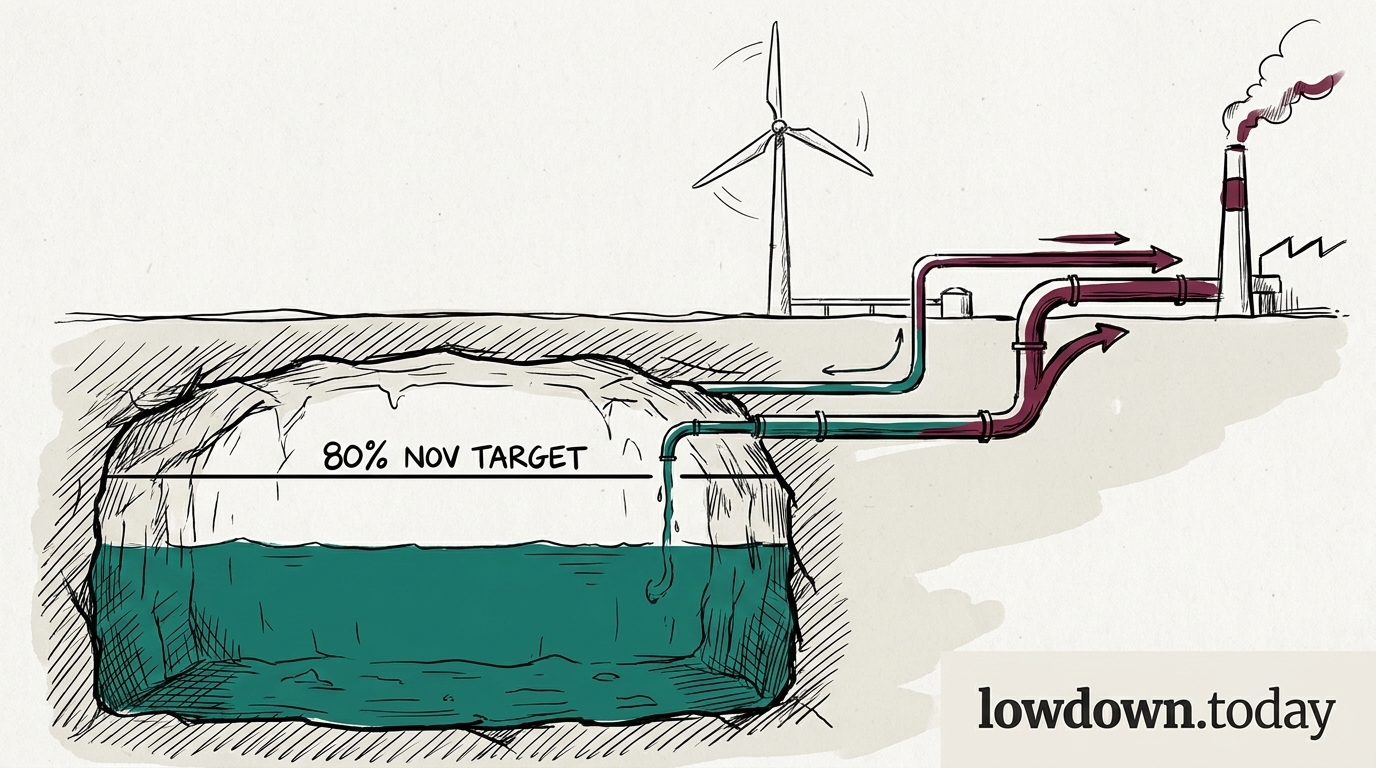
Spain's 9,145 GWh terminal inventory is the largest single stock in the EU LNG network, an option value that can reroute cargoes wherever the winter strip pays best rather than a cavern gas obligation tied to a fixed date. That flexibility matters more as Germany's cavern shortfall pushes more of the winter security question onto import infrastructure.
European Commission
European Commission
Brussels holds the bloc to 90% on a flexible window while Germany, holding roughly a quarter of EU storage capacity, tracks toward missing its own lower 80% figure by 21 points. A national shortfall this size in the anchor market matters more to bloc security than the flexible timetable alone can absorb.
French power exporters and CRE
French day-ahead rose in step with Germany but by less, reopening a EUR 7-17 premium that makes northward export flows commercially attractive again after the EUR 43.09 discount evaporated in days. CRE separately authorised RTE and Enedis to buy flexibility locally, betting the coming winter's binding constraint is grid congestion rather than a shortage of firm capacity.
TTF trading desk
TTF trading desk
A visible national shortfall like Germany's 21-point gap is a directional signal, not noise, for a desk holding the summer-winter spread. TTF's flat EUR 58-60 range through this week's German price swings says the market has not yet chosen to reprice refill risk into the front of the curve.
German cavern and CCGT operators
German caverns kept buying prompt gas at TTF near EUR 58-60 through the inversion; the wind collapse to 2.4 GW then flipped the spark spread to plus EUR 29 and put turbines back in the same queue. Every day turbines win that bid, injection at a third of the 877 GWh/day pace needed falls further behind.
Slovakia
Slovakia
Slovakia says it dropped its hold-out on the 21st sanctions package only after Ursula von der Leyen personally signed written gas-price and supply guarantees. The Council of the European Union's own 17,238-character release on the package names neither Slovakia nor any guarantee, leaving Bratislava's account unconfirmed by the institutional record.



