Skip to content
You can now search across every topic, entity and event.What's new
European Energy Markets
31JUL

Kuwait armed the day Iran hit it

2 min read
09:44UTC

The US State Department cleared a $1.98bn counter-drone sale to Kuwait on 6 June, days after an IRGC drone hit Kuwait's airport. It is the one piece of Iran-related paper Washington has signed in nearly 100 days.

EconomicAssessed
Key takeaway

Washington armed Kuwait against Iranian drones within days while signing nothing to govern the war.

The US State Department approved a $1.98bn counter-drone sale to Kuwait on Saturday 6 June, supplied through Anduril and built around its Anvil intercept system 1. The DSCA (Defense Security Cooperation Agency, the US Defense Department body that runs Foreign Military Sales) notified Congress days after the IRGC (Islamic Revolutionary Guard Corps) drone that hit Kuwait's airport on 3 June , and after Kuwait expelled two Iranian diplomats .

State framed the sale as routine and said it "will not alter the basic military balance in the region". An administration that clears a $1.98bn arms case this quickly is not a slow one.

Set that against the war itself. On the blockade, the nuclear talks, and the fighting, Washington has signed no Iran instrument for close to 100 days . The single piece of Iran-related paper that moved this week armed a Gulf ally rather than governing the conflict that put the ally at risk. The Anvil is an autonomous counter-drone interceptor; the sale buys Kuwait a defence against exactly the weapon that struck it, on US delivery timelines that run behind the threat.


Deep Analysis

In plain English

When a country wants to buy US military equipment, the US government must notify Congress of the sale, which usually takes weeks or months. This time it took three days, immediately after Iran used drones to attack Kuwait's airport (ID:3884). Anduril is a Silicon Valley defence startup, not one of the traditional military contractors like Lockheed or Raytheon. Its Anvil system is an autonomous drone-killing drone: it detects an incoming hostile drone and flies into it to destroy it. The speed of this sale and the choice of a new-generation contractor signals Washington treating Kuwait's air defence gap as urgent rather than routine.

Deep Analysis
Root Causes

The sale is the direct institutional response to two structural failures documented across this conflict. First, CENTCOM's blockade has destroyed Iran's revenue base but has not deterred IRGC tactical strikes, which have escalated from drone harassment to ballistic missiles at civilian terminals . Second, US emergency resupply of PAC-3 rounds excluded Kuwait from the 2 May authorisation, creating a visible gap the IRGC has been probing since 31 May .

The Anduril choice reflects a post-2022 Pentagon policy of fast-tracking non-traditional defence contractors into FMS (Foreign Military Sales) pipelines. Anduril's Lattice AI backbone means Anvil systems network with CENTCOM's existing sensor grid without requiring new infrastructure.

Escalation

The sale accelerates Gulf counter-drone capability, but not quickly enough to close the current gap. Anduril systems require 6-18 months for operational integration. In the interim Kuwait retains interim PAC-3 cover at a depleted magazine. The IRGC's overnight seven-missile salvo (event index 3) demonstrates it is pressing the gap now, not waiting. The risk is a window of 6-12 months during which Kuwait's defence margin is thinner than the sale implies.

What could happen next?
  • Consequence

    Anduril secures its first major FMS contract, accelerating US procurement policy away from traditional prime contractors for autonomous systems.

    Short term · Assessed
  • Risk

    A 6-18 month delivery gap leaves Kuwait in a transitional vulnerability window while the IRGC's salvo tempo is actively accelerating.

    Short term · Assessed
  • Precedent

    Three-day DSCA Congressional notification establishes a speed benchmark for crisis-driven FMS approvals that other Gulf states will cite in future requests.

    Medium term · Reported
First Reported In

Update #119 · Trump's Iran deal: 95% done, 0% signed

Press TV· 6 Jun 2026
Read original
Different Perspectives
Spain's LNG terminal operators
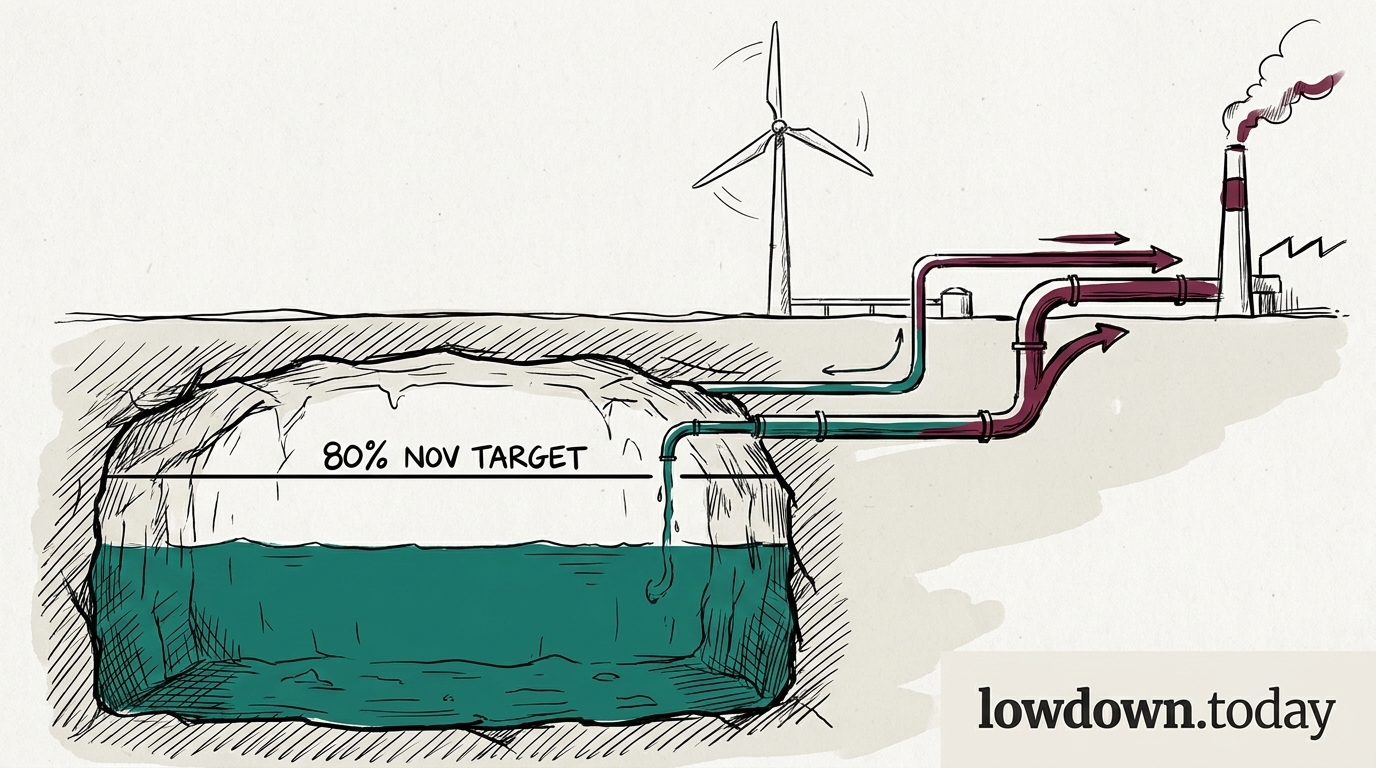
Spain's 9,145 GWh terminal inventory is the largest single stock in the EU LNG network, an option value that can reroute cargoes wherever the winter strip pays best rather than a cavern gas obligation tied to a fixed date. That flexibility matters more as Germany's cavern shortfall pushes more of the winter security question onto import infrastructure.
European Commission
European Commission
Brussels holds the bloc to 90% on a flexible window while Germany, holding roughly a quarter of EU storage capacity, tracks toward missing its own lower 80% figure by 21 points. A national shortfall this size in the anchor market matters more to bloc security than the flexible timetable alone can absorb.
French power exporters and CRE
French day-ahead rose in step with Germany but by less, reopening a EUR 7-17 premium that makes northward export flows commercially attractive again after the EUR 43.09 discount evaporated in days. CRE separately authorised RTE and Enedis to buy flexibility locally, betting the coming winter's binding constraint is grid congestion rather than a shortage of firm capacity.
TTF trading desk
TTF trading desk
A visible national shortfall like Germany's 21-point gap is a directional signal, not noise, for a desk holding the summer-winter spread. TTF's flat EUR 58-60 range through this week's German price swings says the market has not yet chosen to reprice refill risk into the front of the curve.
German cavern and CCGT operators
German caverns kept buying prompt gas at TTF near EUR 58-60 through the inversion; the wind collapse to 2.4 GW then flipped the spark spread to plus EUR 29 and put turbines back in the same queue. Every day turbines win that bid, injection at a third of the 877 GWh/day pace needed falls further behind.
Slovakia
Slovakia
Slovakia says it dropped its hold-out on the 21st sanctions package only after Ursula von der Leyen personally signed written gas-price and supply guarantees. The Council of the European Union's own 17,238-character release on the package names neither Slovakia nor any guarantee, leaving Bratislava's account unconfirmed by the institutional record.



