Skip to content
You can now search across every topic, entity and event.What's new
European Energy Markets
31JUL

Katz: Gaza-model demolitions in Lebanon

4 min read
09:44UTC

Israel's defence minister explicitly invoked the 'Beit Hanoun and Rafah models' for southern Lebanon, ordering accelerated house demolitions and declaring hundreds of thousands of residents will never return to their homes.

EconomicDeveloping
Key takeaway

Israel is codifying demographic displacement as official military doctrine, not improvising tactically.

Israeli Defence Minister Israel Katz ordered 'accelerated demolition of Lebanese houses in the border villages' following what he explicitly called the 'Beit Hanoun and Rafah models in Gaza' 1. He stated that 'hundreds of thousands of Shiite residents of southern Lebanon will not return to their homes south of the Litani area.' Displacement orders issued on 12 March pushed civilians north of the Zahrani River15 kilometres north of the Litani, 40 kilometres from the Israeli border.

The invocation of Beit Hanoun and Rafah is specific. In northern Gaza, Israeli forces systematically razed residential neighbourhoods to create depopulated buffer zones. In Rafah, thousands of structures were demolished to establish permanent military corridors through dense urban areas. Katz is stating, on the record, that the same method — physical destruction of homes to prevent civilian return — will be applied to southern Lebanon.

The infrastructure for permanent displacement is already in place. Bridges over the Litani have been destroyed . The Qasmiyeh Bridge — southern Lebanon's last major highway link north — was severed days ago , and two IDF armoured divisions are operating inside the zone. Lebanese President Aoun called the Qasmiyeh strike 'a prelude to ground invasion' . The displacement zone extends well beyond the Litani buffer established under UN Security Council Resolution 1701, which ended the 2006 war and set the river as the northern boundary of a demilitarised area roughly 25 kilometres from the border. Katz's orders push that boundary a further 15 kilometres north.

Human Rights Watch identified three potential war crimes: forced displacement, wanton destruction, and targeting of civilians 2. HRW warned that arms-supplying countries risk legal complicity 3. Hezbollah responded with a record 63 operations in 24 hours — rockets, drones, and artillery against Israeli positions 4. The civilian population between these forces — more than one million displaced, one in five Lebanese — includes the families of 118 children and 40 medical workers killed. UNICEF deputy executive director Ted Chaiban reported 'one classroom of children' killed or wounded daily 5.


Deep Analysis

In plain English

Israel's defence minister has formally ordered the physical destruction of civilian houses in border villages in Lebanon, explicitly modelling this on what was done in Gaza's Beit Hanoun and Rafah areas. This is not tactical demolition to clear military positions — it is the deliberate destruction of the homes, schools, and infrastructure that residents would return to, making permanent displacement the practical outcome even after fighting stops. The minister has explicitly stated residents will 'not return.' This is a policy decision, not a battlefield one.

Deep Analysis
Synthesis

A sitting defence minister formally invoking a specific destroyed-city model in a written order constitutes doctrinal codification — this is not battlefield excess but stated policy. Combined with Lebanon's already-displaced one million residents, the demolition orders are architecturally designed to make return economically impossible even after formal hostilities end. This converts a military campaign into a self-perpetuating humanitarian crisis: without habitable infrastructure, displaced populations cannot return; without a returning population, the political incentive to negotiate Lebanese sovereignty restoration diminishes. The displacement becomes structurally self-sustaining independent of future military activity.

Root Causes

The demolition policy reflects a strategic lesson drawn explicitly from Gaza operations: temporary displacement creates re-infiltration windows, as Hamas's partial return to northern Gaza demonstrated. Israel's conclusion is that permanent infrastructure destruction is required to deny the physical preconditions for return, converting a temporary military objective into a durable demographic outcome. This is a lessons-learned application, not opportunistic destruction.

Escalation

Katz's explicit invocation of the 'Beit Hanoun and Rafah models' in a formal ministerial order — not an off-the-cuff remark — signals doctrinal codification rather than battlefield improvisation. The displacement line to the Zahrani River (40 km from the border, 15 km north of the Litani) materially exceeds the buffer zone under UN Resolution 1701, signalling Israel does not intend to return to any pre-war legal framework in Lebanon and is operating outside internationally recognised limits.

What could happen next?
1 consequence2 risk1 meaning1 precedent
  • Consequence

    Systematic destruction of civilian housing converts temporary military displacement into permanent demographic change, independent of any future ceasefire.

    Immediate · Assessed
  • Risk

    European arms-exporting governments face domestic legal challenges to Israeli export licences if HRW's war crimes documentation is accepted by national courts.

    Short term · Assessed
  • Meaning

    The Zahrani River displacement line exceeds UN Resolution 1701's requirements, signalling Israel has no intention of returning to the pre-war legal framework governing Lebanese sovereignty.

    Medium term · Assessed
  • Risk

    Permanent displacement of over one million Lebanese creates a sustained humanitarian burden requiring international financing, potentially destabilising Jordan and other host states.

    Medium term · Suggested
  • Precedent

    If the demolition policy achieves a durable buffer zone, it codifies demographic engineering as a replicable template for US-aligned militaries facing asymmetric border threats.

    Long term · Suggested
First Reported In

Update #46 · Trump delays strikes; oil crashes to $99

Human Rights Watch· 24 Mar 2026
Read original
Different Perspectives
Spain's LNG terminal operators
Spain's 9,145 GWh terminal inventory is the largest single stock in the EU LNG network, an option value that can reroute cargoes wherever the winter strip pays best rather than a cavern gas obligation tied to a fixed date. That flexibility matters more as Germany's cavern shortfall pushes more of the winter security question onto import infrastructure.
European Commission
European Commission
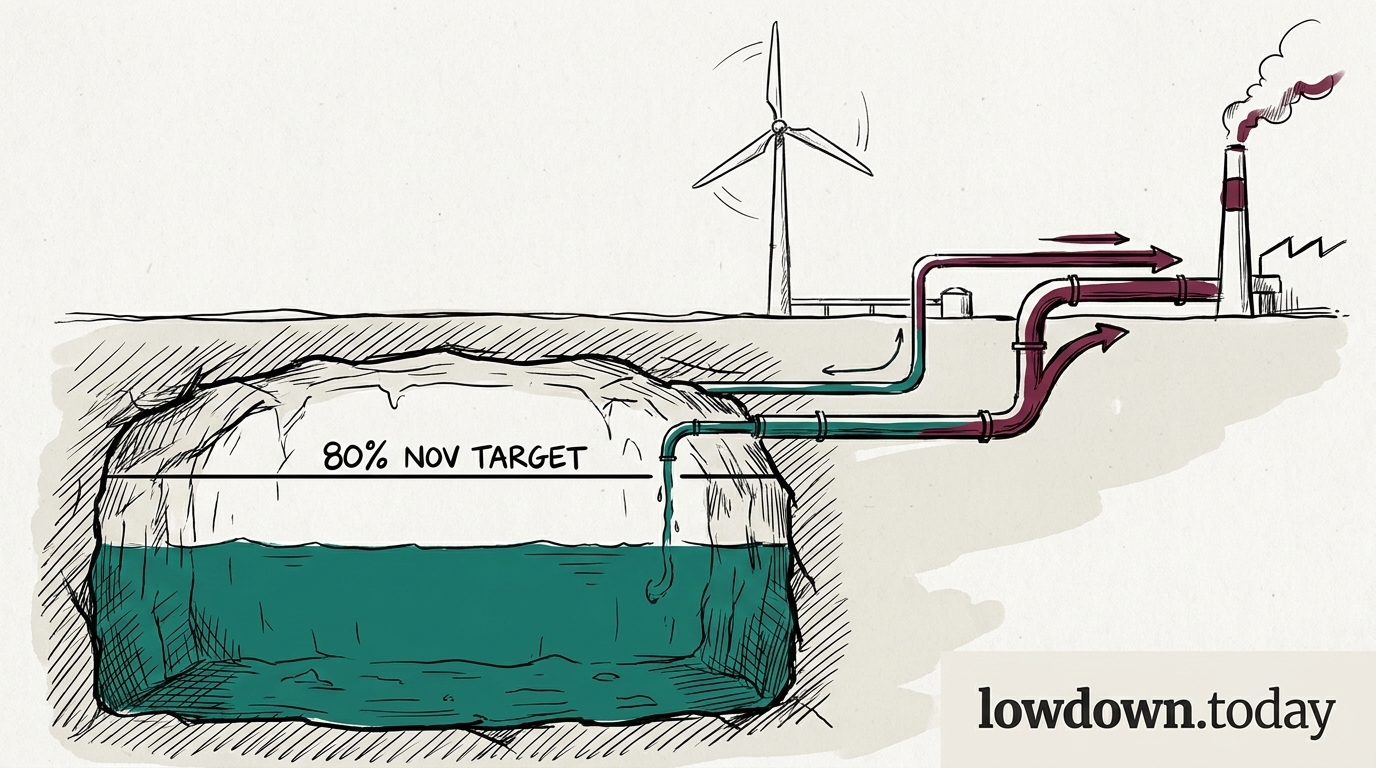
Brussels holds the bloc to 90% on a flexible window while Germany, holding roughly a quarter of EU storage capacity, tracks toward missing its own lower 80% figure by 21 points. A national shortfall this size in the anchor market matters more to bloc security than the flexible timetable alone can absorb.
French power exporters and CRE
French day-ahead rose in step with Germany but by less, reopening a EUR 7-17 premium that makes northward export flows commercially attractive again after the EUR 43.09 discount evaporated in days. CRE separately authorised RTE and Enedis to buy flexibility locally, betting the coming winter's binding constraint is grid congestion rather than a shortage of firm capacity.
TTF trading desk
TTF trading desk
A visible national shortfall like Germany's 21-point gap is a directional signal, not noise, for a desk holding the summer-winter spread. TTF's flat EUR 58-60 range through this week's German price swings says the market has not yet chosen to reprice refill risk into the front of the curve.
German cavern and CCGT operators
German caverns kept buying prompt gas at TTF near EUR 58-60 through the inversion; the wind collapse to 2.4 GW then flipped the spark spread to plus EUR 29 and put turbines back in the same queue. Every day turbines win that bid, injection at a third of the 877 GWh/day pace needed falls further behind.
Slovakia
Slovakia
Slovakia says it dropped its hold-out on the 21st sanctions package only after Ursula von der Leyen personally signed written gas-price and supply guarantees. The Council of the European Union's own 17,238-character release on the package names neither Slovakia nor any guarantee, leaving Bratislava's account unconfirmed by the institutional record.



