Skip to content
You can now search across every topic, entity and event.What's new
European Energy Markets
31JUL

91st Division crosses into Lebanon

4 min read
09:44UTC

The IDF's 'Galilee' Division pushed deeper into southern Lebanon than any prior incursion in this war — but Haaretz's own assessment suggests the operation will move Hezbollah's launch sites without silencing them.

EconomicDeveloping
Key takeaway

The 91st Division's combined-arms structure exceeds what a temporary border buffer requires.

Israel's 91st "Galilee" Division entered eastern southern Lebanon on Saturday night, the IDF's deepest ground penetration since hostilities began on 2 March. The military described the operation as "targeted" and defensive — a forward buffer to protect border communities. Troops killed several Hezbollah fighters during the initial advance 1.

The incursion follows a week of escalating ground commitment. Israeli forces had already pushed more than a kilometre into towns including Kfar Kila, Houla, and Khiam , where Hezbollah reported direct clashes with RPGs and light weapons on Saturday night . The 91st Division's deployment formalises what had been incremental advances into a named divisional operation — a distinction that carries weight in IDF doctrine, where division-level deployments imply sustained commitment rather than raiding.

Haaretz's assessment is blunt: the ground operation is designed to defend the border rather than halt Hezbollah rocket fire 2. Israeli forces will push launch sites northward without stopping the barrages. The conclusion is consistent with the 2006 war, where Israel's 33-day ground campaign across this same terrain failed to suppress Hezbollah's short-range rocket capability. Hezbollah Secretary-General Naim Qassem has committed 30,000 fighters to southern Lebanon, including elite Radwan Force units . The terrain — rocky hills, dense vegetation, fortified tunnel networks built over two decades — favours defenders.

Israel occupied this ground from 1982 to 2000 and withdrew after an 18-year guerrilla war that killed more than 900 Israeli soldiers. A senior Israeli official told Axios the current plan is to seize all territory south of the Litani River, invoking the Gaza campaign as a model . The IDF has already destroyed the Zrarieh Bridge over the Litani and issued evacuation orders covering 1,470 square kilometres — 14 per cent of Lebanon's territory.

The gap between "targeted ground operation" and territorial seizure south of the Litani is the gap between a buffer zone and a full-scale invasion. Lebanon's Health Ministry reports 886 killed and more than one million displaced in a fortnight — a rate of destruction that has already exceeded the entirety of the 2006 war .


Deep Analysis

In plain English

Israel sent soldiers into southern Lebanon, officially describing it as a small defensive move to protect the border. The division chosen for this job is built for large-scale territorial operations — it has tanks and engineering units suited to seizing and holding ground, not just quick strikes. Meanwhile, internal military communications point to a three-month campaign. The gap between what officials say publicly and what commanders are planning has historically closed in favour of the longer, larger operation — most notably in 1982, when a declared 48-hour limited action became an 18-year occupation.

Deep Analysis
Synthesis

The 'defend the border' versus 'halt rocket fire' distinction Haaretz draws has doctrinal consequences beyond framing. Defending a border implies holding terrain indefinitely; suppressing rocket fire implies withdrawal after degrading launch sites. The former requires occupation-level logistics and governance; the latter does not. The 91st Division's deployment posture and the publicly stated Litani seizure intent suggest the IDF has already resolved this question internally, making the official 'targeted operation' language a public communication choice rather than a strategic description.

Root Causes

UN Security Council Resolution 1701 (2006) mandated Hezbollah's disarmament north of the Litani and Lebanese Army deployment to the south. Neither obligation was implemented. UNIFIL's roughly 10,000 troops provided political cover for international inaction without enforcement capability. Israel's operation is structurally an attempt at unilateral enforcement of obligations the international community accepted in 2006 but never fulfilled — a structural failure spanning two decades.

Escalation

The 91st Division's combined-arms composition — integral armour, artillery, and combat engineering — is inconsistent with a temporary fire-suppression mission. These capabilities are structured for seizing and holding terrain. The simultaneous IDF announcement of intent to hold all territory south of the Litani suggests the 'targeted' framing describes a sequenced first phase, not a standalone action. Operational momentum once a combined-arms formation is committed to terrain typically favours extension rather than withdrawal.

What could happen next?
  • Risk

    Mission creep from 'targeted' to territorial operation would trigger UN Security Council debate and accelerate Western diplomatic pressure within weeks.

    Short term · Assessed
  • Precedent

    Unilateral Israeli enforcement of UNSCR 1701 obligations sets a template for bypassing multilateral mechanisms when states judge them ineffective.

    Long term · Suggested
  • Consequence

    UNIFIL forces in the operational area face crossfire exposure, creating potential European troop casualties that would directly escalate diplomatic tensions with troop-contributing nations.

    Immediate · Assessed
  • Risk

    Extended ground presence without Lebanese Army deployment to the south creates conditions for a third Israeli occupation of Lebanese territory.

    Medium term · Assessed
First Reported In

Update #38 · Israel enters Lebanon; Hormuz pact fails

AJ ground ops· 17 Mar 2026
Read original
Different Perspectives
Spain's LNG terminal operators
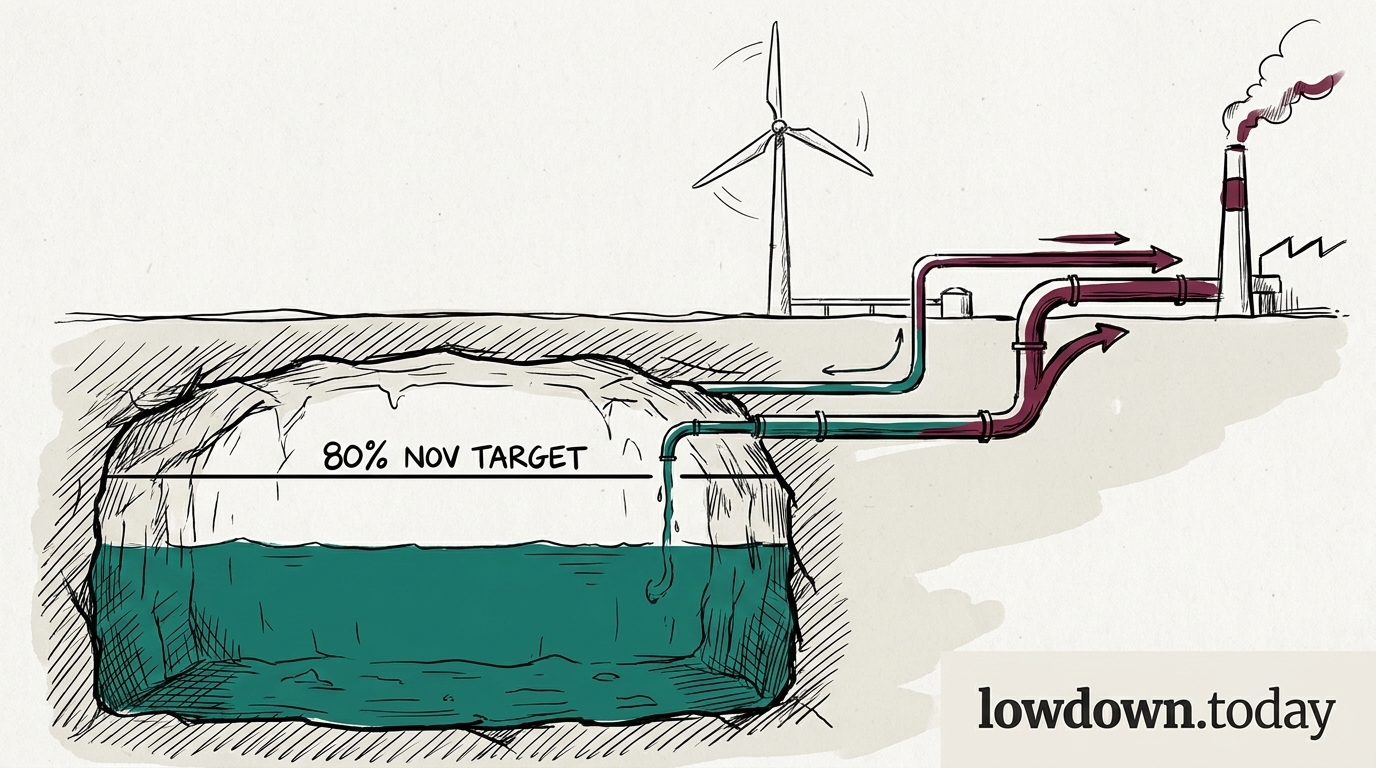
Spain's 9,145 GWh terminal inventory is the largest single stock in the EU LNG network, an option value that can reroute cargoes wherever the winter strip pays best rather than a cavern gas obligation tied to a fixed date. That flexibility matters more as Germany's cavern shortfall pushes more of the winter security question onto import infrastructure.
European Commission
European Commission
Brussels holds the bloc to 90% on a flexible window while Germany, holding roughly a quarter of EU storage capacity, tracks toward missing its own lower 80% figure by 21 points. A national shortfall this size in the anchor market matters more to bloc security than the flexible timetable alone can absorb.
French power exporters and CRE
French day-ahead rose in step with Germany but by less, reopening a EUR 7-17 premium that makes northward export flows commercially attractive again after the EUR 43.09 discount evaporated in days. CRE separately authorised RTE and Enedis to buy flexibility locally, betting the coming winter's binding constraint is grid congestion rather than a shortage of firm capacity.
TTF trading desk
TTF trading desk
A visible national shortfall like Germany's 21-point gap is a directional signal, not noise, for a desk holding the summer-winter spread. TTF's flat EUR 58-60 range through this week's German price swings says the market has not yet chosen to reprice refill risk into the front of the curve.
German cavern and CCGT operators
German caverns kept buying prompt gas at TTF near EUR 58-60 through the inversion; the wind collapse to 2.4 GW then flipped the spark spread to plus EUR 29 and put turbines back in the same queue. Every day turbines win that bid, injection at a third of the 877 GWh/day pace needed falls further behind.
Slovakia
Slovakia
Slovakia says it dropped its hold-out on the 21st sanctions package only after Ursula von der Leyen personally signed written gas-price and supply guarantees. The Council of the European Union's own 17,238-character release on the package names neither Slovakia nor any guarantee, leaving Bratislava's account unconfirmed by the institutional record.



