Skip to content
You can now search across every topic, entity and event.What's new
European Energy Markets
31JUL

Iran's parliament turns on its signatory

3 min read
09:44UTC

Around 60 members of Iran's Majlis signed a letter demanding Ghalibaf explain why he put his name to the memorandum, roughly a fifth of the 290-seat chamber. One MP said renaming a treaty a memorandum changes nothing binding.

EconomicDeveloping
Key takeaway

Iran's parliament wants its speaker to justify a signature the people who run the war never gave.

Around 60 members of Iran's Majlis, the 290-seat Parliament, signed a letter demanding speaker Mohammad Bagher Ghalibaf explain why he put his name to the memorandum. 1 That is roughly a fifth of the chamber, a bloc large enough to threaten any ratification vote. Ghalibaf signed for the Parliament; the Parliament is now asking him to account for it. The revolt followed street protests in which the Basij marched on the foreign ministry and crowds in Mashhad demonstrated against Araghchi .

The legal argument cuts against the government. MP Abolfazl Aboutorabi said the document carries binding obligations "that cannot be resolved by simply changing the name", rejecting any claim that the memorandum label makes it less than a treaty. Amirhossein Sabeti of the hardline Paydari faction said the deal "violates the Supreme Leader's red lines". President Masoud Pezeshkian defended his negotiators, calling it unfortunate that officials safeguarding the national interest "face accusations of betrayal".

Mojtaba Khamenei, the one signature Iran most needs, has not appeared in public since March and rules by handwritten messages carried by courier, with a lag of several days. Trump claimed the Supreme Leader had personally approved the deal, but the approver has stayed unreachable at the speed the diplomacy is moving , and a mediating-country diplomat told Axios the deal was cleared "at high levels" but "likely not" by Khamenei himself. Ghalibaf's name is on the paper; Khamenei's is not.


Deep Analysis

In plain English

Iran's parliament (called the Majlis) has around 290 elected members. About 60 of them have signed a letter demanding that the parliament speaker, Mohammad Bagher Ghalibaf, explain why he personally signed the Islamabad MOU on behalf of Iran. Ghalibaf is not Iran's president or foreign minister; he is the Speaker of Parliament. He signed the deal as the pro-deal face of Iran's government, but his own parliamentarians are now questioning whether he had the authority to do so. Two MPs have spoken out: Aboutorabi says the document carries binding legal obligations regardless of what it is called, and Sabeti from the hardline Paydari faction says the deal breaks lines that the Supreme Leader has said are non-negotiable. Iran's President Pezeshkian is defending the negotiating team, but around one-fifth of parliament has publicly turned on its own Speaker.

Deep Analysis
Root Causes

Ghalibaf's position exposes a structural tension in Iran's constitutional order. The Majlis Speaker is the third-ranking constitutional figure, but Iran's foreign policy authority under the constitution rests with the Supreme Leader (Article 110) and the Supreme National Security Council. Ghalibaf signed an international instrument as the de facto executive face of Iran's pro-deal faction, a role that the constitution reserves for institutions with Supreme Leader endorsement.

Sabeti's invocation of Khamenei's red lines compounds the problem. Khamenei has not publicly endorsed the MOU and is reachable only by sealed courier with a three-to-five-day lag. The Paydari faction is therefore arguing, with some constitutional basis, that a signature was produced by the third-ranking official on an instrument the highest authority has not endorsed.

First Reported In

Update #129 · Iran deal signed, but no paper to show

Euronews Persian· 16 Jun 2026
Read original
Different Perspectives
Spain's LNG terminal operators
Spain's 9,145 GWh terminal inventory is the largest single stock in the EU LNG network, an option value that can reroute cargoes wherever the winter strip pays best rather than a cavern gas obligation tied to a fixed date. That flexibility matters more as Germany's cavern shortfall pushes more of the winter security question onto import infrastructure.
European Commission
European Commission
Brussels holds the bloc to 90% on a flexible window while Germany, holding roughly a quarter of EU storage capacity, tracks toward missing its own lower 80% figure by 21 points. A national shortfall this size in the anchor market matters more to bloc security than the flexible timetable alone can absorb.
French power exporters and CRE
French day-ahead rose in step with Germany but by less, reopening a EUR 7-17 premium that makes northward export flows commercially attractive again after the EUR 43.09 discount evaporated in days. CRE separately authorised RTE and Enedis to buy flexibility locally, betting the coming winter's binding constraint is grid congestion rather than a shortage of firm capacity.
TTF trading desk
TTF trading desk
A visible national shortfall like Germany's 21-point gap is a directional signal, not noise, for a desk holding the summer-winter spread. TTF's flat EUR 58-60 range through this week's German price swings says the market has not yet chosen to reprice refill risk into the front of the curve.
German cavern and CCGT operators
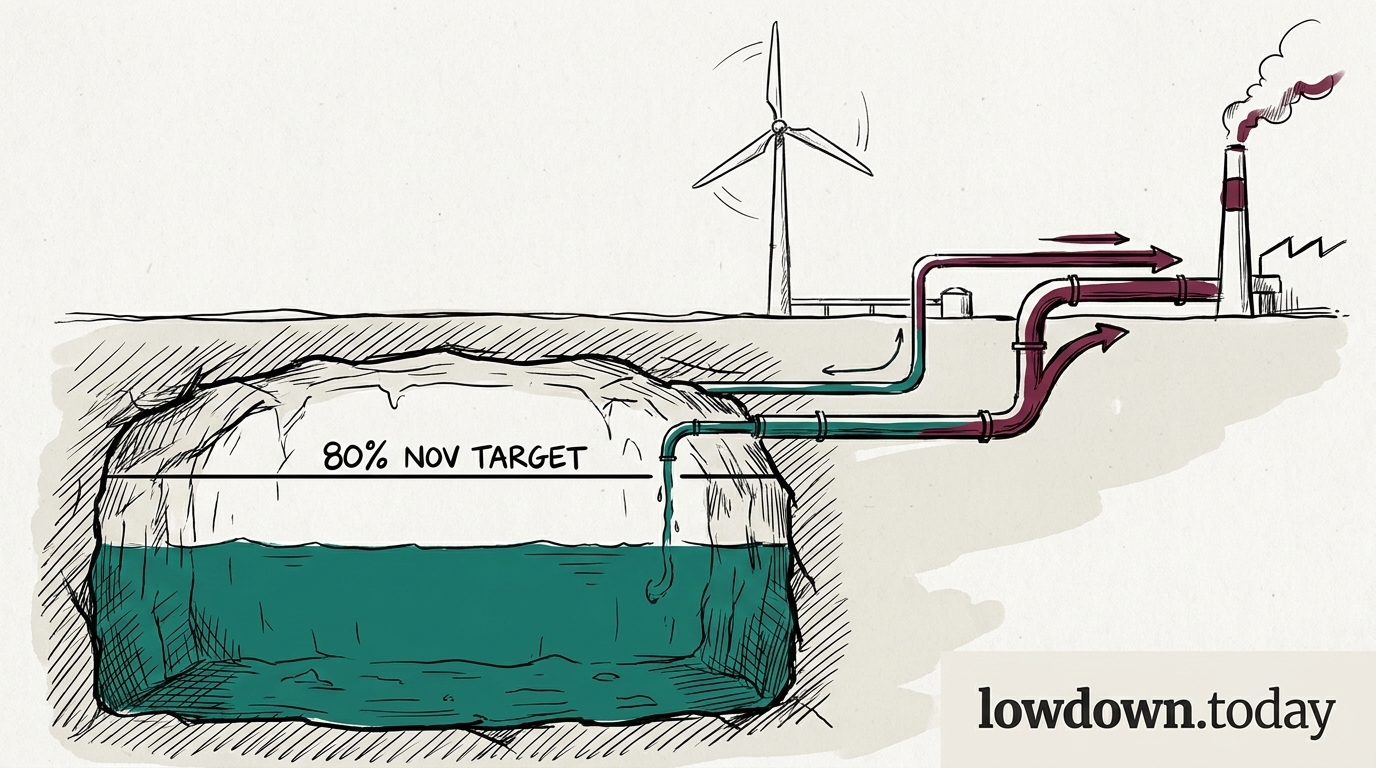
German caverns kept buying prompt gas at TTF near EUR 58-60 through the inversion; the wind collapse to 2.4 GW then flipped the spark spread to plus EUR 29 and put turbines back in the same queue. Every day turbines win that bid, injection at a third of the 877 GWh/day pace needed falls further behind.
Slovakia
Slovakia
Slovakia says it dropped its hold-out on the 21st sanctions package only after Ursula von der Leyen personally signed written gas-price and supply guarantees. The Council of the European Union's own 17,238-character release on the package names neither Slovakia nor any guarantee, leaving Bratislava's account unconfirmed by the institutional record.



