Skip to content
You can now search across every topic, entity and event.What's new
European Energy Markets
31JUL

Iran deal published, Treasury record blank

3 min read
09:44UTC

The 14-point Islamabad memorandum was released on 17 June with a clause requiring crude-export waivers immediately upon signing; three days on, the OFAC record carries no Iran waiver and the White House register shows nothing.

EconomicDeveloping
Key takeaway

The most detailed deal of the war has filed none of the paperwork that would make its immediate clauses real.

The 14-point Islamabad Memorandum of Understanding (MoU) was released on 17 June, the most specified instrument of the war and, so far, the least implemented 1. Provision 3 says the US Treasury will issue waivers for Iranian crude exports "immediately upon signing." Three days on, the recent-actions record of the Office of Foreign Assets Control (OFAC), the Treasury bureau that issues sanctions licences, carries no Iran waiver, and the White House Presidential Actions register shows nothing dated 17 or 18 June 2.

An executive agreement does not move an agency on its own. For sanctions to lift, OFAC has to publish a general licence; for the blockade to end, CENTCOM needs a written order. Without those documents, the signatures bind no agency. the MOU also set the blockade to be "removed immediately," with full withdrawal inside 30 days, but CENTCOM has issued no drawdown statement.

Trump declared the deal complete on Truth Social on 14 June with no instrument behind it ; the signed text was then withheld until 17 June, while Senate leaders demanded to see it . OFAC's most recent Iran actions were crypto designations on 2 June; no waiver has followed the signing. The 17 June release changed what the deal promises, not whether US agencies have acted on it.


Deep Analysis

In plain English

When two countries agree to lift sanctions, it does not happen automatically the moment a document is signed. The US has a body called OFAC, the Office of Foreign Assets Control, which acts like a master switch for economic sanctions. To lift Iran's oil sanctions, OFAC needs to publish an official waiver. That waiver is a legal document that tells banks and tanker operators: you are now allowed to buy Iranian oil without being punished. The MOU says OFAC should issue that waiver 'immediately upon signing.' Three days after the digital signing, the waiver has not appeared on OFAC's public record. Until it does, no bank will finance an Iranian crude cargo and no reputable tanker operator will load one. The deal looks complete on paper; the infrastructure to make it real has not been switched on.

Deep Analysis
Root Causes

The blank OFAC record has two independent root causes operating simultaneously. First, the administration's established pattern of conducting Iran policy through verbal declarations rather than signed instruments, documented across 108 days of conflict, reflects a deliberate executive-branch preference for rhetorical flexibility over legal commitment.

Second, the MOU's Provision 3 obligation creates a technical constraint: OFAC waivers for crude oil exports must identify permissible end-users, volumes, and timeframes to be legally operable.

Drafting a legally enforceable waiver requires the Treasury's national-security team to define which buyers, which tankers, and which destinations qualify. That level of operational specificity takes days to weeks. The MOU says 'immediately'; operational reality requires specification that the 14-point text does not provide.

What could happen next?
  • Risk

    If OFAC does not publish a crude-export waiver by 19 June, oil traders will begin pricing a partial or delayed implementation, reversing some of today's Brent decline.

    Immediate · Assessed
  • Consequence

    Iran's hardline critics of the MOU, who called the deal a 'temporary easing sold as a concession', gain traction domestically for every day the OFAC waiver remains blank.

    Short term · Assessed
  • Precedent

    A blank OFAC record on Day 3 confirms the administration's 108-day pattern: verbal commitments precede legal instruments by days to weeks. Every future Iran announcement will be discounted by markets until the instrument appears.

    Medium term · Assessed
First Reported In

Update #131 · Iran deal's first death tests the text

Times of Israel· 18 Jun 2026
Read original
Causes and effects
This Event
Iran deal published, Treasury record blank
The most specified instrument of the war is, on its immediate clauses, the least implemented.
Different Perspectives
Spain's LNG terminal operators
Spain's 9,145 GWh terminal inventory is the largest single stock in the EU LNG network, an option value that can reroute cargoes wherever the winter strip pays best rather than a cavern gas obligation tied to a fixed date. That flexibility matters more as Germany's cavern shortfall pushes more of the winter security question onto import infrastructure.
European Commission
European Commission
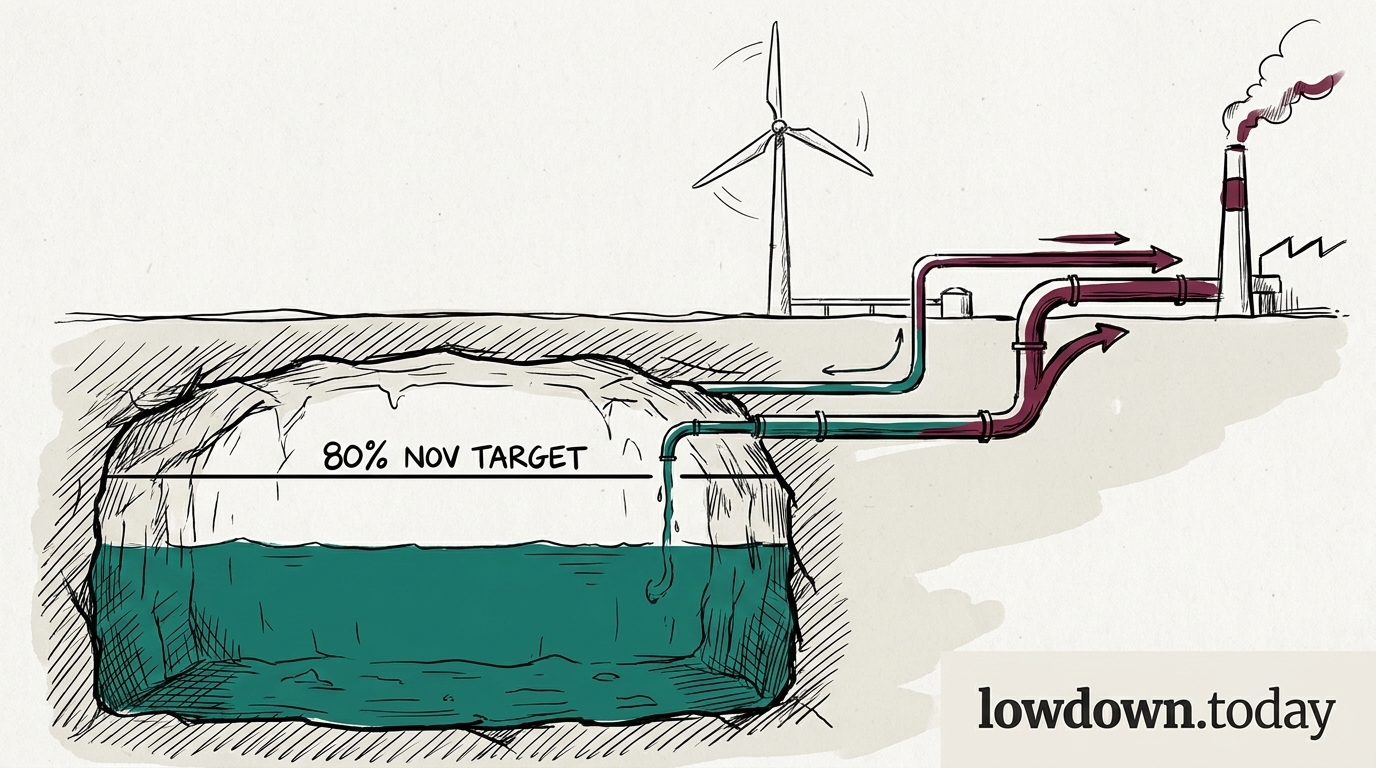
Brussels holds the bloc to 90% on a flexible window while Germany, holding roughly a quarter of EU storage capacity, tracks toward missing its own lower 80% figure by 21 points. A national shortfall this size in the anchor market matters more to bloc security than the flexible timetable alone can absorb.
French power exporters and CRE
French day-ahead rose in step with Germany but by less, reopening a EUR 7-17 premium that makes northward export flows commercially attractive again after the EUR 43.09 discount evaporated in days. CRE separately authorised RTE and Enedis to buy flexibility locally, betting the coming winter's binding constraint is grid congestion rather than a shortage of firm capacity.
TTF trading desk
TTF trading desk
A visible national shortfall like Germany's 21-point gap is a directional signal, not noise, for a desk holding the summer-winter spread. TTF's flat EUR 58-60 range through this week's German price swings says the market has not yet chosen to reprice refill risk into the front of the curve.
German cavern and CCGT operators
German caverns kept buying prompt gas at TTF near EUR 58-60 through the inversion; the wind collapse to 2.4 GW then flipped the spark spread to plus EUR 29 and put turbines back in the same queue. Every day turbines win that bid, injection at a third of the 877 GWh/day pace needed falls further behind.
Slovakia
Slovakia
Slovakia says it dropped its hold-out on the 21st sanctions package only after Ursula von der Leyen personally signed written gas-price and supply guarantees. The Council of the European Union's own 17,238-character release on the package names neither Slovakia nor any guarantee, leaving Bratislava's account unconfirmed by the institutional record.



