Skip to content
You can now search across every topic, entity and event.What's new
European Energy Markets
31JUL

EIA pencils Brent at $89 by Q4 2026

4 min read
09:44UTC

The EIA's 12 May Short-Term Energy Outlook projected Brent at roughly $106 per barrel in Q2 2026, decaying to $89 per barrel by Q4 on the assumption Hormuz partially normalises.

EconomicDeveloping
Key takeaway

The Q2-to-Q4 Brent decay is a $17 calendar trade contingent on Hormuz normalisation no print yet confirms.

The EIA Short-Term Energy Outlook published 12 May 2026 projected Brent at approximately $106 per barrel for Q2 2026, declining to $89 per barrel by Q4 2026 1. The forecast implies a $17 per barrel negative carry for anyone buying Q2 forward for Q4 delivery on the assumption Hormuz physically normalises. EIA also tagged the 2026 global supply deficit at 2.6 million barrels per day and a Q2 inventory draw rate of 8.5 million barrels per day, the highest in STEO history.

The IEA's May Oil Market Report logged the same pattern from the inventory side . Global observed inventory draws ran 246 million barrels across March and April 2026 (129 million barrels in March plus 117 million barrels in April), and 2Q26 crude throughputs were projected to decline 4.5 million barrels per day to 78.7 million barrels per day 2. Russian crude exports rose in April as Ukrainian refinery strikes cut domestic consumption, freeing barrels for export.

The IEA also noted that North Sea Dated traded in an unparalleled $50 per barrel intramonth range in April, the strongest signal that flat price has become an unreliable trading anchor for the current market environment. Both agencies are running the same conditional bet: Hormuz transit clears through Q3, OPEC+ production unwinds materialise, and inventory rebuilds happen in Q4. None of those conditions has been tested yet, and Aramco chief executive Amin Nasser warned on 12 May that the global oil market will not normalise until 2027 if the Hormuz blockade runs .

The shape of the curve carries the risk. Goldman Sachs has Q4 Brent at $90 per barrel on tighter Gulf output, broadly aligned with EIA, but the path from $106 to $89 assumes a clean normalisation that the EFS and freight prints currently dispute. Anyone trading the negative carry is exposed to the same Hormuz timing question driving the speculator positioning, just packaged as a calendar trade.


Deep Analysis

In plain English

Fujairah, in the UAE, is one of the world's biggest fuel stops for oil tankers. Ships fill up with bunker fuel (a type of heavy oil) there before crossing the ocean. In May 2026, Fujairah's storage tanks hit their lowest total inventory reading on record at 6.5 million barrels. Hormuz disruption explains most of the draw. Many tankers have been rerouting around Africa instead of through the Strait of Hormuz. That longer route burns more fuel, and the combined effect has drained Fujairah's bunker supply faster than it can be replenished.

Deep Analysis
Root Causes

Two simultaneous forces drove Fujairah's May 2026 record-low 6.5mb inventory. Hormuz disruption from late February 2026 reduced inbound crude and product flows from Gulf producers, cutting the replenishment rate for Fujairah's bunker storage tanks. At the same time, VLCC Cape rerouting paradoxically increased total marine fuel consumption globally, tightening the regional bunker fuel pool that Fujairah would normally absorb.

The residual fuel oil draw (down 27% in May versus April, below 3 million barrels) reflects that high-sulphur bunker fuel, still the primary fuel for older VLCCs, is being consumed at abnormally high rates by longer Cape voyages while replenishment logistics from Gulf refineries remain disrupted.

What could happen next?
  • Consequence

    Fujairah VLSFO prompt bunker premiums versus Rotterdam widened to $25-40/tonne in May 2026 as record-low inventory cut the regional supply buffer for vessel operators on Cape rerouting.

    Immediate · 0.75
  • Risk

    If Singapore IES weekly stocks are also drawing (not confirmed in this window), the Asia bunker market's aggregate tightness exceeds what Fujairah data alone implies, with potential for a prompt allocation squeeze.

    Short term · 0.6
  • Consequence

    Global shipping freight costs face a structural floor from elevated marine fuel costs even after Hormuz physically clears, as vessel operator risk premium on Gulf routings persists for weeks post-reopening.

    Medium term · 0.65
First Reported In

Update #1 · GL 134B out, Rotterdam dark, OPEC+ pending

Kyiv School of Economics· 18 May 2026
Read original
Different Perspectives
Spain's LNG terminal operators
Spain's 9,145 GWh terminal inventory is the largest single stock in the EU LNG network, an option value that can reroute cargoes wherever the winter strip pays best rather than a cavern gas obligation tied to a fixed date. That flexibility matters more as Germany's cavern shortfall pushes more of the winter security question onto import infrastructure.
European Commission
European Commission
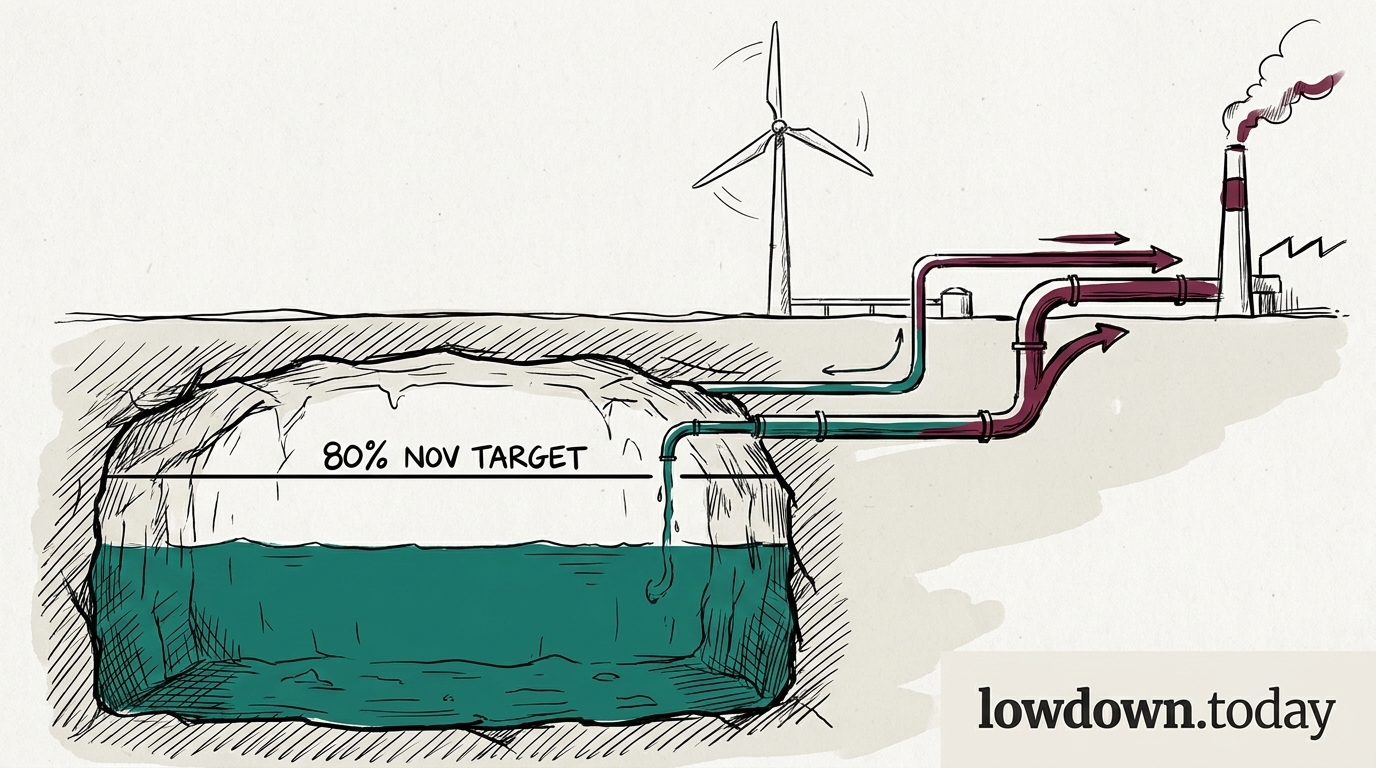
Brussels holds the bloc to 90% on a flexible window while Germany, holding roughly a quarter of EU storage capacity, tracks toward missing its own lower 80% figure by 21 points. A national shortfall this size in the anchor market matters more to bloc security than the flexible timetable alone can absorb.
French power exporters and CRE
French day-ahead rose in step with Germany but by less, reopening a EUR 7-17 premium that makes northward export flows commercially attractive again after the EUR 43.09 discount evaporated in days. CRE separately authorised RTE and Enedis to buy flexibility locally, betting the coming winter's binding constraint is grid congestion rather than a shortage of firm capacity.
TTF trading desk
TTF trading desk
A visible national shortfall like Germany's 21-point gap is a directional signal, not noise, for a desk holding the summer-winter spread. TTF's flat EUR 58-60 range through this week's German price swings says the market has not yet chosen to reprice refill risk into the front of the curve.
German cavern and CCGT operators
German caverns kept buying prompt gas at TTF near EUR 58-60 through the inversion; the wind collapse to 2.4 GW then flipped the spark spread to plus EUR 29 and put turbines back in the same queue. Every day turbines win that bid, injection at a third of the 877 GWh/day pace needed falls further behind.
Slovakia
Slovakia
Slovakia says it dropped its hold-out on the 21st sanctions package only after Ursula von der Leyen personally signed written gas-price and supply guarantees. The Council of the European Union's own 17,238-character release on the package names neither Slovakia nor any guarantee, leaving Bratislava's account unconfirmed by the institutional record.



