Skip to content
You can now search across every topic, entity and event.What's new
European Energy Markets
31JUL

Russia fossil fuel revenue: €510m/day

3 min read
09:44UTC

Russian fossil fuel revenues hit €510 million per day in the first two weeks of the Iran conflict — enough to fund thousands of combat drones daily at current manufacturing costs.

EconomicDeveloping
Key takeaway

Russia's daily fossil fuel revenue now exceeds Western military aid to Ukraine by a ratio of roughly four to one.

CREA data analysed by German NGO Urgewald showed Russia earned €6 billion in fossil fuel revenues in the first two weeks of the Iran conflict, with daily earnings running 14% above February's average at €510 million per day 1. The surge coincides with Washington's 30-day sanctions waivers on Russian oil and the 65% rise in Brent Crude to approximately $103 by 18 March .

The revenue translates into military capacity on a specific and measurable scale. At reported manufacturing costs of $20,000–$50,000 per Shahed-136 drone 2, a single day's oil revenue could theoretically purchase thousands of units. Daily drone volumes had already tripled from 2025 averages of 2,000–3,000 to nearly 9,000 by early March , with 9,616 recorded on 17 March alone . Oil prices in the strait of Hormuz fund drone production; drone production sustains the rate of fire on Ukrainian positions.

Russia's January financial position looked materially different. Oil and gas revenues had fallen 32% year-on-year , and the recruitment deficit — 31,700 personnel lost against 22,700 recruited in January — suggested a war effort under both financial and demographic strain. The Iran conflict eliminated the financial constraint. At €510 million per day, Russia earns in two weeks what its January revenue shortfall implied it could not sustain. The money does not solve the recruitment gap, but it funds the equipment, ammunition, and Iranian-supplied drones that compensate for infantry losses with firepower.

The CREA figures measure revenue from fossil fuel sales, not profit, and not all revenue flows to military procurement. But the direction is clear: every week the Iran conflict continues, Russia's war economy operates further from the constraints that sanctions were designed to impose.


Deep Analysis

In plain English

Because the Iran war has pushed oil prices sharply higher, Russia is earning far more from selling fossil fuels than before. That extra money funds weapons, drones, and troop recruitment. The G7 tried to cap the price of Russian oil at $60 per barrel, but at $103 Brent, buyers simply ignore the cap and pay market rates through ships that avoid Western insurance. The result is that Russia is being financially subsidised by the global oil market at precisely the moment Western governments are trying to squeeze it financially.

Deep Analysis
Synthesis

The €510 million/day figure inverts the logic of Western economic warfare. The Iran conflict has transformed the sanctions regime from a tool of attrition into a mechanism that inadvertently subsidises Russian warfighting capacity. Every barrel priced above the G7 cap threshold represents a direct transfer from Western energy consumers to the Russian state — a fiscal dynamic with no precedent in the post-Cold War sanctions canon.

Root Causes

The G7 price cap was designed for a Brent baseline of approximately $60–80. Above $90, the economic incentive for non-G7 buyers to circumvent the cap structurally exceeds compliance costs — the cap becomes inoperative without physical enforcement capacity, which no Western maritime force has been authorised to exercise. The IEA's 400-million-barrel strategic reserve release, the largest ever attempted, proved insufficient against Hormuz disruption of this scale, signalling that existing crisis management tools were sized for single-theatre disruptions rather than simultaneous dual-conflict shocks.

What could happen next?
  • Risk

    If Brent remains above $90, Russia's war effort becomes financially self-sustaining from energy exports alone, neutralising the central premise of Western economic pressure strategy.

    Medium term · Assessed
  • Meaning

    The G7 price cap has effectively ceased functioning as a revenue-denial tool at current price levels — a structural failure rather than a temporary circumvention.

    Immediate · Assessed
  • Consequence

    Accelerated Russian drone and missile procurement funded by windfall revenues may shorten the timeline before Ukrainian air defence stockpiles are exhausted.

    Short term · Suggested
First Reported In

Update #5 · Trump frees 124m barrels; Russia earns €6bn

CREA / Urgewald· 18 Mar 2026
Read original
Different Perspectives
Spain's LNG terminal operators
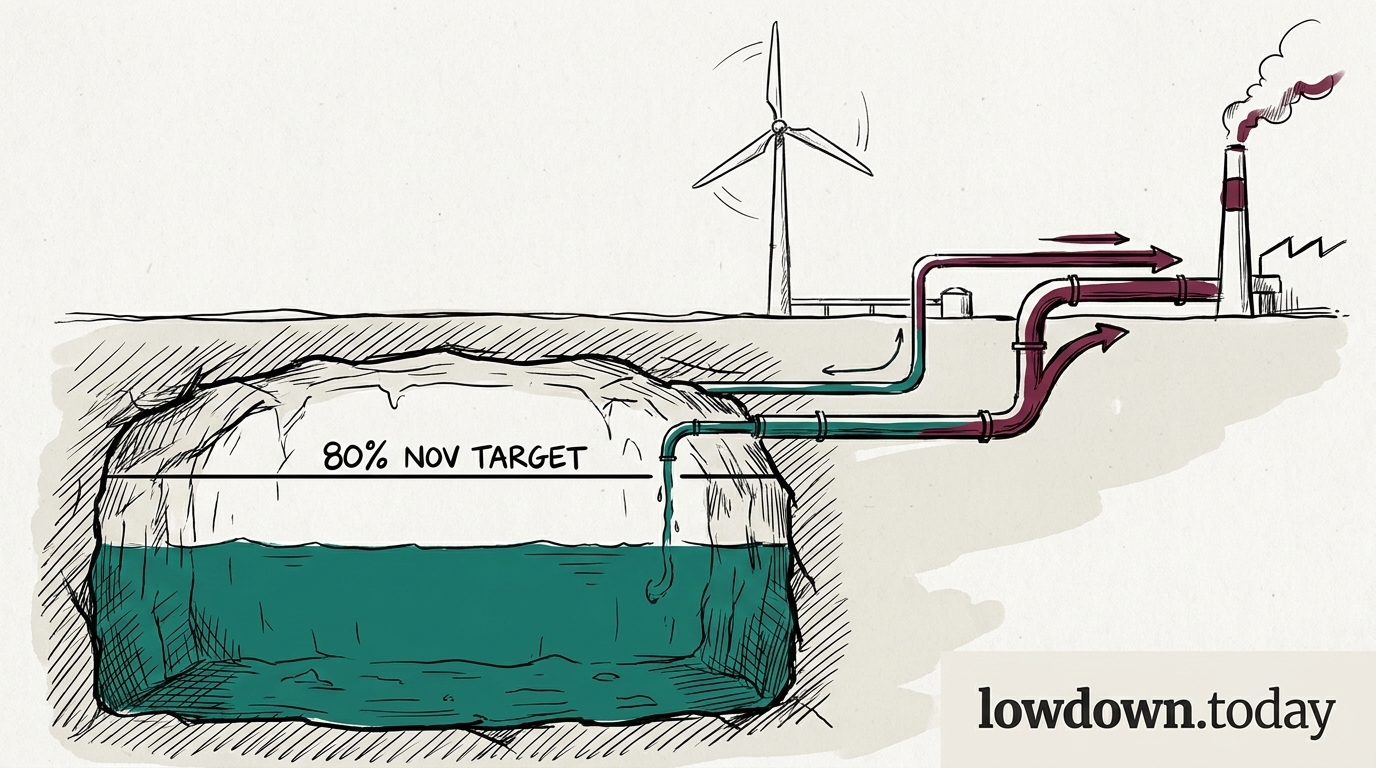
Spain's 9,145 GWh terminal inventory is the largest single stock in the EU LNG network, an option value that can reroute cargoes wherever the winter strip pays best rather than a cavern gas obligation tied to a fixed date. That flexibility matters more as Germany's cavern shortfall pushes more of the winter security question onto import infrastructure.
European Commission
European Commission
Brussels holds the bloc to 90% on a flexible window while Germany, holding roughly a quarter of EU storage capacity, tracks toward missing its own lower 80% figure by 21 points. A national shortfall this size in the anchor market matters more to bloc security than the flexible timetable alone can absorb.
French power exporters and CRE
French day-ahead rose in step with Germany but by less, reopening a EUR 7-17 premium that makes northward export flows commercially attractive again after the EUR 43.09 discount evaporated in days. CRE separately authorised RTE and Enedis to buy flexibility locally, betting the coming winter's binding constraint is grid congestion rather than a shortage of firm capacity.
TTF trading desk
TTF trading desk
A visible national shortfall like Germany's 21-point gap is a directional signal, not noise, for a desk holding the summer-winter spread. TTF's flat EUR 58-60 range through this week's German price swings says the market has not yet chosen to reprice refill risk into the front of the curve.
German cavern and CCGT operators
German caverns kept buying prompt gas at TTF near EUR 58-60 through the inversion; the wind collapse to 2.4 GW then flipped the spark spread to plus EUR 29 and put turbines back in the same queue. Every day turbines win that bid, injection at a third of the 877 GWh/day pace needed falls further behind.
Slovakia
Slovakia
Slovakia says it dropped its hold-out on the 21st sanctions package only after Ursula von der Leyen personally signed written gas-price and supply guarantees. The Council of the European Union's own 17,238-character release on the package names neither Slovakia nor any guarantee, leaving Bratislava's account unconfirmed by the institutional record.



